Imprint app review: I stopped at the paywall and read 184 user reviews
On October 4, 2026 I installed Imprint, typed my way through a long personalisation questionnaire, and reached a screen that wanted a subscription before it would show me a lesson. I did not pay, so I have not taken a lesson, and this review rests on what I saw up to that screen, Imprint's own pages, the store listings, and 184 user reviews.
Imprint is a well-drawn summary app for popular nonfiction. It is worth a month if five illustrated minutes would replace five minutes of scrolling, and you should read the renewal terms before you enter a card. I build Understand, a voice tutor for adults, and I have no connection to Imprint.
The Imprint app in brief
Imprint is made by Polywise, Inc. Its home page says "The world's most important knowledge, visualized." Its sign-up page says "Replace scrolling with Microlearning."
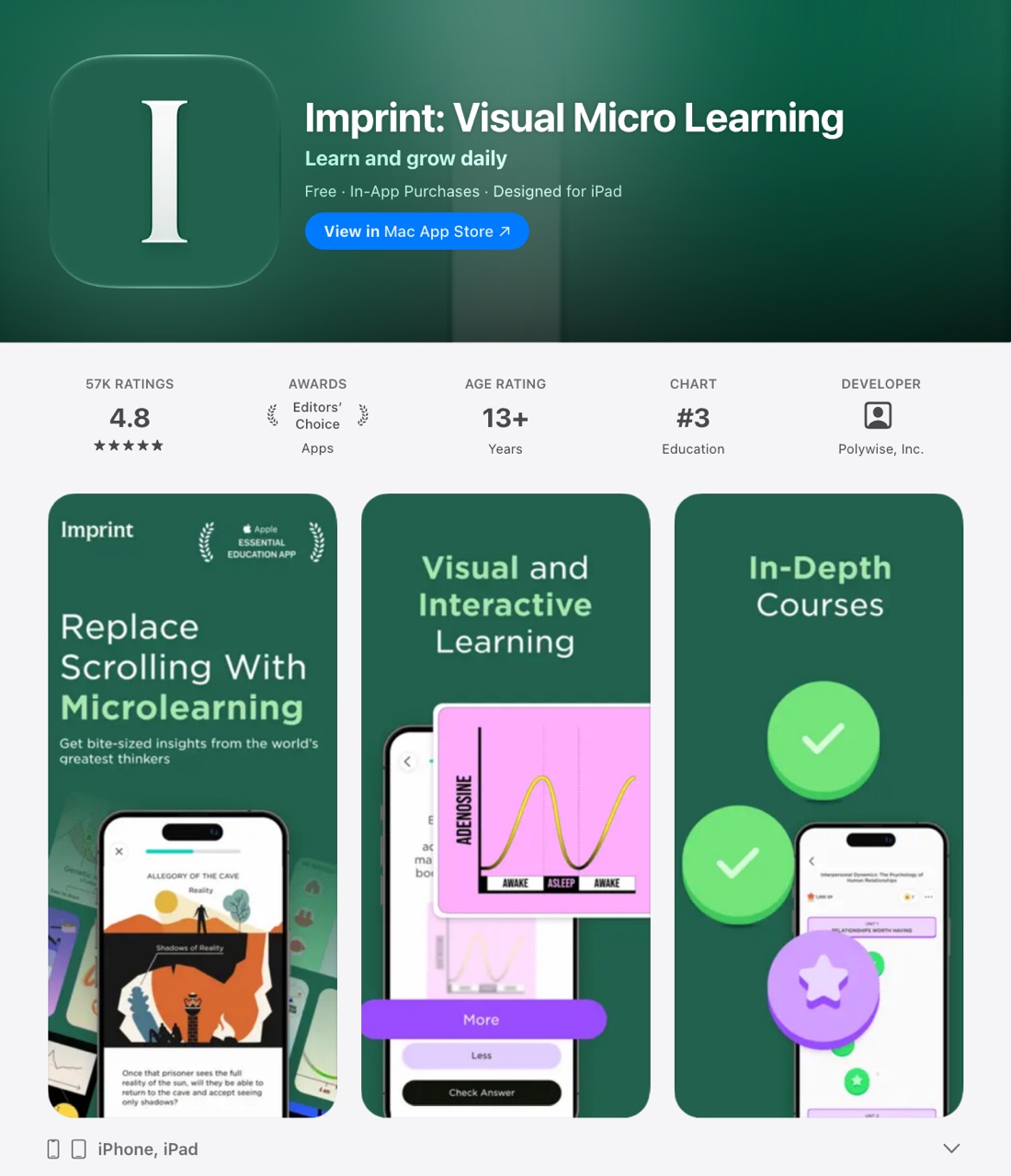
The App Store listing names the contents: courses, "quick reads" such as a guide to gerrymandering, and "visual guides to bestselling books" such as Sapiens and Atomic Habits. The cards in the listing's screenshots pair an illustration with a sentence or two, and one of them asks a question with a "Check Answer" button. The listing promises "challenging daily quizzes" and that you can "complete a chapter in two minutes or less".
Imprint's sitemap lists 166 course pages. Most are the books you would expect: Thinking, Fast and Slow, Deep Work, The 7 Habits of Highly Effective People. A few are not, and I would open "The Physics of Falling Cats" first.
The page for Thinking, Fast and Slow says the course "takes about 3-4 hours total, broken into bite-sized 5-10 minute lessons". The same page's description for search engines says "1.1 hours of interactive visual lessons". Either way it is shorter than the book.
The App Store shows 4.8 from 57,000 ratings, an Editors' Choice badge, and third place in the Education chart on the day I looked. Google Play shows 4.5 from 13,200 reviews and more than a million downloads.
The questionnaire and the paywall
The app presented itself to me as self-development in small visual lessons, pitched against doomscrolling, and not tied to books alone. Then it asked questions, a great many, and I had to type a lot of the answers. The stated purpose was personalisation. I did not count the screens, so I give no number for the app.
Imprint's website has its own version, which one of its landing pages calls a "2-minute quiz", and that one I could count. In a clean browser it asked eight questions: what I want to focus on, my age, my gender, whether its guide should sound "Deep" or "Warm", up to five topics, a goal within the topic, a daily target of 2, 5 or 10 minutes, and the time of day. Then it asked for an email address, and I stopped.
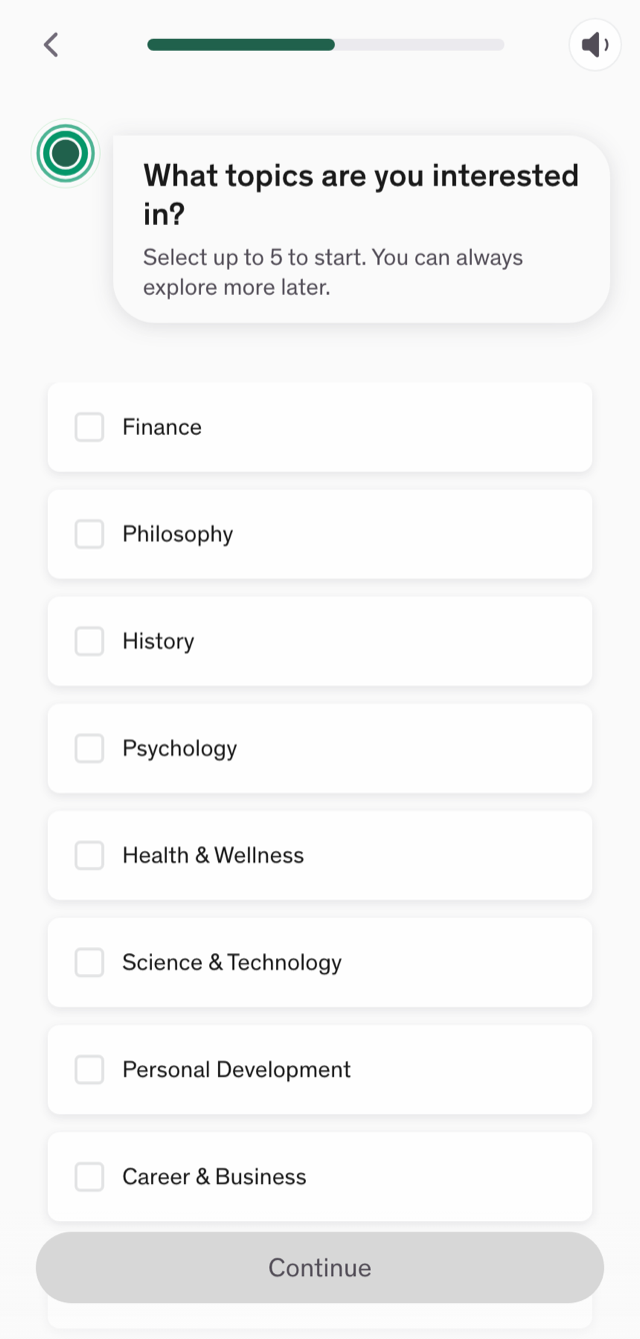
In the app, the questions ended at a paywall. It offered me no free trial. The cheapest price I saw was $12.90, and the screen carried a money-back guarantee. I closed it.
Of the 160 App Store and Google Play reviews I read, 57 say that nothing in the app can be used without subscribing or entering a card. An App Store reviewer with the handle jdbdkfndbsktttggg titled a review on September 24, 2026 "Not free. Don't find out until 5 minutes in" and wrote the body in four words: "Just say your prices." A Google Play review from August mentions a "daily free read". I did not see one.
Imprint app cost
Imprint has no pricing page: imprintapp.com/pricing returns a 404. These are the prices I could see on October 4, 2026.
- The app's paywall, shown to me: no trial, cheapest price $12.90, money-back guarantee.
- Imprint's public discount page: $7.20 for the first month, $12.90 for the first three months, $30 for the first twelve months, each marked 70% off struck-through prices of $23.99, $42.99 and $99.99.
- The App Store's list of in-app purchases: a monthly subscription at $15.99, yearly subscriptions at $74.99 and $99.99, and an "Imprint premium" item at $29.99.
- Reviews from July to October 2026: most often $74.99 for a year after a seven-day trial that needs a card. Single reviewers report $15.99 a month after a two-day trial, $0.99 for a first month, $4.99 for a first month, and a "$2/month" promotion.
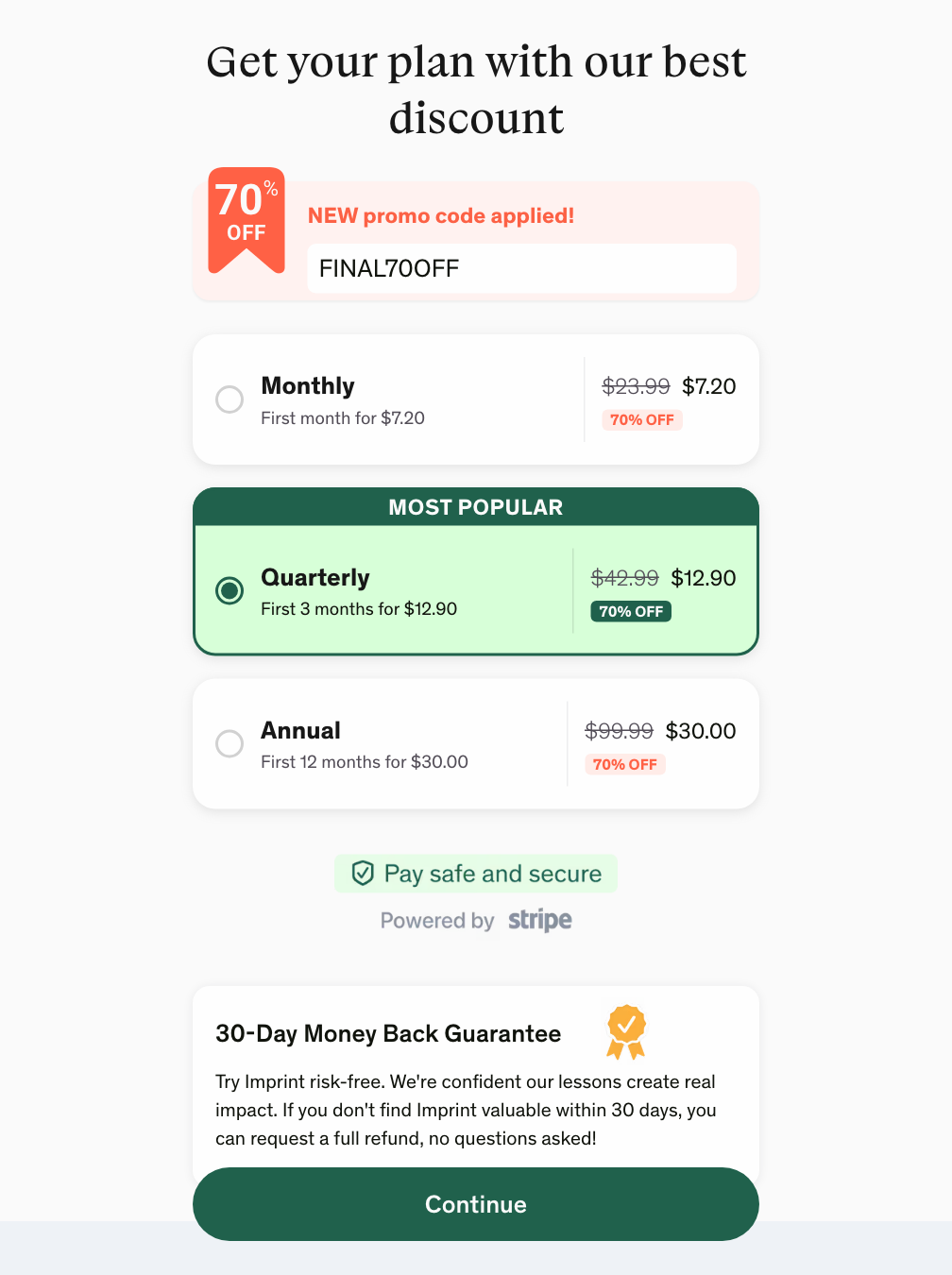
My $12.90 matches the discount page's price for the first three months, so check which period your price covers. The offer differs by person, and the price that matters is the one the plan renews at.
The refund terms disagree with each other. The discount page promises a "30-Day Money Back Guarantee": "you can request a full refund, no questions asked!" The course pages say "we offer a full money-back guarantee." Imprint's terms of service, live on the same day, say in capitals: "YOUR PURCHASE IS FINAL AND YOU WILL NOT BE ABLE TO CANCEL THE PURCHASE AND/OR RECEIVE A REFUND OF YOUR SUBSCRIPTION FEE." The terms add that a subscription bought through Apple or Google falls under that store's payment terms. I found no page saying whether the 30-day guarantee covers a store purchase. If you rely on the guarantee, screenshot it when you pay.
Cancelling is documented. Imprint's FAQ says a website subscription is cancelled under "Manage" after logging in at imprintapp.com, and an App Store or Google Play subscription is cancelled in that store. Deleting your account does not cancel the subscription.
184 user reviews, counted
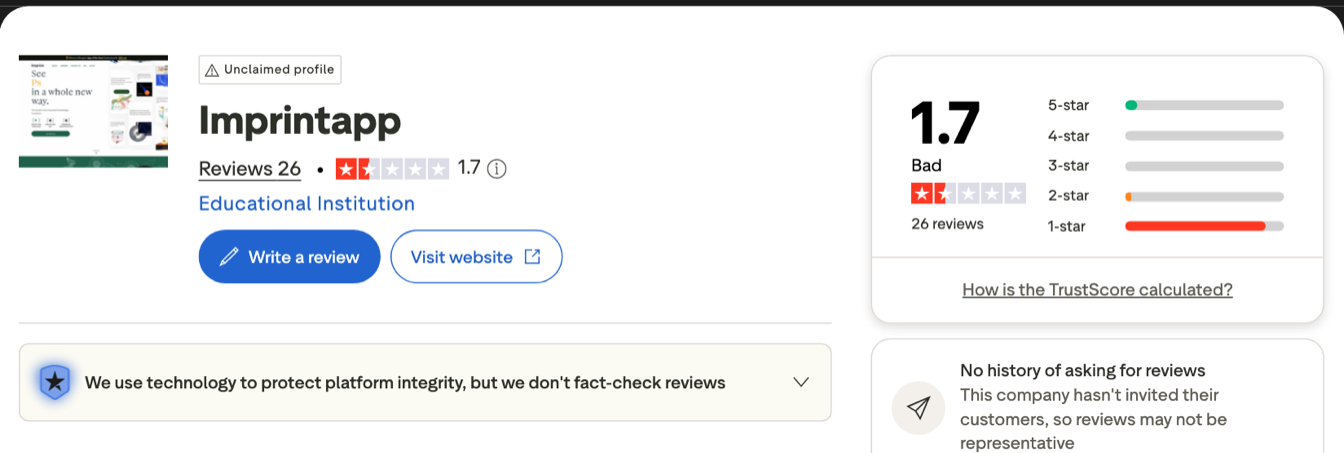
I read the 100 most recent US App Store reviews (August 29 to October 2, 2026), the 60 newest Google Play reviews (August 16 to October 2, 2026), and every review on Imprint's Trustpilot page (November 2024 to September 2026). Trustpilot lists 26. Two of them are complaints about a credit card company that is also called Imprint, and they count toward the app's score of 1.7 anyway. That leaves 24. Reddit's threads sat behind a login wall and I read none.
People who write a review are angrier or happier than people who tap a star. The App Store average is 4.8, and the 100 written reviews I read average 2.8: 44 one-star, 37 five-star, 19 in between. The 60 on Google Play split 31 one-star to 17 five-star. On Trustpilot, 21 of the 24 are one-star.
The largest group is the 57 who met the paywall and left. The second is about charges. Thirty of the 184 describe a charge they did not expect: 17 on Trustpilot, 10 on the App Store, 3 on Google Play. The amount is most often $74.99 for a year. Thirteen of the 30 say they had cancelled before the charge. Six say the money came back, four from Imprint and two from Apple or Google. DonDTX wrote on the App Store on August 29, 2026 that after an unexpected $74.99 charge the money was back "the next day".
I found no reply from Imprint under any review. The Trustpilot profile is marked "Unclaimed", and none of the 60 Google Play reviews has a developer response. Apple's public feed does not carry developer responses, so I cannot say for the App Store. Two Trustpilot reviewers say Imprint's support told them by email that it is a small team. The About page lists ten people.
The claim that Imprint charges on day six of a seven-day trial comes from a Trustpilot review of December 2025, which says so in capitals. Another from June 2025 gives dates: a trial due to end on June 12 and a charge on June 9. An App Store reviewer on September 23, 2026 says the charge came "a day early". The App Store listing's own terms explain one day of that: auto-renewal must be turned off "at least 24-hours before the end of the current subscription period", and the account "will be charged for renewal within 24 hours prior to the end". On Apple, a seven-day trial has to be cancelled by day six. That accounts for a day. It does not account for three days, or for the thirteen who say they had already cancelled.
Ten reviewers, seven of them on Google Play, say an advertisement promised a subject the app did not have: anatomy for some, art history for others. Imprint's sitemap does list landing pages headed "Replace scrolling with Anatomy" and "Replace scrolling with Art". Among the 166 course pages, none has anatomy in its title, and the two with "art" are The Art of War and The Art of Letting Go. One of the ten says support replied that there is a single art course, on Apple devices only. The sitemap may not be the whole catalogue.
Eight reviewers call the content basic. Estobang on the App Store, August 30, 2026: "Should be called Imprint for beginners." A two-star Google Play review from August 17 goes at the pictures: "the visuals are nice but rarely convey additional info." It adds: "At least 1 course had recall exercises but most don't".
The happy reviewers are specific too. Fifty-four of the 160 store reviews are five-star, and nine of the App Store's 37 say Imprint replaced social media for them. Storyoft, September 3, 2026: "Haven't touched social media since download." The Real E. Lev, September 25: "Have already found new books to read because of this app".
Pictures, short lessons and recall
I found no study of Imprint's lessons, and the Imprint pages I read cite none.
Pictures can help. Russell Carney and Joel Levin reviewed the research in 2002 and concluded that "carefully constructed text illustrations generally enhance learners' performance". The condition is in the first two words. Shannon Harp and Richard Mayer ran four experiments in 1998 in which students read science passages with or without interesting but irrelevant additions. The students who got the additions recalled fewer main ideas and solved fewer transfer problems. I read only the abstracts of both papers.
So the question for Imprint is which kind of picture a card carries. The adenosine curve in its App Store screenshot is the first kind: the rise and fall across waking and sleep is the idea. A five-star App Store reviewer, mc0527, describes the other kind: the diagrams are helpful "except when they are simply an illustration of the sentence on the page."
A quiz after a lesson is the right instinct. In Roediger and Karpicke's experiment, students who tried to recall a passage remembered 56% of it a week later, against 42% for students who reread it; the numbers are in my post on audiobook alternatives. Reviewers disagree on how many Imprint lessons have a quiz, and the one quiz card in the store screenshots offers two answers, "More" and "Less". Picking one of two is easier than recalling.
A clear summary also produces a feeling. Rozenblit and Keil asked people to rate how well they understood a zipper, then to explain it, then to rate themselves again, and the rating fell from 3.89 to 3.10 out of 7. The details are in my post on audiobooks and reading. An hour of well-drawn cards on Kahneman will leave you feeling that you know Kahneman. Explain one of his biases to a friend the next week, with the app closed, and you will find out.
A summary keeps a book's conclusions and drops the argument, as I wrote in learning apps for adults. For deciding whether a book deserves ten hours, that is the right tool.
Imprint and Brilliant
Brilliant is the other well-known app that teaches with pictures.
| Imprint | Brilliant | Understand | |
|---|---|---|---|
| Subjects | Psychology, philosophy, finance, history, book summaries | Math, coding, data, some science | Whatever you ask about |
| A lesson | Illustrated cards you read, sometimes a quiz | A puzzle you solve before the explanation | A voice conversation, with a board |
| Before paying | A questionnaire, then a paywall | Two lessons a day, free | Free for now |
| Price | $7.20 to $23.99 a month on the discount page; $15.99 on the App Store | $30 or $60 a month shown to me | Free for now |
| Refunds | A 30-day guarantee on the sales pages; "final" in the terms | Nonrefundable, per its help page | Nothing to refund |
Brilliant makes you commit to an answer and then explains. Imprint explains with a picture and then, sometimes, asks. The research in my Brilliant review favours trying first for conceptual understanding.
They rarely compete. Nobody opens Brilliant for the gist of Sapiens, and Imprint has no tangent line to drag.
My view of the Imprint app
From what I saw and read, Imprint is a handsome deck of illustrated cards for book summaries and short courses. It suits someone who wants to trade a few minutes of scrolling a day for something better, and nine reviewers say it did that for them.
It does not suit someone who wants to try before paying, or who wants a technical subject. Its sign-up says of its guide, "you can ask me anything", and I could not test that; the one reviewer who mentions the "Ask AI" button, 8nanomus on September 24, 2026, got an error each time. The lessons were written in advance, and most of what I get curious about on a given day is on nobody's list of 166 courses.
If you subscribe, write the renewal date and price in your calendar that day, cancel through the channel you bought on, and do it more than 24 hours before the trial ends.
Understand, and its limits
Understand is a voice chat with an AI tutor that you can interrupt. It answers directly on any subject, and after an idea that is new to you it asks one question that takes the idea to answer. It draws on a board while it talks, reads a text aloud word for word and stops when you ask something, and talks through the links and PDFs you bookmarked. It keeps a record of the ideas you have shown you understand, which you can read and correct.
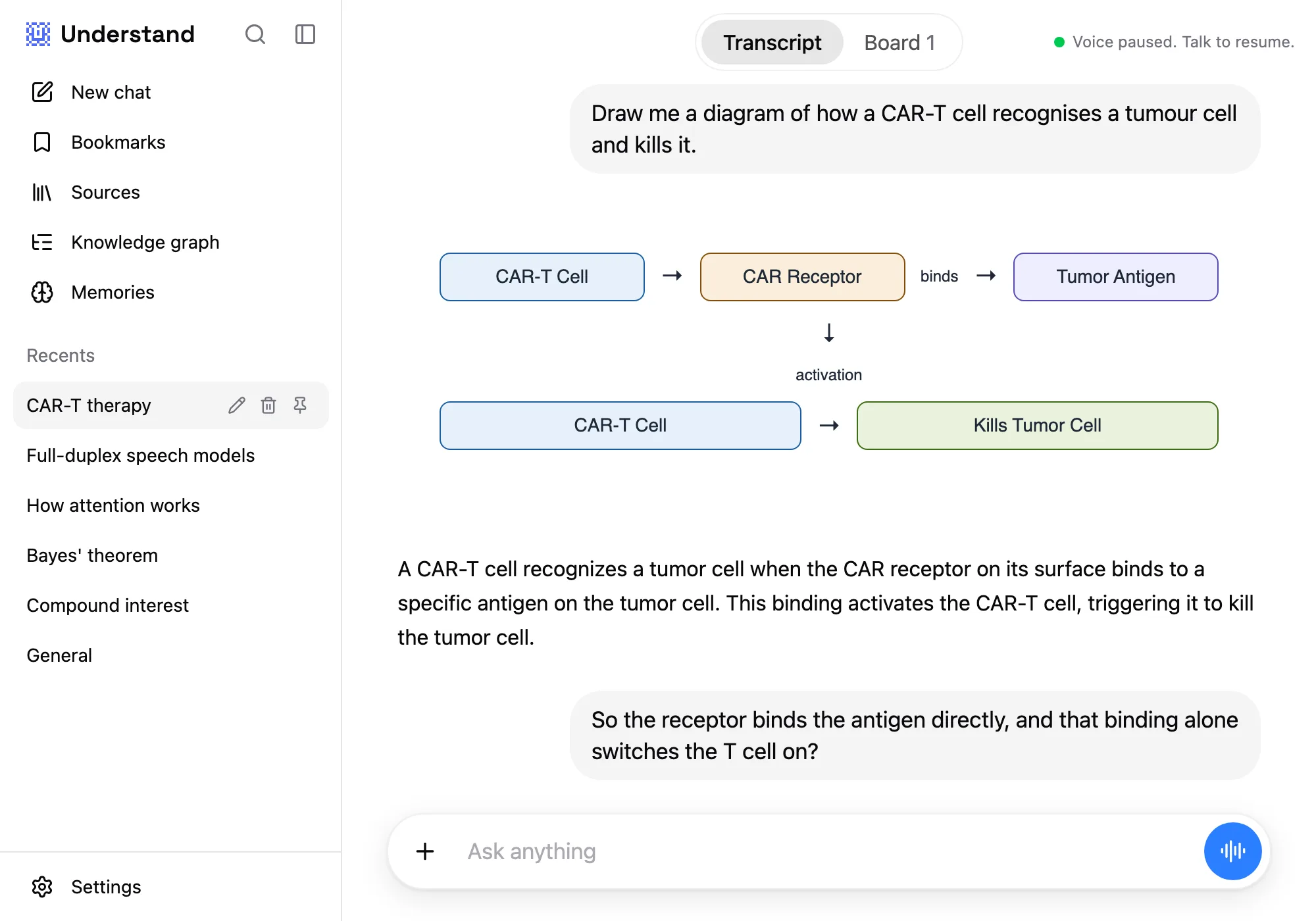
It has no courses, no problem sets and no spaced repetition. Its board draws boxes and arrows, and Imprint employs a director of animation. There is no Android app, and no trial has evaluated it. It is for adults and it is free for now.
Questions people ask
Is the Imprint app worth it?
For five minutes a day of illustrated summaries, at a first-month price near $7, it is a cheap experiment. At $74.99 a year, decide after the month.
Is the Imprint app free?
The download is free. I could open no lesson without subscribing, and 57 of 160 store reviewers say the same.
How do I cancel the Imprint app?
In the store you bought it from, or under "Manage" at imprintapp.com. Deleting the account does not cancel.
Are there apps like Imprint?
Deepstash and Headway sell short summaries too, and my comparison of Blinkist, Headway and Shortform covers the rest.