The best learning apps for adults, sorted by what you want to be able to do
Most lists of learning apps for adults rank Duolingo, Coursera and a brain-training game against each other, as if a person choosing between Spanish and linear algebra were choosing between apps. I sorted these by what you want to be able to do when you are finished.
I build Understand, a voice tutor for adults, and it is one of the picks below. For most of the goals on this page it is the wrong pick, and I say which app is the right one.
I have not used most of these apps for long enough to review them. The verdicts rest on what each vendor publishes, on store ratings, and on the research about learning. Prices are for the US, read on October 4, 2026, from the vendor's own page unless I name the App Store.
The short version
| You want to | Pick | Price | The catch |
|---|---|---|---|
| Do math | Math Academy | $49 a month | No free trial, and the path is not yours to change |
| Do math, more gently | Brilliant | $30 a month, or $20 billed yearly | Fewer graded repetitions |
| Relearn school math for nothing | Khan Academy | Free | Built for school and early college |
| Speak a language | Pimsleur or Speak | About $18 to $21 a month on the App Store | Speak teaches six languages |
| Learn to code | freeCodeCamp, then Exercism | Free | No one sets your schedule |
| Take a university course | MIT OpenCourseWare or Coursera | Free, or $59 a month | About 3% of people in MIT's and Harvard's online courses finished one |
| Remember what you learn | Anki | Free, $24.99 once on iPhone | You write the cards and face the reviews |
| Get through books | Libby | Free with a library card | Holds queues |
| Study your own documents | Gemini Notebook | Free | It keeps no record of you |
| Ask about anything | ChatGPT Study Mode | Free; Plus $20 a month | It knows little about last week |
| Explain an idea in your own words | Understand | Free for now | No courses, no problem sets, no Android app |
| Learn a little every day | Kinnu or Wikipedia | Free | Closer to reading than to study |
Be able to do math or quantitative work
Math Academy is the pick. It gives you a diagnostic, a short worked example and graded problems, and it schedules reviews for you. It costs $49 a month with no free trial and a full refund in the first 30 days. Adults who stuck with it report real gains, and several of them also report understanding less than they could compute. I went through their accounts in my Math Academy review for adults.
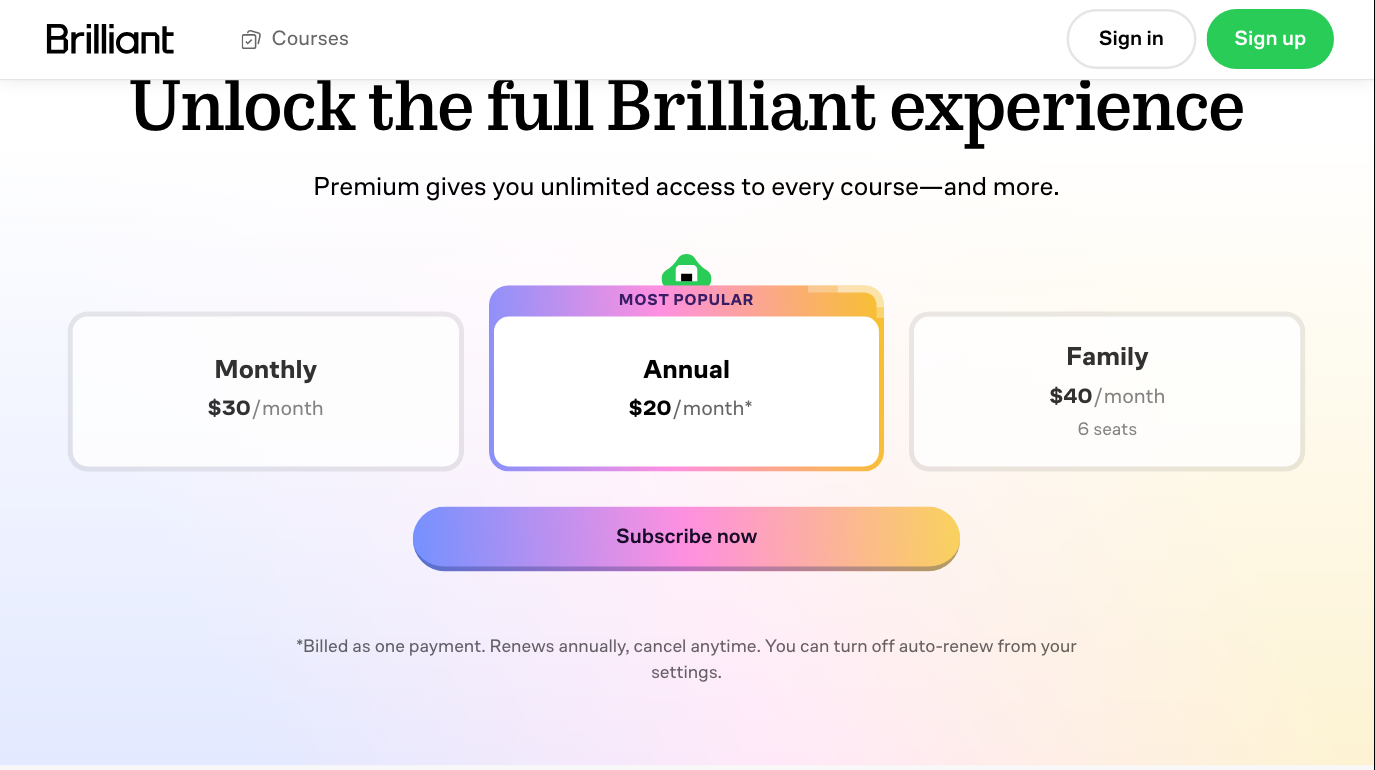
Brilliant is the runner-up. Its Premium page lists more than 40 interactive courses across math, computer science, science and data. Premium is $30 a month, or $20 a month billed as one yearly payment, and a family plan with six seats is $40 a month. Premium includes Koji, a tutor that sees the problem you are on and draws on it. The App Store shows 4.7 from 33,000 ratings and Google Play 4.5 from 114,000 reviews. Brilliant teaches through interactive puzzles, and its lessons are shorter than Math Academy's. My guess is that a course of puzzles gives you fewer checked repetitions than a year of Math Academy's problems, and fluent calculation comes from the repetitions.
Khan Academy is free and has more than 840 courses covering school and early college. For an adult relearning algebra or statistics it is the place to start before paying anyone. Its tutor, Khanmigo, costs $4 a month and is sold only in the United States, as I describe in the Khanmigo review.
Speak a language
A language is mostly a problem of practice with your mouth, so I keep this short.
Duolingo is free with ads, teaches more than 40 languages, and has a 4.7 rating from 5.5 million people on the App Store. Its store listing promises quick, bite-sized lessons, and the streak is good at getting you to open it every day. Whether a streak turns into a conversation depends on how much of that time you spend speaking out loud.
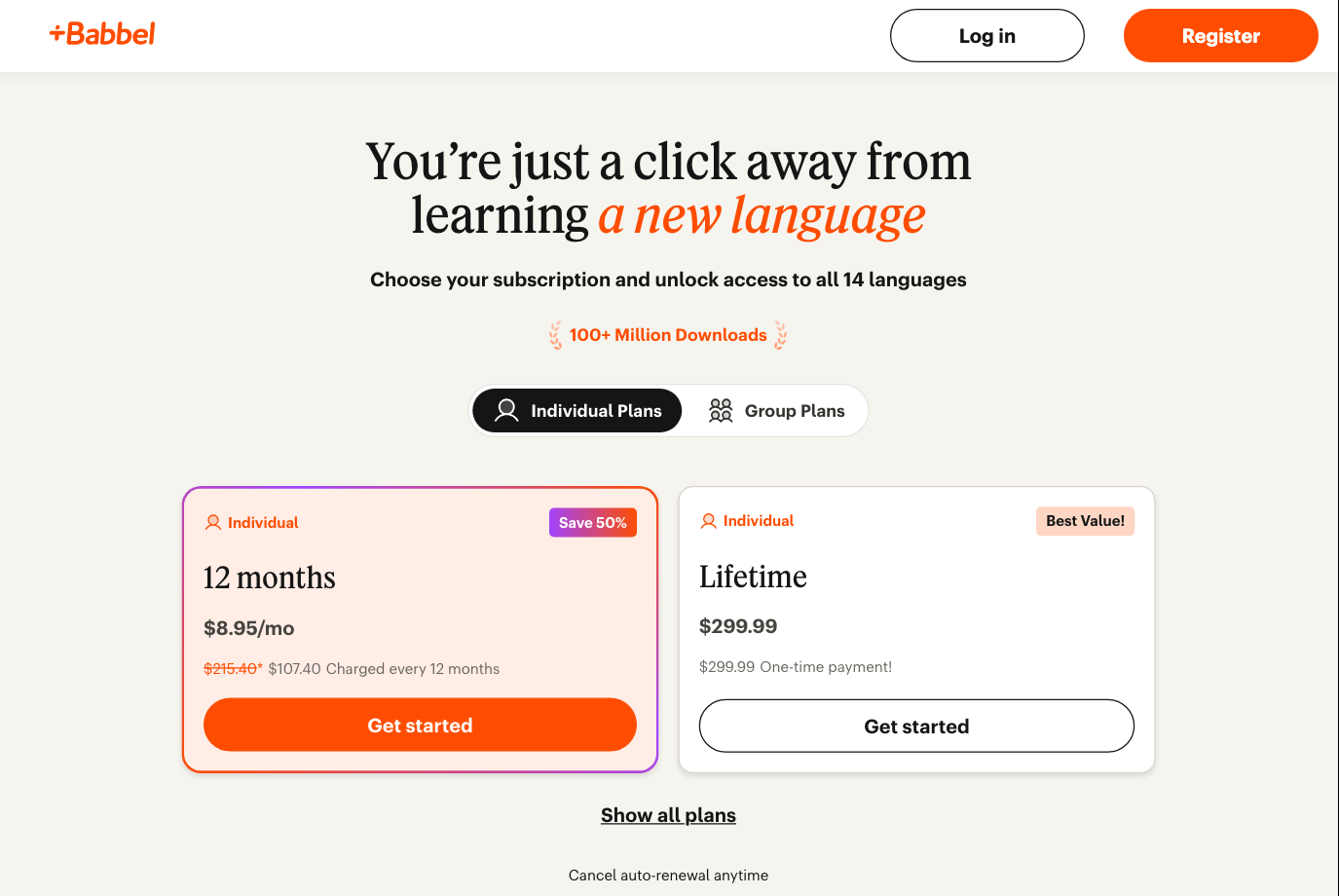
Babbel is the structured course: 14 languages, grammar explained, $107.40 for twelve months or $299.99 once for life.
If the goal is to speak, pick an app built around speaking. Pimsleur is audio lessons in which you answer out loud, in more than 50 languages; the App Store lists All Access at $20.99 a month. Speak is conversation practice with an AI that corrects your pronunciation, in Spanish, French, Korean, Japanese, Italian and Simplified Chinese. Speak's site says its prices are shown in the app. The App Store lists Premium at $17.99 a month or $83.99 a year.
Learn to code
freeCodeCamp is a charity, and its site says "every aspect of freeCodeCamp is 100% free", certifications included. It also says something the paid schools avoid: "it may take several years of practicing coding to learn these skills well enough to get a job as a software engineer."
Exercism is also free. It has exercises in 83 programming languages and volunteer mentors who read your solution and comment on it. I would start with freeCodeCamp for a first language and move to Exercism for practice and feedback.
Boot.dev is the paid runner-up, at $399 a year. It teaches back-end development in Python and Go, and estimates about 12 months part-time for a full path. Codecademy has a free Basic tier, with Plus at $29.99 a month or $14.99 billed yearly.
Pay for a coding course when you need a path and a deadline. The material itself is free.
Take a university course
MIT OpenCourseWare publishes materials from more than 2,500 MIT courses. It is free, it asks for no account, and it gives no credit or certificate. Its slogan is "Knowledge is your reward."
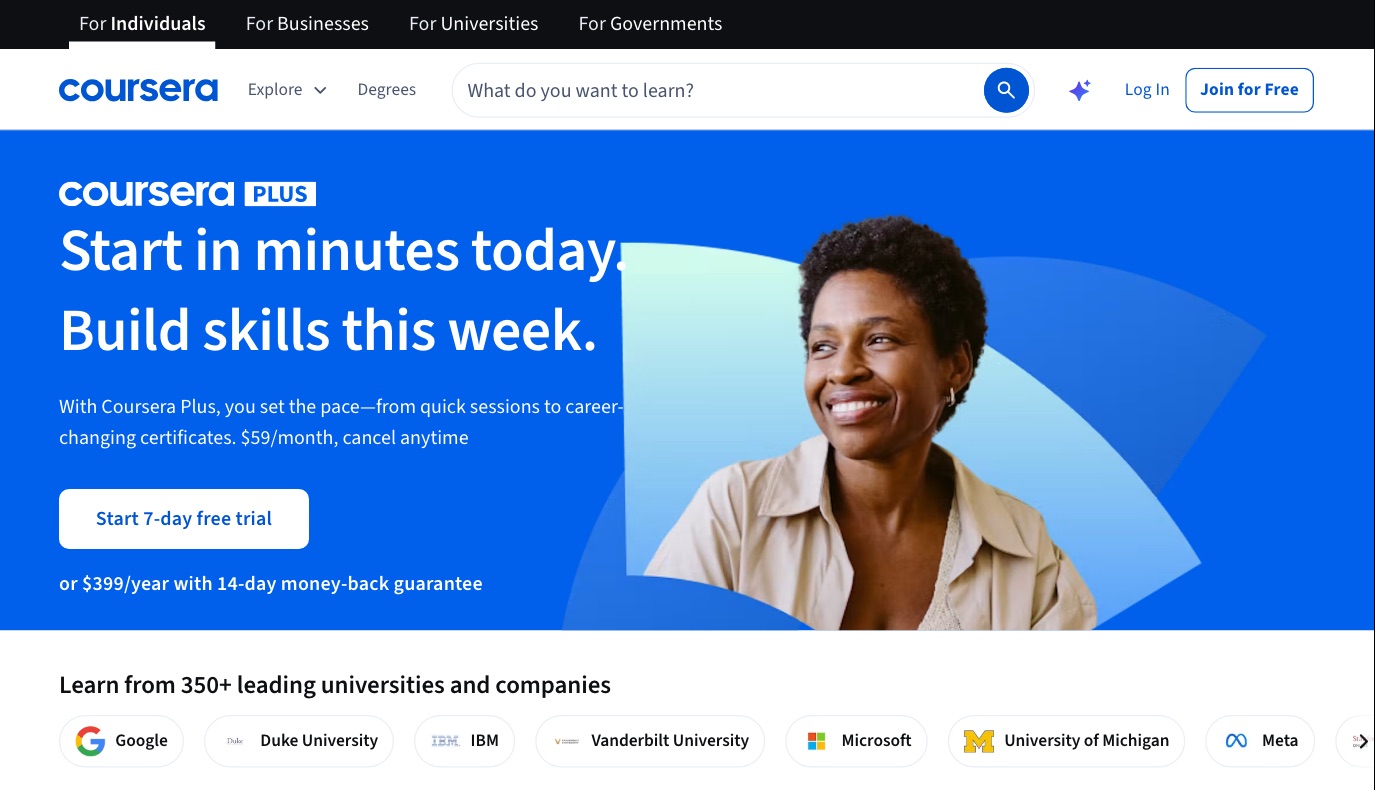
Coursera Plus is $59 a month or $399 a year for more than 10,000 courses, with certificates. On edX most open courses can be audited free, without certificates or graded assignments, and the verified track usually costs $50 to $300 a course.
Few people finish. Justin Reich and José Ruipérez-Valiente studied every MOOC that MIT and Harvard ran on edX from 2012 to 2018, which came to 5.63 million learners. In 2017-18, 3.13% of participants completed their course. Among those who had paid for the verified track, 46% did. I take the figures from Inside Higher Ed's report on the paper.
If you want lectures for pleasure, The Great Courses Plus has hundreds of college-level courses on video. It was called Wondrium for a while, and wondrium.com now shows the old name. The App Store lists it at $19.99 a month or $149.99 a year.
Remember what you learn
Spacing reviews over time beats cramming them together. Cepeda and colleagues (2006) pooled 839 assessments from 317 experiments and found that the best gap between reviews grows with how long you want to remember.
Anki is the flashcard program that schedules cards this way. It is free on computers and on Android, where AnkiDroid has a 4.8 rating from 165,000 reviews, and the iPhone app is $24.99 once. The catch is the work. You write the cards, and the reviews arrive every day whether you want them or not. Frank Hecker, one of the adults in my Math Academy review, gave up on Anki because the reviews overwhelmed him. A card also holds a fact or a definition, and I have not seen one hold an argument.
RemNote puts the flashcards inside your notes. Its free plan has unlimited notes and cards, and Pro is $8 a month billed yearly. Readwise does the same job for readers: it collects your highlights from Kindle and other apps and sends some of them back to you each day, for $12.99 a month or $9.99 billed yearly.
Get through books and articles
Libby lends ebooks and audiobooks free with a library card, and popular titles have a queue. Audible is $14.95 a month for a book you keep, or $8.99 for one you can hear while you subscribe. The cheaper services are in my post on alternatives to Audible.
For articles and PDFs, Readwise Reader is a read-later app that also reads aloud, included in the Readwise subscription.
Blinkist ($15.99 a month on the App Store) and Shortform ($24 a month) sell summaries. A summary keeps a book's conclusions and drops the argument that led to them, along with the objections the author answered. I use summaries to decide whether a book deserves ten hours.
The reading time calculator tells you how long a book will take, and the audiobook speed calculator shows what 1.5x saves.
Study your own documents
Gemini Notebook, which was NotebookLM until July 2026, answers only from the sources you give it and cites the passage. It is free with a Google account for up to 100 notebooks of 50 sources each. For a folder of PDFs it is the best tool here; details are in my post on NotebookLM alternatives.
YouLearn turns a lecture video or a PDF into a chat, a quiz and flashcards. Its free plan stops at three uploads and five chat messages a day, and Pro is $20 a month or $12 billed yearly.
Ask questions about anything
ChatGPT has a Study Mode on every plan, the free one included. You turn it on by typing @study in the message box, and it asks you questions before it explains. Gemini has Guided Learning, also free, which answers with diagrams and videos. Neither documents a record of what you have mastered. I compare them with the other AI tutors in the best AI tutors in 2026.
Understand an idea well enough to explain it
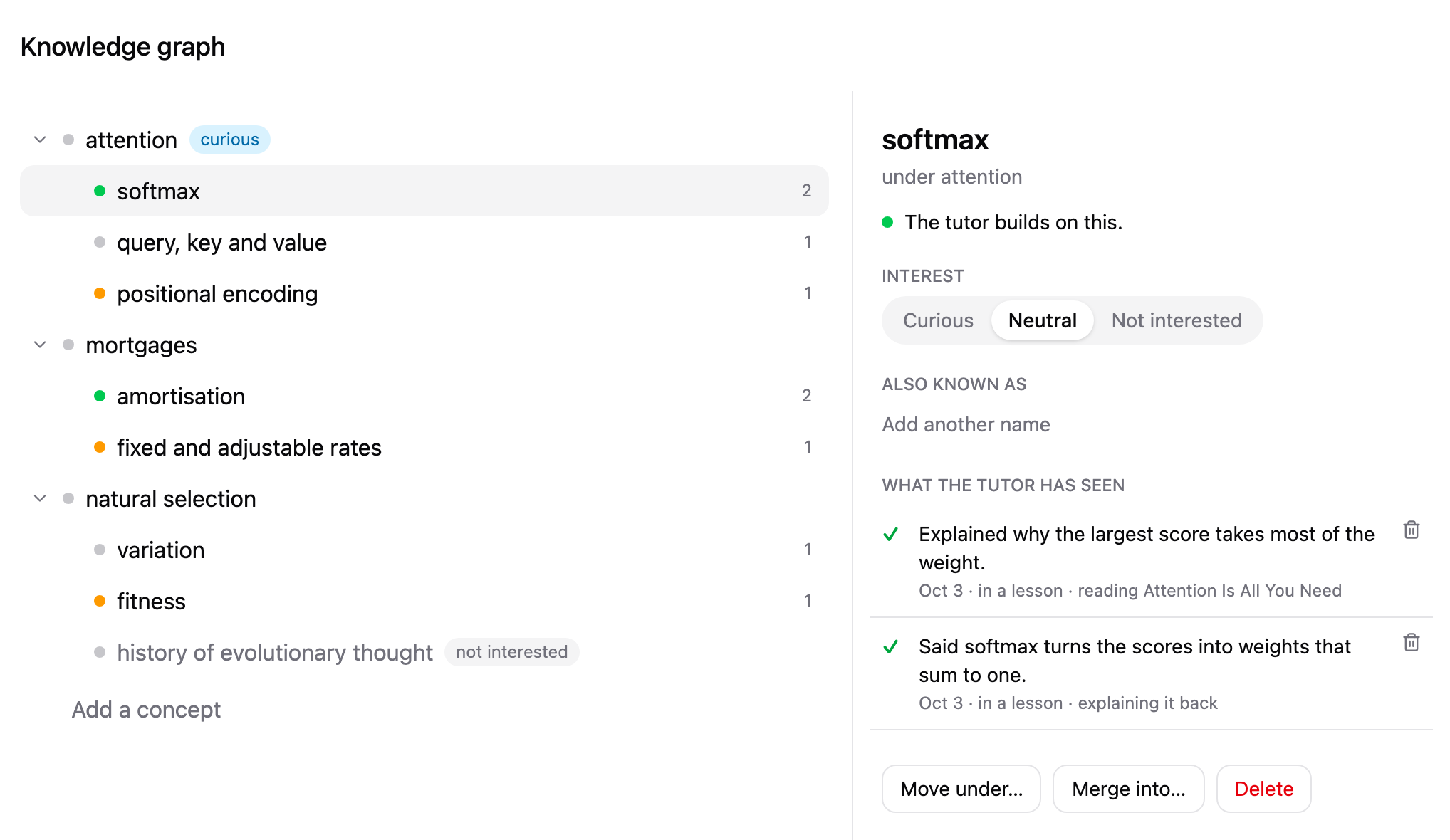
This is the goal I build Understand for. It is a voice call with a tutor on any subject. It reads an article or a text PDF aloud word for word, and it stops when you speak. The tutor asks you to put an idea in your own words. What you say is recorded under that concept in an outline you can read and correct, and the tutor builds on an idea only after you have succeeded with it twice in different contexts.
It has no courses, no problem sets and no spaced repetition, so it will not make you fluent at calculation or at Spanish. There is no Android app; it runs on the web and on iOS through TestFlight. Nobody has run a trial of it. It is free for now.
Short daily lessons for curiosity
Searches for apps that make you smarter, or for apps to learn something new every day, lead here. This is the category where the marketing runs furthest ahead of the evidence.
Kinnu teaches general knowledge in short lessons, and its listing promises you will "never forget what you've learned with our Memory Shield technology". It is free to use; the App Store lists a $1.99 monthly purchase and paid certificates. It has 4.8 from 506 ratings there and 4.4 from 7,160 reviews on Google Play.
Imprint turns books and courses into illustrated lessons. The App Store lists it at $15.99 a month or $99.99 a year, with 4.8 from 57,000 ratings. It is a summary app with better pictures, and the limits of summaries apply.
Nibble offers 10-minute lessons across 30 topics. Its App Store rating is 4.3 from 47,000, and the listing shows a monthly subscription at $19.99. A review displayed on that listing describes a long sign-up quiz followed by a subscription screen with no way past it.
Elevate is brain training: more than 40 games for reading, writing, memory and math, at $9.99 a month or $39.99 a year on the App Store, with 4.8 from 544,000 ratings. Simons and colleagues (2016) reviewed the studies that brain-training companies cite. They found that people improve on the games they practice, and "little evidence that training enhances performance on distantly related tasks or that training improves everyday cognitive performance". I would count Elevate as a game.
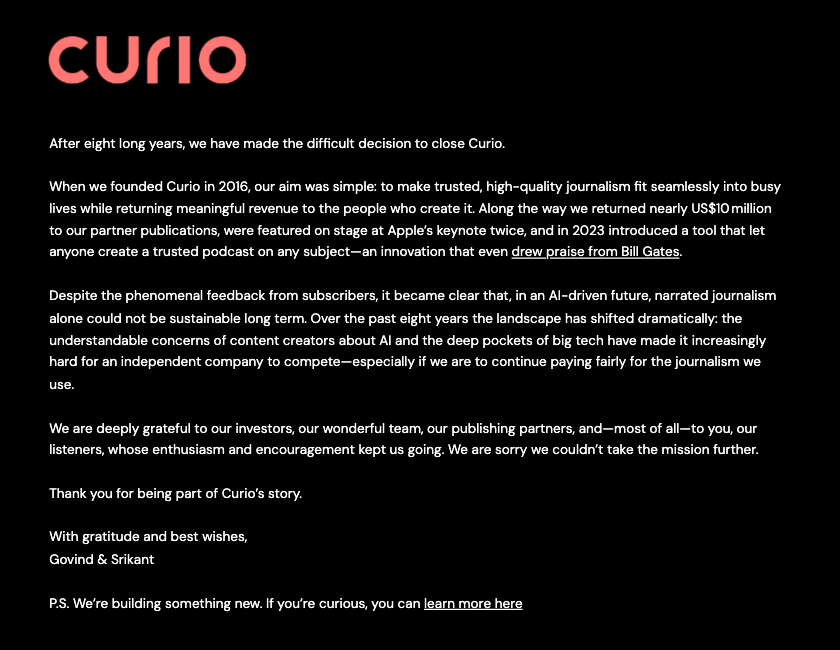
Curio, an app that narrated journalism, has closed, and its site now carries only a notice from the founders.
The Wikipedia app is free, has no ads, and holds more than 60 million articles in nearly 300 languages. For daily curiosity I would take it over anything with a subscription.
These apps are pleasant, and reading them beats most other things on a phone. A lifelong learner who wants a skill from them will be disappointed.
The evidence on adult self-study
Recalling beats rereading. In Roediger and Karpicke's experiment, students who tried to recall a passage remembered 56% of it a week later, against 42% for students who reread it. Dunlosky and colleagues (2013) reviewed ten study techniques and rated practice testing and distributed practice the most useful. Rereading and highlighting were rated low.
A concrete goal matters too. I read the completion gap in the MOOC data, 46% against 3%, as the difference between people who had committed to something and people who were browsing. An adult who quit Math Academy wrote that "it's better to have strong motivation in the form of a concrete goal you are working towards."
So look at what an app makes you produce. Math Academy makes you solve problems and Pimsleur makes you speak. A summary app or a lecture asks you to receive, and the feeling of having learned arrives before the learning does. The studies behind that claim are in do audiobooks count as reading.
Picking one
If you need math for a degree or a move into data work, pay for Math Academy and expect a year. If you are going abroad in six months, use Pimsleur or Speak daily and treat Duolingo as a supplement.
A career changer should start with freeCodeCamp today and pay for Boot.dev only if the free course has stalled. For a pile of documents and a deadline, open Gemini Notebook.
If you read a lot and keep little, add Anki or Readwise to what you already read before you subscribe to a summary app.
If there is one idea you want to be able to explain to someone else, ask ChatGPT in Study Mode tonight, or talk it through with Understand.