How to remember what you read: what the studies support, and what I aim for instead
Close the book and say or write what it said, then do the same thing a few days later and again a few weeks after that. Testing yourself and spacing the tests out have the most evidence behind them. Highlighting and rereading, which most readers do instead, were rated low by the review that compared ten such techniques.
I build Understand, a voice tutor for adults that has no flashcards and no spaced repetition. I also built RemNote, one of the two flashcard apps named below, and I have no connection to Anki or to the researchers. Weigh the later sections, where I argue that remembering is usually the wrong target, with that in mind.
Forgetting most of a book is the ordinary result
Readers who ask why they can't remember what they read, or how to retain more of it, are describing what the experiments find. In the first study below, students read a passage about the sun or about sea otters twice, for seven minutes each time. A week later they could write down 42% of its ideas. The passage was shorter than this section.
The forgetting curve is Hermann Ebbinghaus's. In 1879 and 1880 he memorised lists of nonsense syllables, usually eight series of 13 at a sitting, until he could recite each twice without an error. He relearned them after intervals from 20 minutes to 31 days and measured how much time the earlier learning saved him. Across 163 such double sessions, his table gives a saving of 58.2% after 20 minutes, 33.7% after a day and 21.1% after a month.
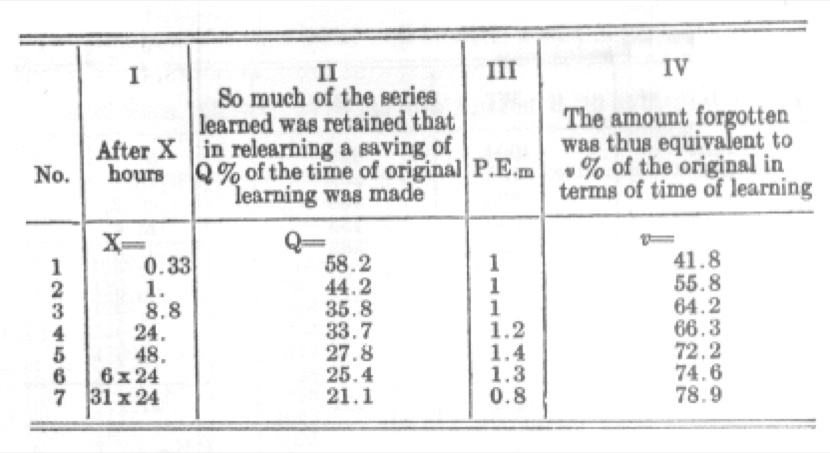
The only subject was Ebbinghaus, who was 29. He wrote that the results "have been found but once", and that he could not say whether they would hold "under other circumstances or with other individuals".
In 2015 Jaap Murre and Joeri Dros published a replication in PLOS One. Dros, then 22, spent 70 hours on lists of the same kind, and his curve resembles the original. The paper also reports a German replication from 1991 with two subjects. Across 135 years, the curve in the figure below rests on four people memorising nonsense.
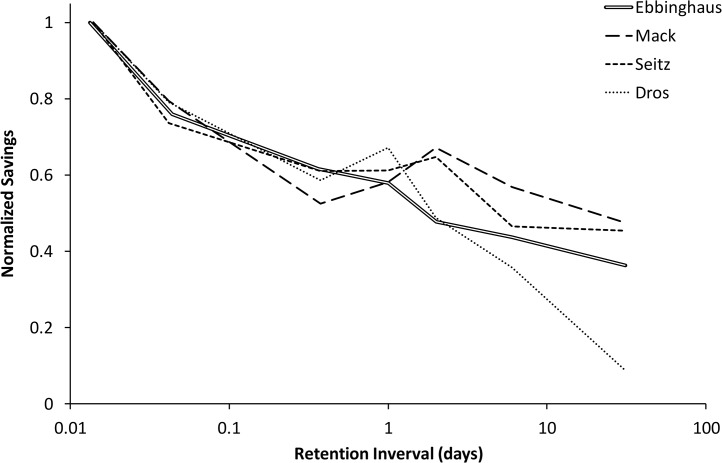
These numbers are time saved in relearning syllables, so they say little about how much of a chapter on the Roman republic you will keep. Forgetting itself is not in doubt.
Testing yourself
Roediger and Karpicke's 2006 paper reports two experiments with undergraduates at Washington University. In the first, 120 students each studied one passage twice, and studied another once and then spent seven minutes writing down everything they could recall of it, with no feedback. Students tested five minutes later remembered the reread passage better, 81% against 75%. For those tested two days later the order had reversed, 54% against 68%, and for those tested after a week it was 42% against 56%.
In the second, with 180 students, one group studied a passage in four periods and read it 14.2 times on average. Another read it 3.4 times in one period and then took three recall tests. A week later the first group recalled 40% and the second 61%. Asked before the test how well they would remember it, the rereaders were the most confident, at 4.8 on a 7-point scale against 4.0.
The passages were under 300 words, each delay had 40 students in the first experiment, the longest delay was a week, and the final test had the same form as the practice.
Karpicke and Blunt (2011) answered part of that in Science. Eighty undergraduates studied a science text. Some then drew a concept map with the text open, and some put it away and wrote what they could recall, in the same time. A week later, on questions that included inferences the text never stated, the recall group scored 67% and the concept mappers 45%. In a second experiment 101 of 120 students did better on the text they had recalled than on the text they had mapped, and 90 of the 120 had predicted that mapping would do as well or better. It is still one lab and one week, and I cover it at more length in the audiobooks post.
Spacing the tests out
Cepeda and colleagues (2006) pooled 839 assessments from 317 experiments and found that the best gap between two study sessions grows with how long you want to remember. Their 2008 follow-up points out the weakness of that literature: of more than 400 papers, about a dozen had tested memory even a day later.
So they taught 1,354 adults a set of 32 obscure facts, such as which European nation eats the most spicy Mexican food (Norway). Each person reviewed the facts once, after a gap of anything from three minutes to 105 days, and was tested 7, 35, 70 or 350 days after that.
For a test a week away, the best gap was one day. For a test 70 or 350 days away it was three weeks. Against reviewing straight away, the best gap raised recall by 10% at a week and by 111% at 70 days, for the same study time. A gap that was too long cost much less than one that was too short.
The paper puts the practical problem in one sentence: "if you want to know the optimal distribution of study time, you need to decide how long you wish to remember something." Its limit is the material: one-word answers to trivia questions.
Explaining as you read
Self-explanation means stopping to say how the sentence you just read connects to what you already know. In Chi and colleagues' 1994 study, 14 eighth-graders were prompted to explain each line of a text on the circulatory system, and 10 read the text twice. The prompted group gained more from pretest to posttest, and the students who explained most all ended with a correct mental model of the circulatory system. I read the abstract of this one, not the paper. It is 24 children and one text, and Dunlosky's review notes that nobody had shown the effect lasts.
Highlighting and rereading
In 2013 John Dunlosky and four colleagues published a 55-page review of ten study techniques, and included highlighting and rereading because students rely on them. In one survey they cite, 84% of undergraduates at an elite university listed rereading among their study methods, and 55% ranked it first.
Their model experiment is Fowler and Barker's, from 1974. Undergraduates spent an hour with about 8,000 words of articles from Scientific American and Science, on boredom and city life. Some highlighted whatever they wanted and some only read. On a 54-question test a week later the highlighters did no better. Among the 19 who highlighted, those who marked more scored somewhat lower (r = -.29, not significant at that size).
The reviewers' verdict: "In most situations that have been examined and with most participants, highlighting does little to boost performance."
They expect students to carry on regardless. Finding ways to make highlighting work, they write, "might be easier than convincing students to abandon it entirely".
Highlighting is a fine way to find a passage again. Rereading has the trouble of Roediger and Karpicke's four study periods: it makes the page familiar, and familiar feels like known.
Dunlosky's ratings of ten techniques
| Technique | What you do | Rating |
|---|---|---|
| Practice testing | Test yourself on the material | High |
| Distributed practice | Spread study over time | High |
| Elaborative interrogation | Explain why a stated fact is true | Moderate |
| Self-explanation | Explain how new information relates to what you know | Moderate |
| Interleaved practice | Mix kinds of problem or material in one session | Moderate |
| Summarization | Write summaries of the text | Low |
| Highlighting or underlining | Mark the parts that look important | Low |
| Keyword mnemonic | Tie words to mental images | Low |
| Imagery for text | Picture the text while reading | Low |
| Rereading | Read it again | Low |
The ratings are from Table 4 of the review. They are the authors' judgment of how widely a benefit has been shown across learners, materials and tests. They are not effect sizes, and low does not mean harmful. The review is about students preparing for exams.
Taking notes on a book
The research on taking notes from a book is thinner than the advice about it. Dunlosky's review describes one experiment, by Bretzing and Kulhavy in 1979. High school students read a 2,000-word text. Those who wrote three lines of summary or notes per page did best, both straight away and a week later. Those who copied out the three most important lines of each page did about as well as students who wrote nothing.
The review still rates summarising low, because many people summarise badly and the gains were inconsistent across tests. Putting that together with the testing studies, I would take notes this way:
- Read the chapter with the pen down.
- Close the book and write three or four lines from memory, in your own words.
- Open it again only to check what you could not produce.
- A few days later, before you look at the notes, try to say them.
Notes copied out with the book open are highlighting done by hand. My guide to Adler's How to Read a Book is about reading a hard book in the first place.
Flashcards automate the two that work
Dunlosky's two high ratings are the description of a flashcard program. Anki's manual names "active recall testing and spaced repetition" as the two ideas behind it: a card asks a question, you answer from memory, and the program shows the card again when it estimates you are about to forget. RemNote attaches the same kind of card to your notes.
If you need to remember what you read, this is the tool. A conversation does not do this job better, and I will not argue that it does.
Nothing here lets you remember everything you read. Flashcards let you remember whatever you put on a card, for as long as you keep reviewing it.
Remembering is usually the wrong target
This is my view, and nobody has tested it. Every study above was built around a test: a passage, then a score. A student has that test coming. An adult reading a book about the immune system on a Tuesday night does not.
When I look at what I kept from the nonfiction I have read, I find two or three ideas per book that answered something I had been wondering about. I do not miss the rest.
Cepeda's sentence asks me to decide how long I wish to remember something. For most of what I read I have no answer, because I do not know which idea will matter until a question of mine runs into it. Scheduling reviews for a whole book means paying to keep the parts I never cared about.
Recall scores also measure something next to what I want. Roediger and Karpicke counted how many of a passage's 30 ideas a student wrote down. I want to be able to say why a vaccine works. Rozenblit and Keil (2002) had Yale students rate how well they understood devices such as a zipper, then write out how one works, then rate themselves again. The rating fell from 3.89 to 3.10 on a 7-point scale. They found the gap "far stronger for explanatory knowledge" than for facts or stories. Explanations are where a reader is most likely to think a book has stuck when it has not.
I also think an explanation is easier to rebuild than a list. David Deutsch calls a good explanation "hard to vary, because all its details play a functional role." If each part of an idea constrains the others, a few parts bring back the rest. That is my reading of his book.
So my target for a book is narrower than retention. Find the two or three ideas you were curious about. Understand them while you still care, which means using them: explain one aloud, or predict a case the author did not cover. Then keep a record of what you managed, so you can rebuild it when it comes up.
The strongest objection
Some things have to be memorised. You cannot rebuild the Spanish word for spoon from first principles, or the branches of the facial nerve. For a language, anatomy, an exam or fluent calculation (the case I made for Math Academy), the evidence above applies and my argument does not. Use the flashcards.
The harder version of the objection is that understanding is made of remembered things. Nobody reasons about immunity without the word "antibody" to hand, and my confidence that I could rebuild an idea later is the very confidence Rozenblit and Keil showed to be inflated.
I concede most of this. Explaining an idea with the book closed is the recall condition in Karpicke and Blunt's experiment, so the test I propose is retrieval. An idea I explain once and never meet again will fade.
What I hold on to is the choice of what to test and when. Test the few ideas you wanted, at the moment you want them, and let the rest go. I know of no study that compares a reader who follows curiosity with one who runs flashcards on the same books for a year. Until one does, this stays an argument.
On a walk
The use I have in mind is a commute or a walk. Something from last night's chapter is still bothering you, so you call a tutor and ask. A summary app can only serve what was written in advance. For deciding whether a book is worth your time that is the right tool, and I compare the apps in Blinkist vs Headway vs Shortform. A question that occurred to you an hour ago has no summary.
Understand
Understand is what I built for that walk: a voice chat with an AI tutor that you can interrupt. It answers directly, and after explaining an idea that is new to you it asks one question that takes the idea to answer. It draws on a board while it talks, and it reads an article or PDF aloud and stops when you ask something.
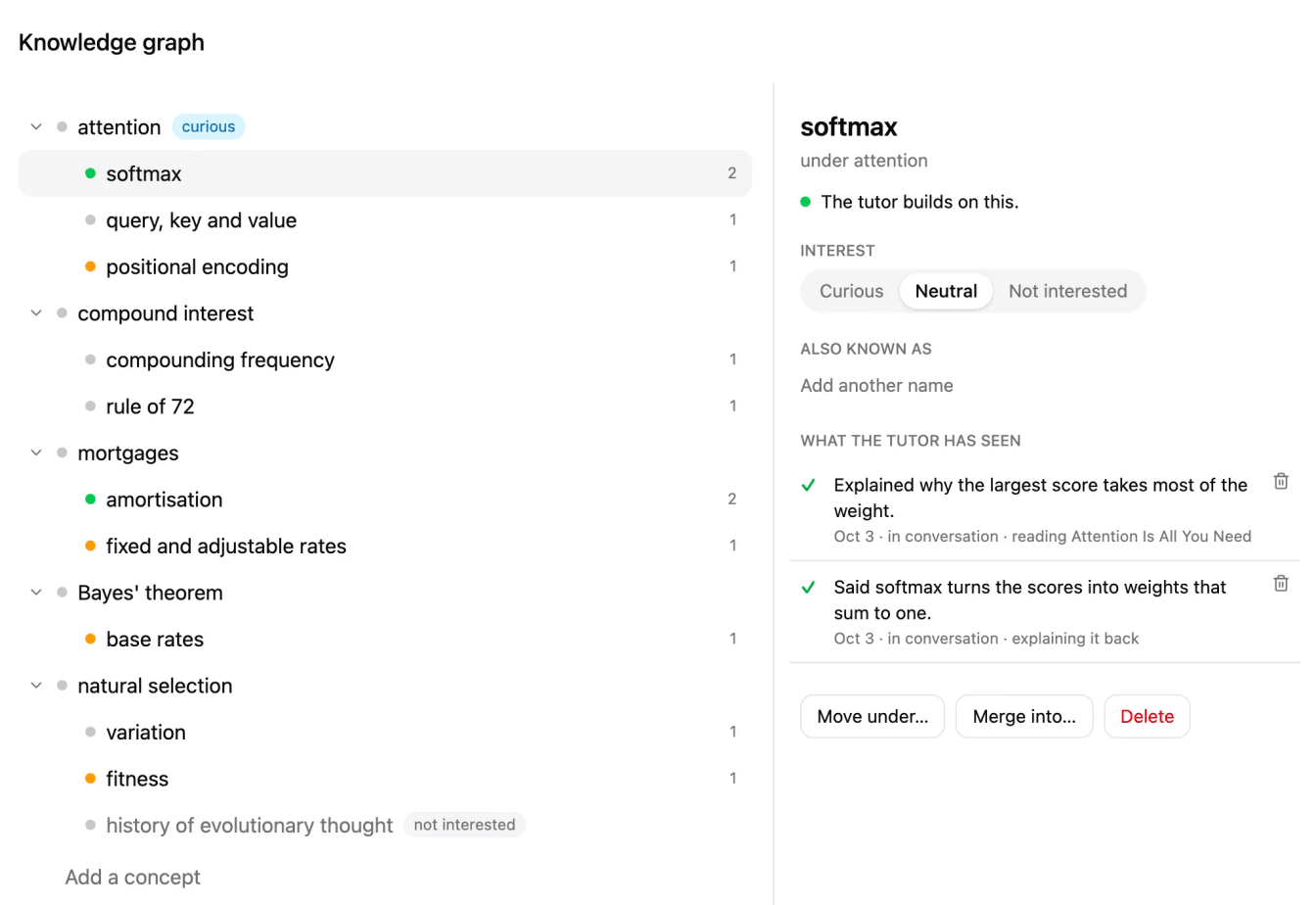
What you say in reply is kept as a record of what you have shown you understand, with the evidence and the date under each idea. An idea counts as something to build on only after you have shown it in two different contexts. You can read the record and correct it.
It imports Anki decks. The import tells the tutor what your cards say you can recall and which topics keep slipping, and it treats both as leads. Four hundred mature cards on a subject still count as nothing shown until you use the idea in conversation.
It will not remind you of anything in three weeks. There is no spaced repetition, no course, no problem set and no Android app, and nobody has run a trial of it. If your reading has a test at the end, use Anki or RemNote. A tutor can also be used lazily, and the post on cognitive debt has the studies on that. Understand is for adults, and it is free for now.