Do audiobooks count as reading? The evidence on listening versus reading
For following a story or the gist of an argument, yes: the studies that compare listening with reading find about the same comprehension. Whether either one counts depends on what you wanted from the book, and for understanding a hard idea neither is enough by itself.
I build Understand, a tutor that reads documents aloud, so weigh the last section with that in mind.
The book club answer
The argument about whether audiobooks "count" is usually about status, and it has an easy answer. A listened book is a read book for every purpose a book club or a reading list cares about.
Daniel Willingham, a psychologist at the University of Virginia who studies reading, wrote in the New York Times in 2018 that the question he hears most often is "Is it cheating if I listen to an audiobook for my book club?" His answer: "So no, listening to a book club selection is not cheating." In a 2016 blog post he compared the complaint to calling a friend a cheater for taking the bus to Disneyland.
For a blind reader, or one with dyslexia, audio is the way into the book. Willingham makes the point about dyslexia himself: audiobooks "allow listeners to get the meaning while skirting the work of decoding."
How much ends up in your head is a separate question, and the studies below are about that one.
Decoding is the step that differs
Reading researchers use a model called the simple view of reading, from Gough and Tunmer (1986). Reading is decoding (turning print into words) plus language comprehension, the same process you use to understand speech. An audiobook removes the decoding and leaves the comprehension.
For a child learning to read, decoding is most of the work. For a fluent adult it is not the bottleneck. Willingham puts it this way in the Times piece: decoding is "automatic by high school, and no more effortful or error prone than listening."
The brain imaging agrees. Deniz and colleagues (2019), from Jack Gallant's lab at Berkeley, scanned nine people while they listened to more than two hours of stories from The Moth Radio Hour and again while they read the transcripts. They mapped which parts of the cortex responded to which kinds of meaning. The paper's summary: "the semantic representations evoked by listening versus reading are almost identical."
The readers in that study saw one word at a time, at the speed the storyteller had spoken, so they could not slow down or look back. The scanner also shows where meaning is represented and says nothing about how much each person understood.
The comparison studies
| Study | What was compared | Result |
|---|---|---|
| Rogowsky, Calhoun and Tallal (2016) | 91 adults heard, read, or heard and read part of Unbroken | No significant difference, immediately or two weeks later |
| Clinton-Lisell (2022) | Meta-analysis of 46 studies, 4,687 participants | No reliable overall difference; reading ahead when self-paced and on inferential questions |
| Daniel and Woody (2010) | Psychology students heard a podcast of a primary source or read it | Listeners scored lower on the quiz |
| Deniz et al. (2019) | fMRI of 9 people hearing and reading the same stories | Maps of meaning across the cortex almost identical |
| Varao Sousa, Carriere and Smilek (2013) | 211 students read aloud, read silently and listened | Most mind wandering and worst memory when listening |
| Schotter, Tran and Rayner (2014) | Normal reading against reading with each word masked once passed | Comprehension fell when rereading was impossible |
| Murphy et al. (2022) | Lecture videos at 1x, 1.5x, 2x and faster | Minimal cost up to 2x, decline beyond it |
| Karpicke and Blunt (2011) | Recalling a science text against drawing a concept map of it | A week later: 67% correct against 45% |
| Rozenblit and Keil (2002) | Self-rated understanding of devices before and after explaining them | Ratings fell from 3.89 to 3.10 on a 7-point scale |
I covered the Rogowsky study in my post on alternatives to Audible. Time and NPR both build their answer on it, and it tested one chapter of narrative nonfiction.
Virginia Clinton-Lisell's meta-analysis in Review of Educational Research is the broadest evidence. Across 46 studies the overall difference between reading and listening was not reliable (g = 0.07, p = 0.23). Reading came out ahead when readers set their own pace (g = 0.13, p = 0.049). It also came out ahead on inferential questions, which ask for something the text implies and never states (g = 0.36, p = 0.02). On literal questions the two were level (g = -0.01).
Willingham's Times piece describes a classroom study of the same shape as Daniel and Woody's. Students learned a scientific subject from a 22-minute podcast or from a printed article, and spent the same time on each. On a quiz two days later "the readers scored 81 percent and the listeners 59 percent." His conclusion is "equivalence for easy texts and an advantage to print for hard ones."
Going back and drifting off
A reader's eyes go back. Schotter, Tran and Rayner tested how much that matters by masking each word as soon as the reader's eyes had moved past it. Comprehension dropped, and the drop was not confined to ambiguous sentences. An audiobook has the same property: the sentence is gone once it is said.
Audio players have a back button that jumps a fixed number of seconds. That is a blunt tool for recovering one clause, and with your hands on a steering wheel you will not use it. I think this explains Clinton-Lisell's self-pacing result better than anything about ears and eyes.
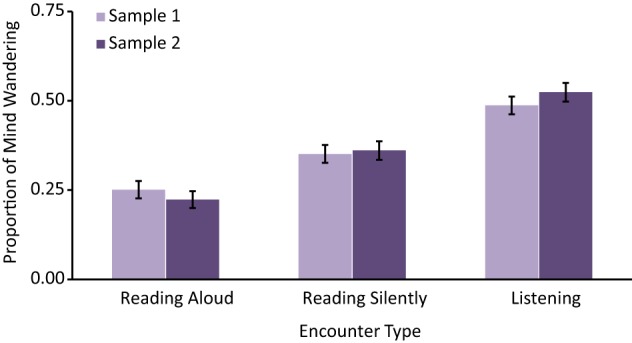
Listeners also drift more. Varao Sousa, Carriere and Smilek had students at the University of Waterloo meet three passages from Bill Bryson's A Short History of Nearly Everything: one read aloud, one read silently, one heard in Bryson's own recording. A prompt interrupted them every 30 to 90 seconds to ask whether their mind had been wandering. Listeners said yes about half the time. Silent readers said yes about a third of the time, and people reading aloud about a quarter. Listening also gave the lowest scores on the memory test, in both samples. These listeners sat in a lab with a blank screen in front of them and nothing else to do.
Speed and doing something else
Listening at 1.5x costs little, as far as the evidence goes. Murphy and colleagues at UCLA found "minimal costs incurred by increasing video speed from 1x to 1.5x, or 2x speed, but performance declined beyond 2x speed." A 2022 meta-analysis by Cheng, Pastore and Ritzhaupt pooled seven papers on time-compressed instruction and found a small loss at 1.4x to 1.5x (g = -0.21) and a larger one at 1.8x to 2x that did not reach statistical significance (g = -0.36). Both results come from recorded lectures and narrated lessons. I found no equivalent study of audiobooks.
On multitasking I expected worse than I found. Willingham writes that 81 percent of audiobook listeners like to drive, work out or otherwise multitask, and that "if we multitask, we'll get gist, not subtleties." A 2025 trial in PLOS One put 41 medical residents and undergraduates in a driving simulator with medical education podcasts. Their test scores did not differ significantly from scores after listening at a desk. That is one small study with multiple-choice questions, which sit closer to gist than to subtleties.
Intake and the feeling of understanding
Listening and reading are both ways of taking a text in. The older and larger finding in learning research is that taking a text in, by either route, does less than people expect.
The testing effect is the name for it. Students who close the book and try to recall what it said remember more a week later than students who spend the same time rereading; the other post has Roediger and Karpicke's numbers. Karpicke and Blunt (2011) ran the version I find most convincing, in Science. Eighty undergraduates studied a science text. Some reread it, some drew a concept map with the text in front of them, and some put it away and wrote down what they could recall. A week later the recall group answered 67% of the questions correctly and the concept mappers 45%, and the advantage held on questions that required inferences. Asked in advance, the students had predicted that rereading would work best and recall worst.
This is usually filed under active learning versus passive learning, and concept mapping is supposed to be the active one. The students with the text open were busy. The students with the text closed had to produce the ideas themselves, and found out which ones they could not produce.
Rozenblit and Keil's 2002 paper on the illusion of explanatory depth measures the same gap in people's own ratings. They asked Yale students to rate how well they understood devices such as a zipper and a flush toilet, on a scale from 1 to 7. Then the students wrote a step-by-step explanation of how the device works and rated themselves again. In the second study the average fell from 3.89 to 3.10. Independent judges who read the explanations gave them 2.72.
The authors add a detail that bears on audiobooks. The illusion was "far stronger for explanatory knowledge than many other kinds of knowledge, such as that for facts, procedures or narratives." People judge better whether they followed a story than whether they understood how something works.
That lines up with the comparison studies. For a novel or a memoir, listening and reading come out the same, and your sense of having followed it can be trusted. For an argument or a mechanism, reading has a modest edge, and in both cases the sense of having understood arrives before the understanding does.
Karl Popper and David Deutsch explain why. Knowledge is created by conjecture and criticism, and an explanation you hear or read arrives as words you have to guess the meaning of. The guess stays untested until something criticizes it. Recalling a chapter or explaining it to someone is the cheapest criticism available, because a wrong or missing guess shows up as a sentence you cannot finish.
On a commute
I listened to books and podcasts on my commute for years without knowing any of this.
Choose audio for narrative, such as fiction or history told as a story. The comparison studies say you lose little. I would add subjects you already know well, though none of the studies above tested that.
Keep the dense book for a time when you can stop and go back. If the author builds an argument across a chapter, or you would want to reread a paragraph on the page, the audio will carry you past the hard part at the narrator's pace.
Raise the speed if you like. Up to 1.5x the measured loss is small, and the audiobook speed calculator shows what a given speed saves on a given book. The reading time calculator gives the same figure for reading it yourself.
When a chapter ends, pause and explain its argument out loud before the next one starts. If the explanation comes, keep listening. If it does not, you have learned something the feeling of listening would not have told you.
Understand
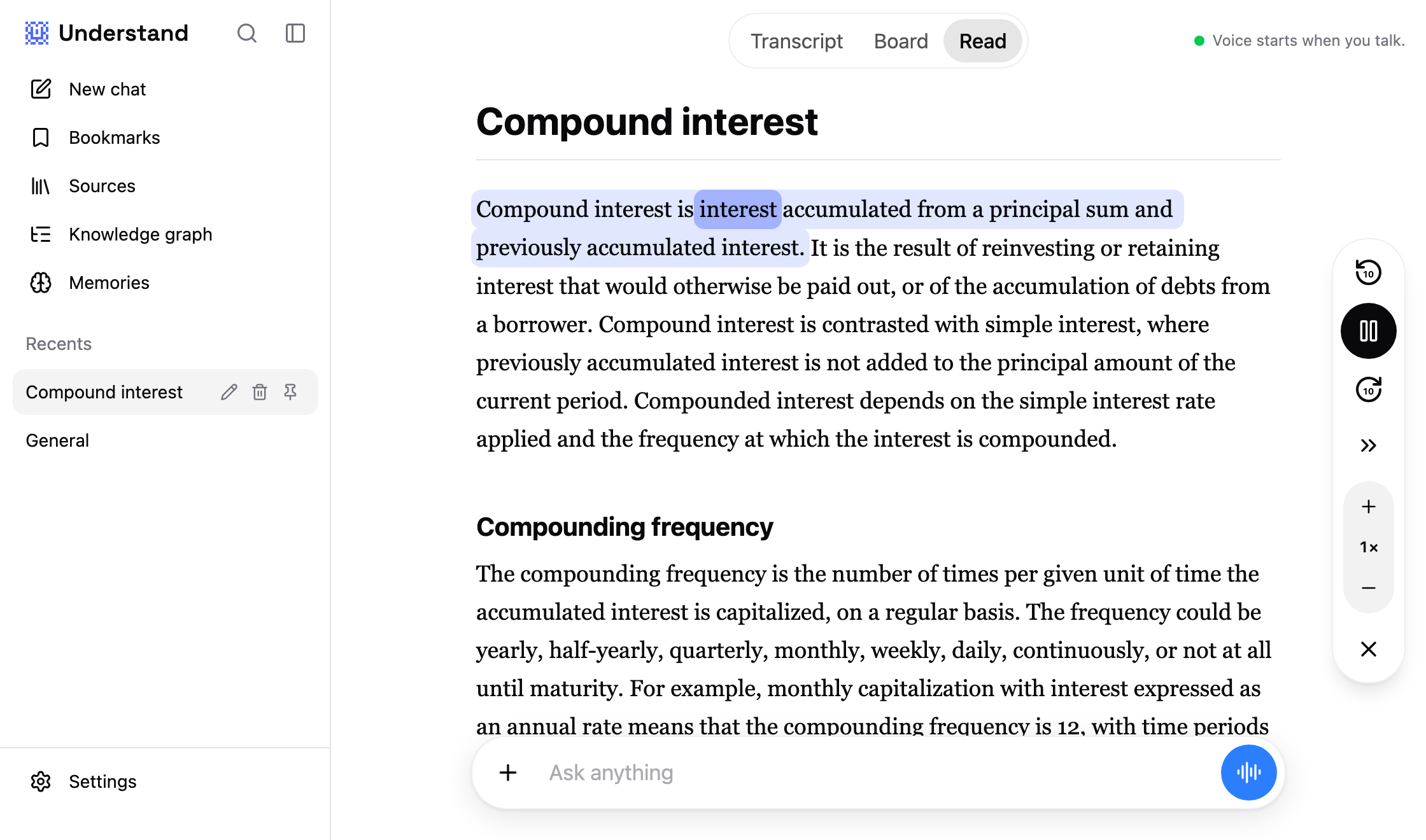
I built Understand because I kept failing that last step. It reads an article or a PDF aloud word for word. When you start speaking it stops, answers your question and goes on from the sentence where you interrupted. When you open a saved piece to talk about it, the tutor asks you to explain an idea before it explains anything, and it records what you got right in an outline you can read and correct.
It will not replace an audiobook app. It has no catalogue of narrated books and no human narrators, and a book has to arrive as a PDF with real text in it. There is no Android app. It needs a connection the whole time, so it is no use on a flight or in a tunnel. Nobody has run a trial of it.