Brilliant review for adults: good for intuition, thin on technique
Brilliant's own help page on calculus says its coverage is "deep on the concepts and thin on technique, so it works best alongside a class or textbook." I found no better one-line review of Brilliant, and it answers the question for an adult: pay for it if you want to see why an idea is true and would enjoy twenty minutes a day finding out, and plan on a second resource before you can compute anything under pressure.
I have not completed a Brilliant course. This review rests on Brilliant's own pages, the store listings, the research on learning from problems, and adults who used it and wrote under a name or a handle. I build Understand, a voice tutor for adults, and I have no connection to Brilliant.
Brilliant in brief
Brilliant teaches math, coding, data analysis and some science through interactive problems. It has no lecture videos. You drag a tangent line or pick an answer, and the explanation comes after you commit.
Its About page describes the order: "We don't teach how to do something before asking questions. Instead, we pretest on the material, letting the learner try to find a solution before learning the procedure." Each lesson covers one concept and comes with practice sets where the hints and visuals are removed.
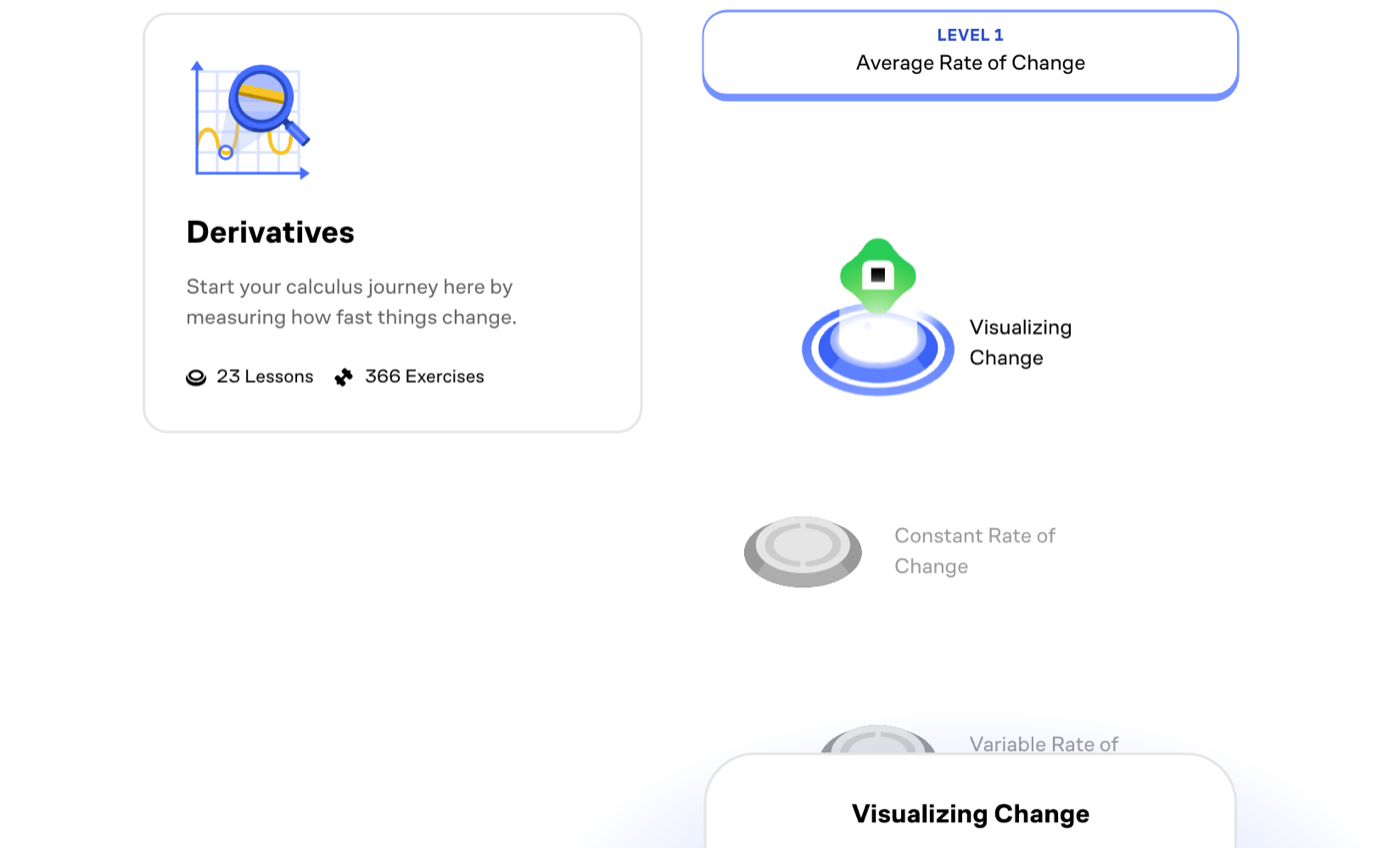
The course list runs from fractions to limits, derivatives, vectors and matrices, with separate paths for Python, data analysis and logic. The Premium page counts more than 40 courses. The Derivatives course has 23 lessons and 366 exercises so far, with later levels marked "Coming soon".
Brilliant is accredited by ACS WASC and issues no certificates or credit. The company says more than 10 million people have used it.
The front door has moved toward families. The homepage now reads "A world-class tutor for every home", the courses carry school grade labels, and Brilliant's own comparison with Khan Academy has a section called "Which is better for my child?" Adults are still on the list: the help page names "lifelong learners", and there is a math page for adults. You should know which customer the product is being built for this year.
Price and the free tier
I loaded Brilliant's Premium page five times on October 4, 2026, in fresh browser sessions from one US connection. Twice it showed $30 a month, or $20 a month billed as one yearly payment. Three times it showed $60 a month, or $30 a month billed yearly. The six-seat family plan doubled in step, from $40 to $60 a month on yearly billing.
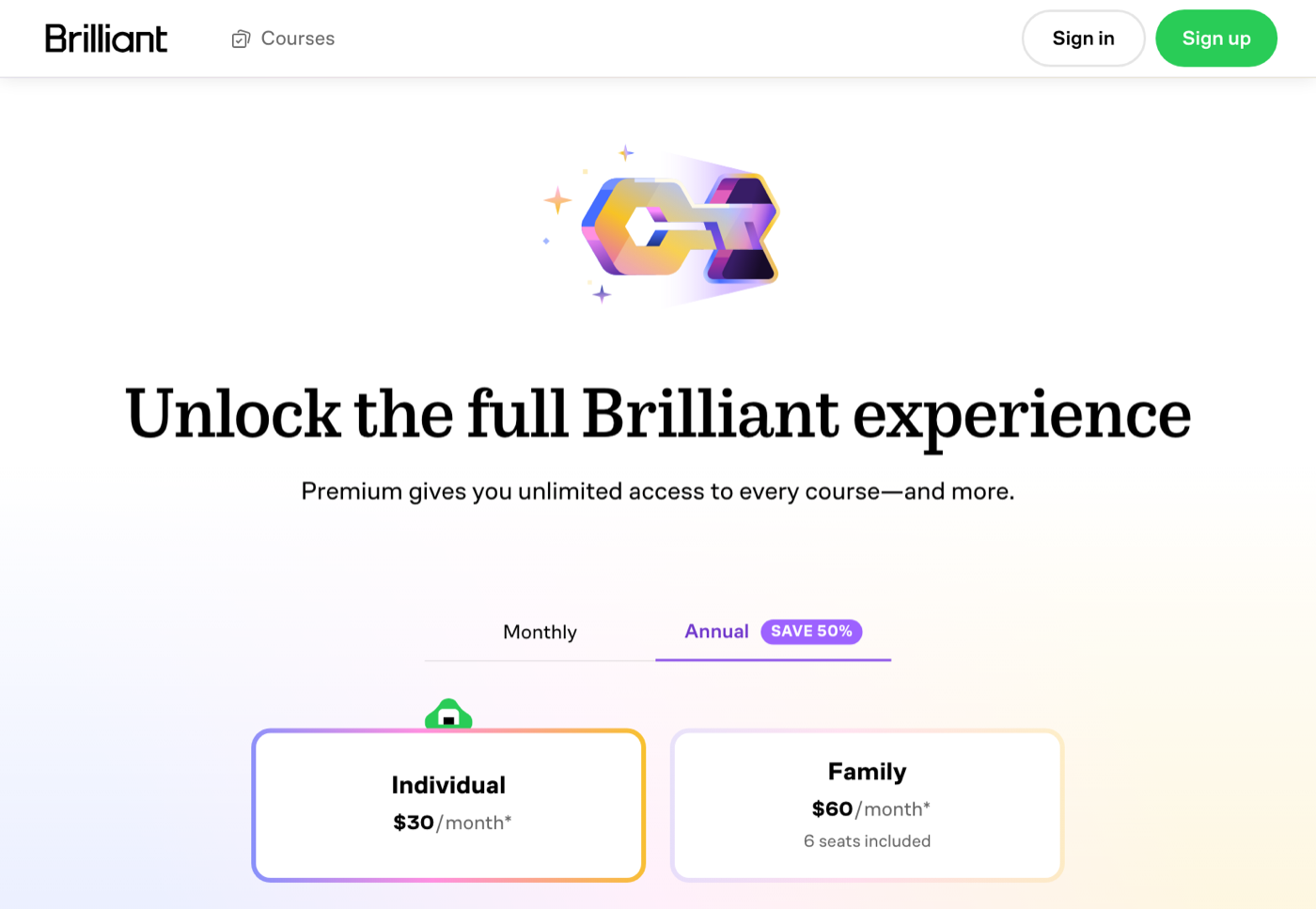
Brilliant's help article on cost gives no figure. It says pricing "varies by plan type and subscription length" and sends you to the Premium page. My earlier posts quoted $30 and $20, which is the lower set. Read the checkout before you pay. Charges are nonrefundable "except as required by applicable law", and a free trial of Premium is offered only sometimes.
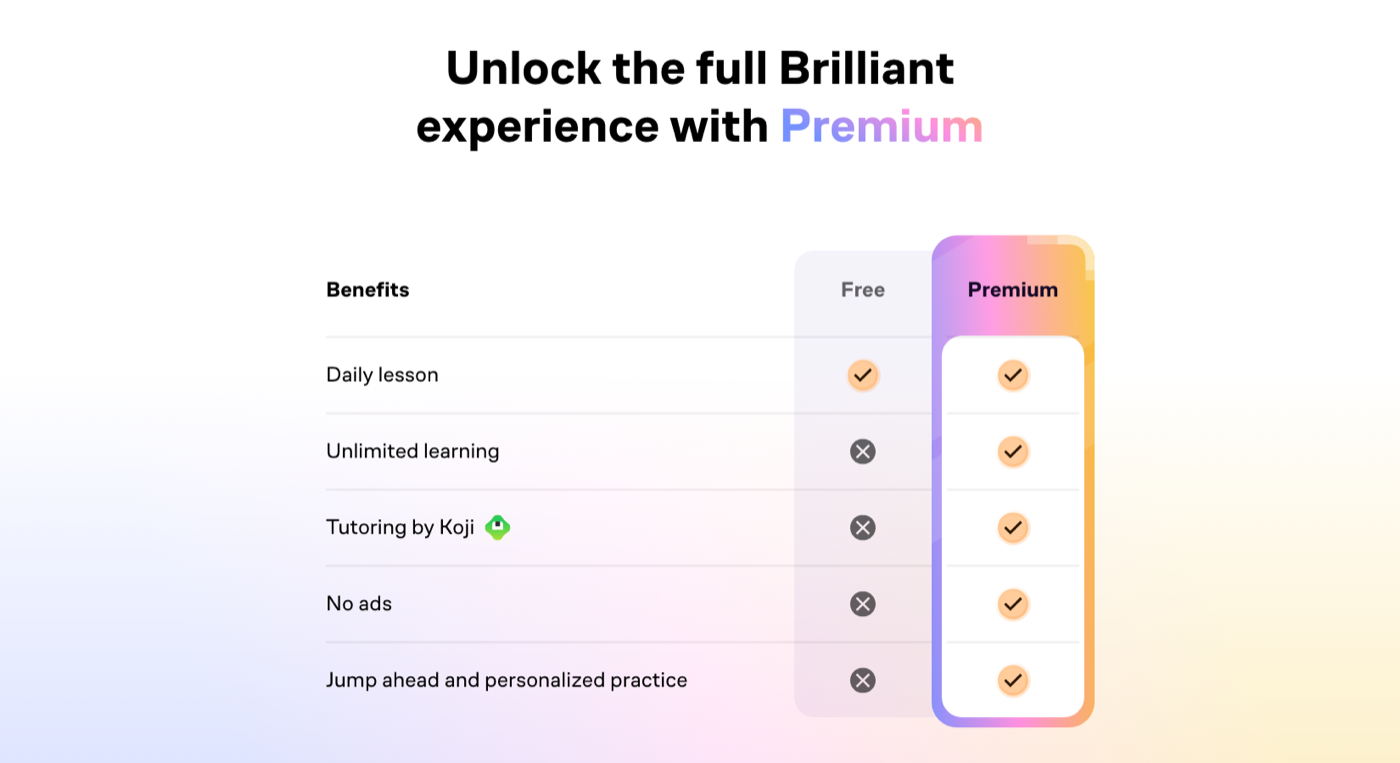
The free tier is usable. Brilliant's help page gives free users two keys a day, and each key opens one lesson or one practice set. You must take a course in order, you see occasional ads, and you get a limited preview of the tutor. A streak needs three problems or one lesson a day, so the free tier is enough to keep one going indefinitely.
The App Store shows 4.7 from about 33,000 ratings. Google Play shows 4.5 from 114,000 reviews and more than five million downloads.
Koji, the tutor inside the lesson
Koji arrived on May 29, 2026. Brilliant's help page says it can see the problem on your screen, including the interactive parts, and can highlight or rearrange them while it talks you toward the answer without giving it. It works in most math and coding courses. Premium subscribers get unlimited use.
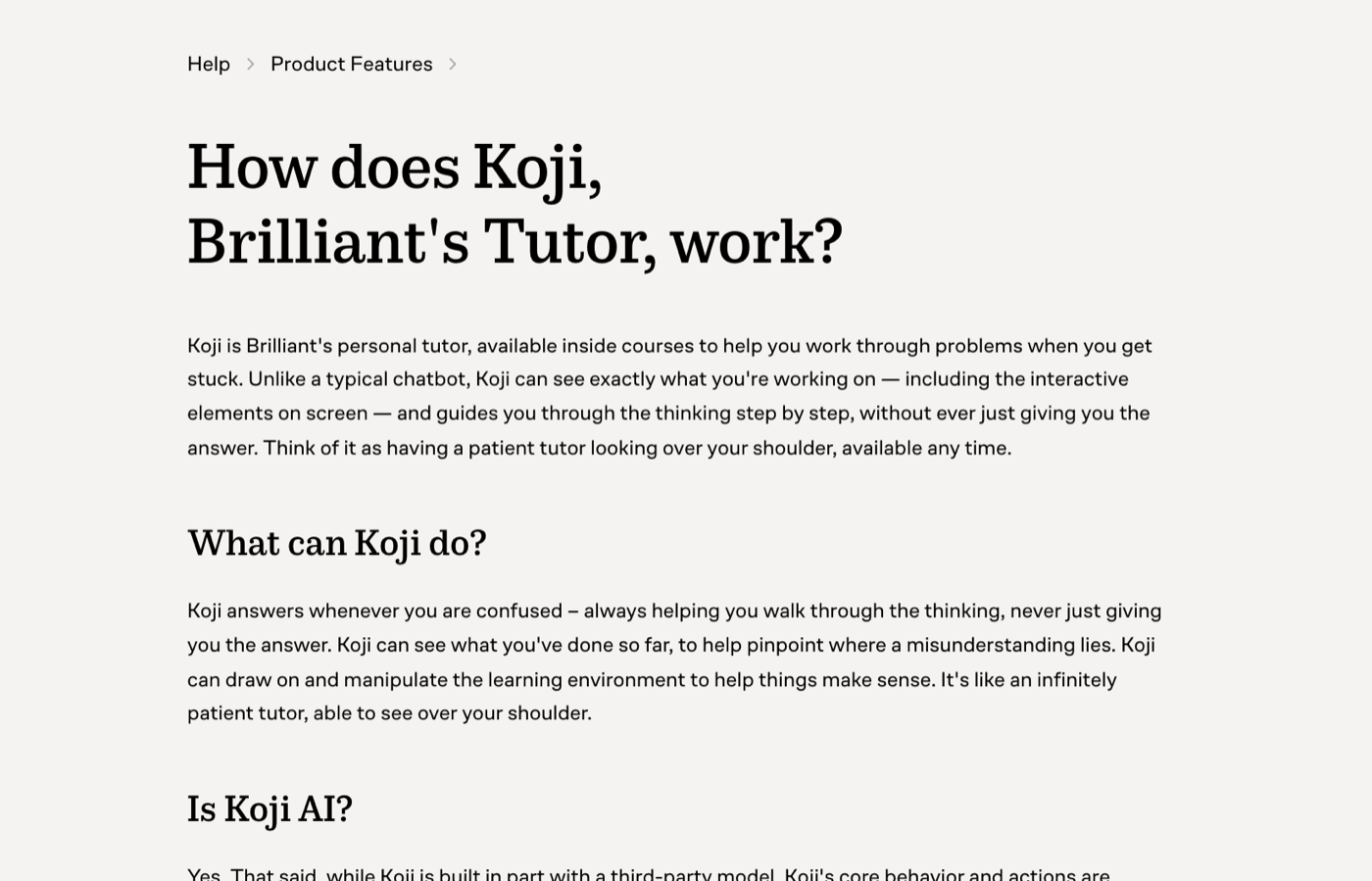
By default Koji speaks first. Brilliant's launch post says that it talks at the start of every lesson page, because a tutor who speaks before you ask "dramatically lowers the barrier to asking". You can mute it. The voices are ElevenLabs voices built from recordings of Brilliant's staff. In that article Blake Farrow, Brilliant's Chief Content Officer, explains what they were avoiding: "Koji confidently saying 'nine' when he should have said 'five' is catastrophic in a tutoring context."
Brilliant claims Koji is "exceedingly unlikely to make a math mistake". I found no independent test of that. Every learner quoted in the launch post is between 10 and 14, so there is no adult account of Koji in this review.
On the web you can also ask Koji a question outside a lesson. Ask why negative exponents work the way they do and, by Brilliant's description, Koji "routes the learner to relevant instruction or practice". You asked a question and received a lesson, which is Brilliant in one transaction.
Streaks, leagues and XP
A streak counts consecutive days. Miss one and a Streak Charge is spent to save it; you can hold two. Leagues put you in a group of 30 that competes on weekly XP, across ten levels named after elements, from Hydrogen up to Einsteinium. I would settle for Carbon.
Brilliant is open about why. The About page calls this a "gamification layer" for "motivation and habit formation" and says the company is "testing various mechanics to extend your learning session".
Users split on it. On Hacker News in 2022, bananarchist praised Brilliant because it "doesn't emphasize gamification". In November 2023, ben_w, who had quit Duolingo after a 2,500-day streak over "twee gamification", wrote: "Similar direction of changes are now actively annoying me with Brilliant.org". Cedar Sanderson used it daily for six months and concluded: "Other than the streaks, there isn't really a reason for me to keep at it".
Reports from adult users
The happiest account I found is from 2020. johnsonjo bought a lifetime subscription for $599.99 and described the courses as "a lot less plug and chug" than Khan Academy. Brilliant's Premium page no longer lists a lifetime plan.
Duncan Smith, who writes the Red-Green-Code blog and was studying discrete math, described in 2019 a lesson that taught modular arithmetic with colored grids before any notation appeared. Smith liked it, and then found the limit: "a handful of exercises aren't enough to solidify a concept." Smith's recipe was "Brilliant for intuition, Khan Academy for more traditional explanations and problem drills, and textbooks for learning from the ground up."
dcw303 wanted the math for 3D games, liked "the level of polish in the interactive lessons", and found the structure "out of sequence, often referring to things that haven't been covered yet". The Art of Problem Solving textbooks replaced it.
Sanderson came for Python, paid $161 for a year, and got stuck after a few levels because the lessons contained "insufficient information and explanation". The same review reports questions where the task was to guess which answer the app wanted. Sanderson's verdict in November 2024: Brilliant is "better suited to refreshing and reinforcing concepts learned in much more depth elsewhere."
solardev called it "TOO interactive (requiring click after click after click, with many simple questions in between), but it's good for learning something you know nothing about." The same comment names the thing Brilliant is known for: it is "always mentioned at the end of a bunch of engineering channels". Sanderson: "I see it advertised everywhere".
Long-time users say the product got easier. ben_w wrote in January 2026 about working through the old courses until group theory and vector calculus got too hard, and that the newer material looked like "easier questions that teach little, padding out a progressions system". Brilliant's pages show part of that change. Its problem-solving wiki "is no longer maintained", and retired courses sit in an Archived section on the desktop site. A January 2025 post calls lessons "learning games" and says a course now needs "20+ problems per concept", with AI tools generating the variants under human review. Smith's complaint was too few exercises. ben_w's complaint is the cure.
Justin Skycak, who builds the rival Math Academy, puts the ceiling plainly: "the coverage & rigor on Brilliant isn't really comparable to what you'd find at a top university." He adds that this is fine "if you're just curious about math". He sells the alternative, and Brilliant's calculus page agrees with him anyway.
Research on puzzles before explanations
Brilliant says of its problem-first order: "Based on our testing to date, we believe this is the optimal approach." Its About page cites no study. The published research is kinder to the claim than I expected.
Manu Kapur calls the design productive failure. In two randomized studies published in 2014, students who attempted problems before being taught showed "significantly greater conceptual understanding" and transfer than students taught first, while both groups reached high procedural knowledge. A 2021 meta-analysis by Tanmay Sinha and Kapur pooled 53 studies and 166 comparisons and found a moderate effect for problem solving before instruction (Hedges' g of 0.36, with a 95% interval from 0.20 to 0.51). The effect reversed for second to fifth graders. I read the abstracts of both papers. In these studies instruction follows the failed attempt, and I cannot tell from outside whether Brilliant's explanation screens do that job.
The other side is John Sweller's. In five experiments on algebra in 1985, Sweller and Graham Cooper found that students who studied worked examples solved later problems faster and with fewer errors than students given conventional problems to solve. The gain held only for problems with the same structure as the examples. Again I read the abstract. Paul Kirschner, Sweller and Richard Clark argued in 2006 that minimally guided instruction is less effective than guided instruction until the learner already knows a good deal. Brilliant is guided at every click, so that paper is aimed at something else.
Scott Freeman's meta-analysis of 225 studies found that active learning raised exam scores by 0.47 standard deviations over lecturing in undergraduate science and math. That supports doing over watching. It compares against lectures, and says nothing about puzzles against worked examples with drill.
None of these papers claims that understanding a concept makes you fluent at using it. Fluency takes volume, and Brilliant's About page says so itself: "To learn math well requires many, many reps."
I like the order for a reason outside the trials. Karl Popper held that knowledge grows by conjecture and criticism, and that a conjecture is an attempt on a problem. A Brilliant puzzle makes you guess before you are told, and the interactive tells you at once that you were wrong. The problems are Brilliant's, though. David Deutsch's version of the idea starts from a problem you have.
Brilliant, Math Academy, Khan Academy and Understand
| Brilliant | Math Academy | Khan Academy | Understand | |
|---|---|---|---|---|
| What you do | Solve interactive puzzles in short lessons, then practice sets | Read a worked example, then solve graded problems | Watch a video or read an article, then do exercises | Talk with a tutor, or have a text read aloud and interrupt it |
| Feedback | Instant on every answer; Koji gives spoken hints | Every answer checked; timed quizzes | Exercises checked; Khanmigo costs $4 a month, US only | The tutor answers, asks you to explain it back, and keeps a record you can correct |
| Schedule | Streak and weekly league; review sets still rolling out | Software picks your tasks and spaces the reviews | Self-paced | None |
| Price | $30 or $60 a month shown to me; less billed yearly; free tier of two lessons a day | $49 a month, no free trial | Free | Free for now |
| Suits | A curious adult who wants intuition and a daily habit | An adult who must be able to compute | An adult relearning school math for nothing | An adult with a question or a text |
My Math Academy review has the detail on its side. The recurring complaint there is the mirror image of Brilliant's. Michael Pershan aced Math Academy's quizzes and wrote, "I still don't know what a geometric distribution is." Brilliant is built to fix that sentence, and Math Academy is built to fix Smith's.
Brilliant's own comparison with Khan Academy concedes the main point: "Choose Khan Academy if free access across the widest possible range of school subjects is the deciding factor." Khan Academy has more than 840 courses at no cost.
My view
Brilliant is the best of these four at making you want to open it. Its About page says, "We've grown on the strength of being so good that you'll voluntarily learn each day", and the store ratings back that up. An app you open beats a better one you do not, and my Math Academy review quotes a user who quit.
Intuition is worth paying for. Knowing why the derivative is a slope changes what you do with every formula afterwards, and Brilliant's calculus page describes a course that spends four levels getting there.
Brilliant's own list of gaps is long. For calculus it names integration technique and convergence tests, and says there are "no full-length timed exams anywhere on Brilliant". It issues no certificate. On the free tier you cannot choose your own order. Sanderson's six months suggest it is the wrong tool for learning Python from nothing.
For an adult I would use the free tier for a month. If the two daily lessons leave you wanting more, pay for a year at whichever price you are shown, and add Khan Academy's exercises or Math Academy when you meet something you need to be able to do.
Understand, and its limits
Understand is a voice tutor you can interrupt. It will read an article or PDF aloud word for word and stop when you ask a question. It asks you to explain an idea back, and it keeps a record of what you explained that you can read and correct. It starts from your question, on any subject.
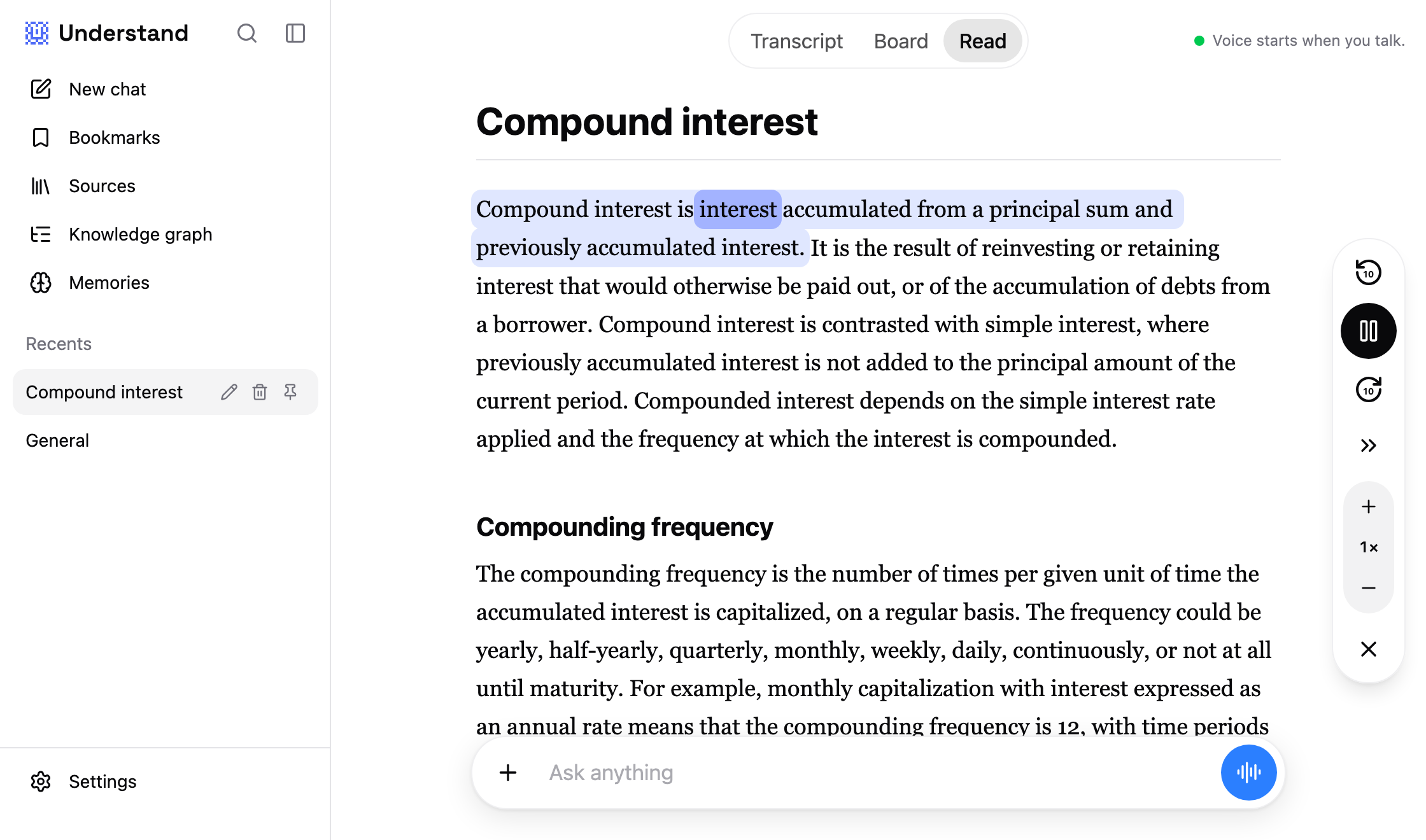
It has no courses, no problem sets and no spaced repetition. A voice call cannot hand you a tangent line to drag, and for a visual idea Brilliant's interactives are the better teacher. There is no Android app, and no trial has evaluated it. It is for adults and it is free for now.
Questions people ask
Is Brilliant worth it?
For an adult who wants to understand ideas and will use it most days, yes, at the lower price. For passing an exam, no. Brilliant's own calculus page says it is not enough for the AP exam.
Is there a good Brilliant alternative?
For drill, Khan Academy at no cost or Math Academy at $49 a month. Smith's third ingredient was a textbook.
Is Brilliant Koji good?
Brilliant says Koji sees your screen and withholds the answer. I found no adult's account of using it and no independent test of its accuracy.