Deepstash review: what an idea card keeps, and what 208 reviews say
In Deepstash's version of The Richest Man in Babylon, the chariot builder is called Bansal and gets paid on Fridays. In George Clason's book he is called Bansir, and the word Friday does not occur. Deepstash is a feed of short illustrated cards made from nonfiction books, and it is worth having if you want to know what a book says before you decide to read it. Use the free version first, and read the trial terms before you give it a card number.
I have opened the app and looked around. I have not paid for it. My impression was a TikTok for book summaries, with nothing in it to interact with. This review rests on Deepstash's own pages, the two store listings, 208 user reviews that I read and counted, and one card that I traced to the book it came from. I build Understand, a voice tutor for adults, and I have no connection to Deepstash.
Deepstash in brief
Deepstash calls its unit an idea. Its About page defines one as "short notes that are condensing profound thoughts into simple sentences", and asks that an idea be atomic, short and self-contained. A book becomes a dozen or so ideas of three to five minutes each. You swipe through them, or have them read to you.
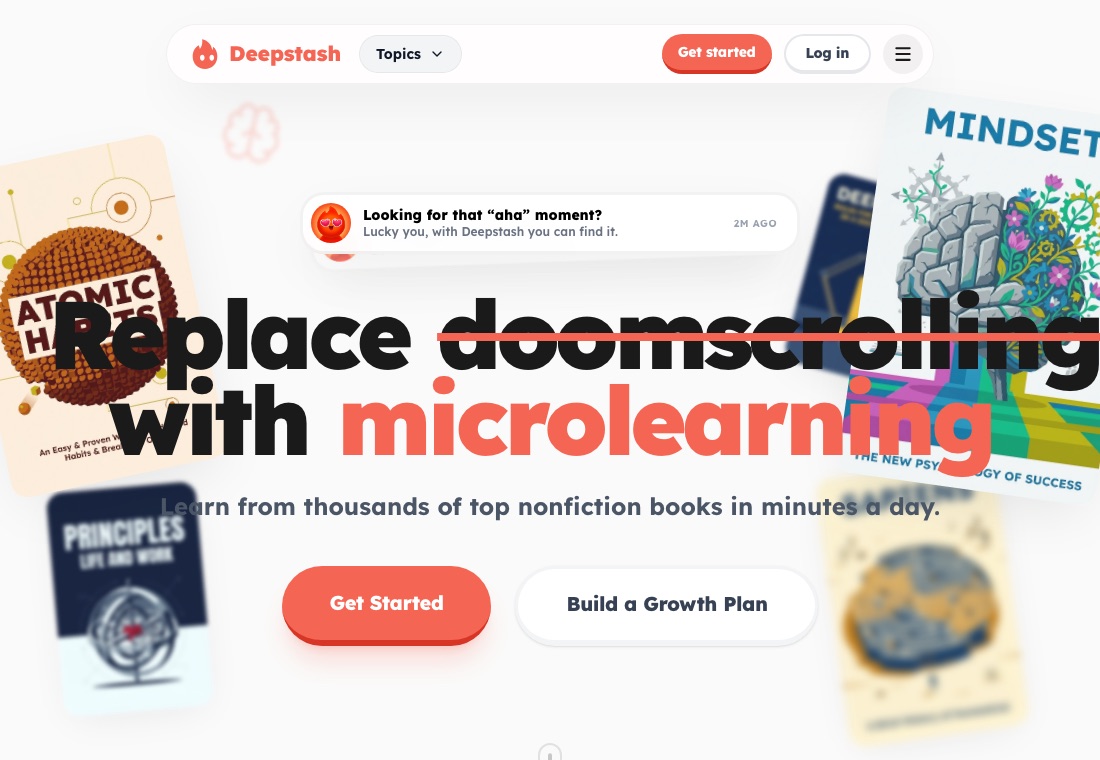
The home page says "Replace doomscrolling with microlearning" and counts more than 10 million downloads, 5,000 books and 200,000 ideas. The App Store listing shows 4.7 from 76,000 ratings and fourth place among free education apps. Google Play shows 4.5 and more than five million downloads. The terms name the operator as Deepstash SRL of Bucharest, a subsidiary of Brainstash Inc., which also makes apps called Paladin, Dilemmo, Empirio and Protocol.
The product has changed. The About page still describes ideas that users cut from articles and podcasts. An App Store reviewer, Malcomxdidit, wrote on February 27 that the loose ideas had given way to "structured book breakdowns". The release notes for the current version mention quizzes and audio.
One card, traced to its book
Deepstash shows the opening of each book summary without a login. I took The Richest Man in Babylon because Clason's book can be read in full at the Internet Archive. Deepstash lists 12 ideas for it. The first is called "The Leaky Coin Pouch":
One skilled chariot builder exposed the flaw in how we handle money. Bansal stared at his calloused hands. He worked from dawn until dusk. Yet his leather coin pouch lay flat on the wooden table. Every Friday brought a heavy bag of copper and silver. He felt rich for exactly two days. Then the baker claimed a share. The landlord took his cut. The tailor demanded payment for new tunics. By Wednesday the pouch felt light again.
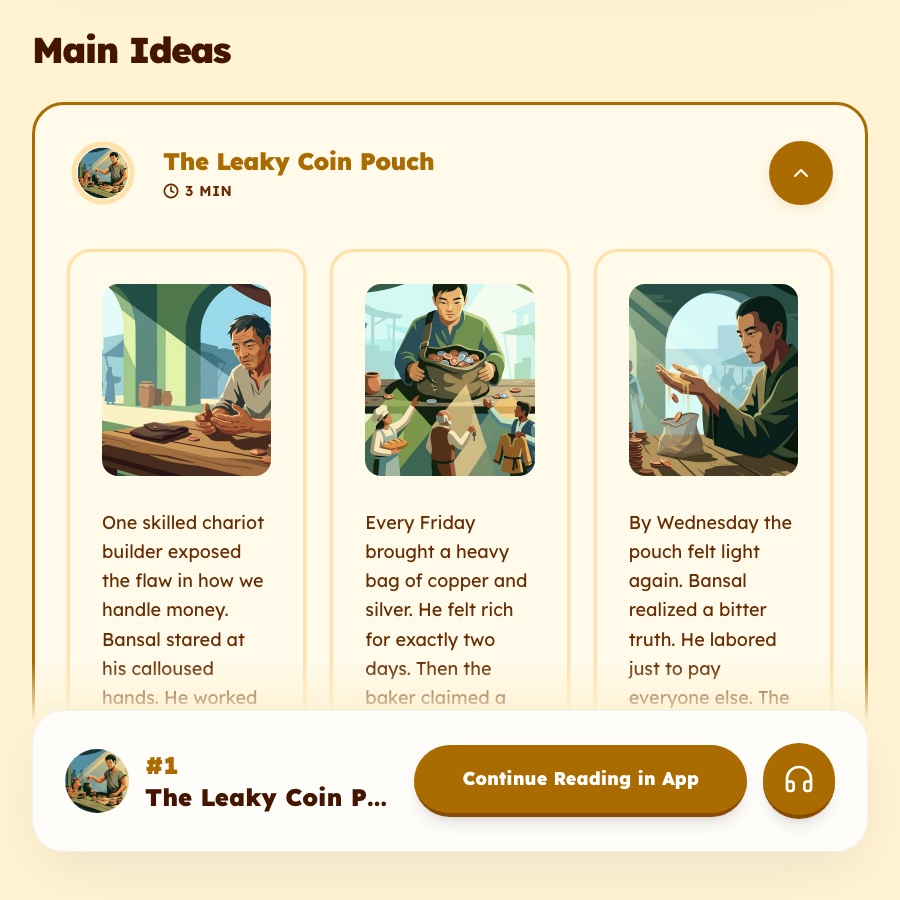
The card keeps the predicament. Clason's Bansir also works "from early dawn until darkness stopped me" and has an empty purse.
It drops the chapter's argument. In the book Bansir is sitting on a wall beside a half-built chariot when his friend Kobbi, a musician, asks to borrow two shekels. Bansir has none. He describes a dream in which his purse was full, and then he asks why the two of them cannot "acquire silver and gold". Kobbi answers with a question: "Might we not find out how others acquire gold and do as they do?" They decide to visit Arkad, a friend who became rich. The chapter is about a man who notices that he has a problem and works out whom to ask. The card reports the poverty and leaves out the question.
It also adds things. I searched the full text. The book has no Friday, no Wednesday, no tailor and no coin pouch, and the baker and the landlord turn up in later chapters. Bansir's wages do not arrive weekly. The name is different. None of this changes the lesson, which Arkad gives later as "Pay yourself first". It does mean the card is a retelling, and a reader who quotes it is quoting Deepstash.
I could see only the first idea. A four-star App Store review by Pegbot0123 on September 25 describes the rest: "the richest man in Babylon has 4 big ideas that are all 'save 10% of everything you earn'".
A second trace was quicker. A Thinking, Fast and Slow page with 165,700 reads has a card that says: "A warm cup in your hands makes you act kind. A picture of eyes makes you act good." The eyes are from Kahneman's chapter on priming. In 2017 Ulrich Schimmack and two colleagues examined the twelve articles that chapter cites, and Kahneman replied in the comments: "I placed too much faith in underpowered studies." The card states the finding as fact. A card has no room for the author changing his mind.
Seven times the searches in a year, and 4,500 ads
Google's keyword data, which I pulled for this blog, puts "deepstash review" at about 2,400 searches a month in September 2025 and about 18,000 in August 2026.
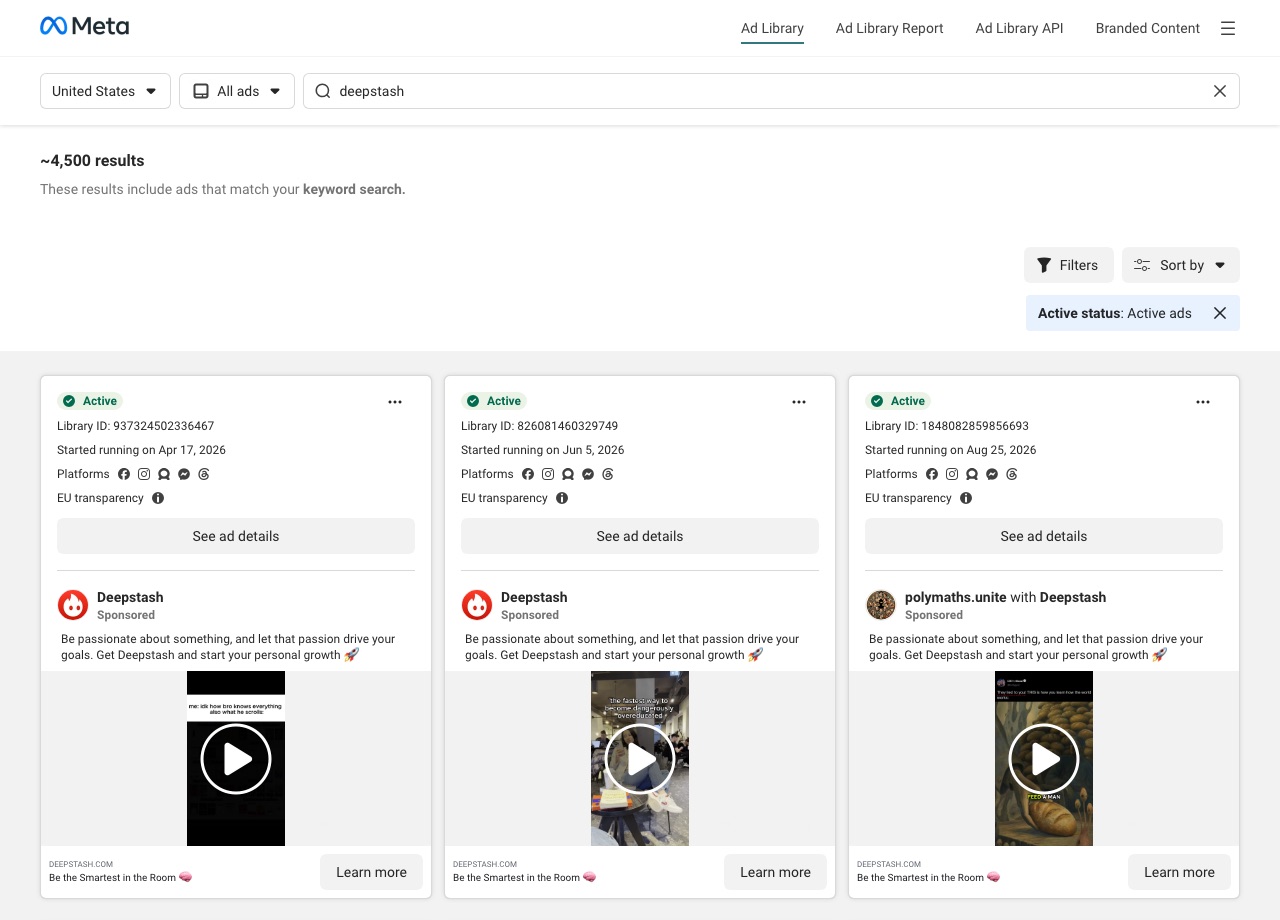
I cannot prove the cause. I can show the advertising. On October 4, Meta's Ad Library returned about 4,500 active ads in the United States for the keyword "deepstash". The 28 that loaded started running between February and September 2026, and most carry the headline "Be the Smartest in the Room".
The reviews point the same way. Of the 150 App Store reviews I read, 21 mention an ad or the marketing, and 10 mention TikTok or Reels by name. Deepstash's own sign-up page displays the quote "TikTok vibes but for smart people."
Price, as far as I could see it
I never reached a checkout, so these are the prices each public page showed me on October 4. The price you are shown may differ.
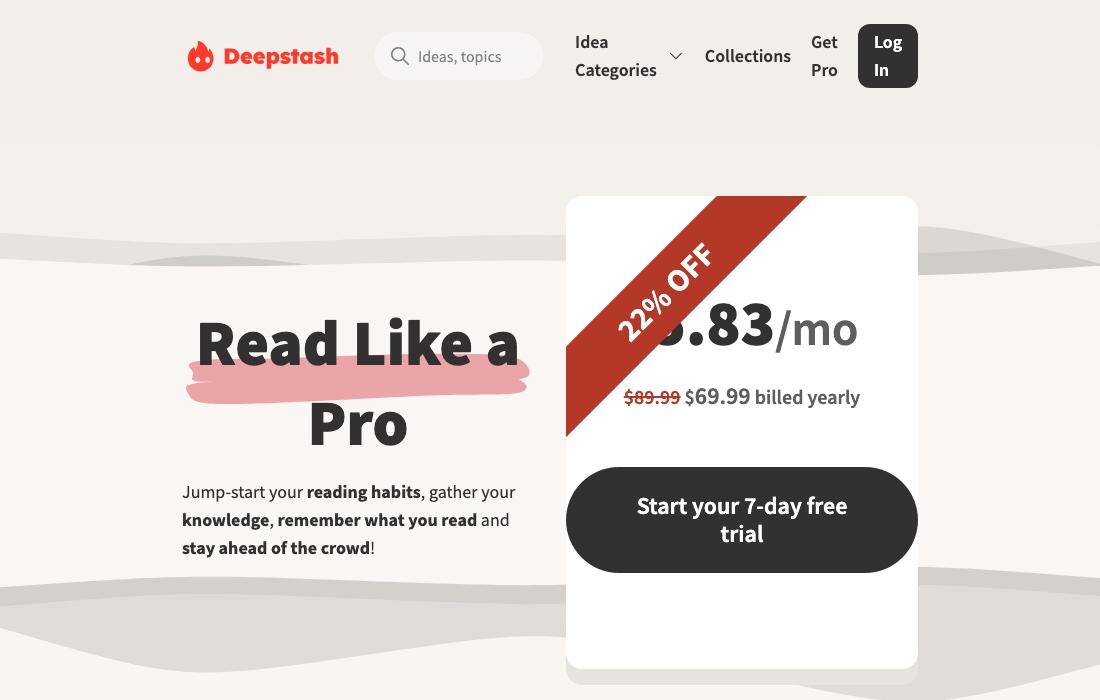
- deepstash.com/get-pro shows $69.99 billed yearly, with $89.99 struck through, after a 7-day free trial.
- The App Store listing shows one in-app purchase, a Pro yearly subscription at $49.99 with a trial.
- The sign-up quiz on the website asked me 33 screens of questions, one of them whether Simon Sinek seemed interesting to me, and then asked for an email address before showing any price. I stopped there.
- Reviewers report other plans. Several describe $69.99 charged when a trial ended. A Google Play review of August 18 describes $20.95 for a Pro trial and then "$49.95 every 3 mo". A reply from Deepstash on Trustpilot confirms a website plan at $19.98 that has no trial and carries a 30-day money-back guarantee.
There is a free version. The Play listing says it includes the ideas and that Pro removes ads and adds audio, offline reading and unlimited history. Twelve of the 150 App Store reviewers wrote that they could not find a way in without starting a trial. Deepstash's reply to one such complaint on Trustpilot was: "Deepstash is free to use, and a Pro subscription is entirely optional."
208 reviews, counted
Reviews come from the angry and the delighted, so read these as what recurs among people who bothered to write. The store averages of 4.7 and 4.5 include every rating ever given. My samples are recent written reviews.
| Sample | Dates in 2026 | Stars | About charges, cancelling or refunds | Ad did not match the app |
|---|---|---|---|---|
| App Store, the 150 newest | Sep 17 to Oct 3 | 72 one, 18 two, 4 three, 6 four, 50 five | 50 | 18 |
| Google Play, the 20 "most relevant" | Jul 9 to Sep 16 | 12 one, 6 two, 1 three, 1 five | 5 | 4 |
| Trustpilot, the 20 newest | Sep 30 to Oct 4 | 2 one, 1 three, 17 five | 3 | 2 |
| Trustpilot, 18 more one-star reviews | Sep 14 to Oct 2 | 18 one | 14 | 3 |
A third of the App Store sample is about money, and a third gave five stars. The sorting is mine, and another reader would move a few reviews between columns.
The happy reviewers say what the home page says. kokonut_kid, after a month: "my thoughts race about what I have read, not what I saw." Separated0905 wrote that "A book can take an entire chapter to get one simple idea across", and Jalani Splash uses it as "a preview determining if the book's worth the buy".
Twelve App Store reviewers called the content shallow, repetitive or machine-written. Boncredible: "Seems useless like subscribing to a newspaper that delivers only headlines." The ad complaints are mostly one complaint. People expected short videos and found text and narration. Deepstash replied to one on Trustpilot on September 19 that "our advertisements are not intended to claim that Deepstash has a video-based interface".
Trustpilot looks different from the stores: 4.4 overall, 77% five-star, and almost all of its 1,732 reviews written in the last 12 months. Trustpilot notes that the company invites its customers to review, and that it has replied to 95% of negative reviews.
Auto-renewal, refunds and cancelling
The complaints in the 72 money reviews fall into a few kinds: charged when a trial ended, charged at a renewal nobody remembered, refund refused, and a subscription that could not be found in Apple's settings.
Deepstash's terms, last updated on September 16, 2026, are plain on the first three. Pro renews automatically. Fees are "non-refundable" except where the law requires otherwise. And on trials: "To avoid being charged, you must cancel the subscription at least 24 hours before the Trial Period ends." The Get Pro page puts it more loosely: "If you are on a trial and you cancel it, you won't be charged." Go by the terms.
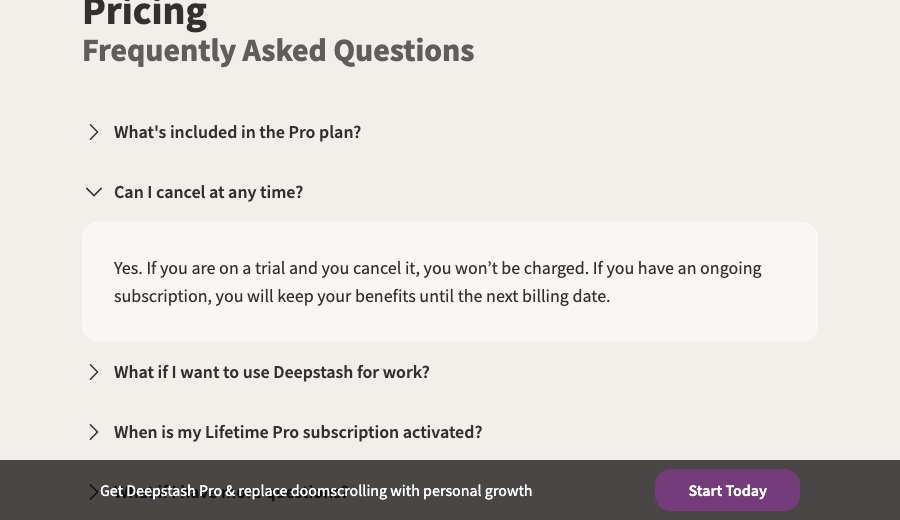
Deepstash answers most one-star reviews on Trustpilot, and its replies give its side. Subscriptions bought on the website "are not managed through Apple", which is why they are missing from Apple's list. It says it sends a push notification and an email two days before a trial converts; several reviewers say they received neither. On refunds, six of the twenty one-star reviewers on Trustpilot describe being offered half their money back, and Deepstash's replies describe the same sequence: the charge is not eligible, free access to its other apps is offered, and then "a 50% refund as a goodwill exception".
I found no help page on cancelling. The terms and the company's replies give this much:
- If you subscribed in the iPhone app, cancel under Subscriptions in your Apple account. On Android, cancel in Google Play.
- If you paid on deepstash.com, cancel inside Deepstash, under Settings and then Manage Subscription. Irishtorrent counted the steps on September 21: "13 clicks later it finally let me cancel."
- Do it more than 24 hours before the trial ends, and keep a screenshot of the confirmation.
- For anything else the only contact given is support@deepstash.com.
The limits of learning from a feed of cards
A summary is the right tool for deciding whether a book deserves ten hours. Deepstash does that with good pictures, and against an hour of short video it is the better hour. My list of learning apps for adults has the other daily-lesson apps.
Reading a card is close to rereading a sentence someone else underlined. In Roediger and Karpicke's experiment, students who reread a passage remembered 42% of it a week later, and students who tried to recall it remembered 56%. Reviewers describe a quiz at the end of each lesson. I have not seen one. One reviewer liked them and another called them "laughable".
The larger gap is between recognising an idea and being able to explain it. Rozenblit and Keil asked students to rate how well they understood devices such as a zipper, then to explain one step by step, then to rate themselves again. The ratings fell from 3.89 to 3.10 out of 7. A card about saving a tenth of your income feels understood on sight. Whether you can say why a tenth, or what Arkad did when his first savings were lost, is a different test, and the card dropped the part of the book that would help. The studies are described in do audiobooks count as reading and alternatives to Audible.
A feed can also only serve what somebody wrote in advance. Most of what I get curious about is technical or odd, and no summary of it exists. Bansir's chapter is the better model of learning: he had a question of his own and went to ask someone who could answer it. David Deutsch's account of knowledge starts from a problem you have, and a feed starts from its catalogue.
If summaries are what you want, I compare the bigger apps in Blinkist vs Headway vs Shortform and review Imprint separately. If the aim is to keep more of what you read, see how to remember what you read.
Understand, and its limits
Understand is a voice chat with an AI tutor that you can interrupt. You ask about whatever you are curious about and it answers directly. When it has explained an idea that is new to you, it asks one question that takes the idea to answer. It draws on a board while it talks, reads a text aloud word for word and stops when you ask something, and talks through the links and PDFs you bookmarked. It keeps a record of the ideas you have shown you understand, which you can read and correct.
It has no library of book summaries and no feed, so for browsing ideas you did not know to ask about, Deepstash is the better choice. It has no courses, no problem sets and no spaced repetition. There is no Android app, and no trial has evaluated it. It is for adults and it is free for now.
Questions people ask
What is Deepstash?
An app and website that turn nonfiction books into short illustrated cards, called ideas, which you read or listen to in a few minutes each.
Is Deepstash worth it?
As a free preview of books, yes. I would not start a paid trial without reading the terms, and I would not expect to be able to explain a book from its cards.
How much does Deepstash cost?
On October 4, 2026 the website showed $69.99 a year after a 7-day trial and the App Store listing showed $49.99 a year. Reviewers also report quarterly plans at $49.95.
Is Deepstash free?
Deepstash says there is a free version with ads and that Pro is optional. Twelve of the 150 App Store reviewers I read said the app asked them to start a trial before they found it.