Blinkist vs Headway vs Shortform vs Imprint vs Deepstash: one chapter in five summary apps
In the first chapter of Thinking, Fast and Slow, Daniel Kahneman stops to tell the reader that System 1 and System 2 do not exist. In the free pages of five summary apps I found that warning nowhere, and one Deepstash card says which part of the brain System 1 occupies. I have not paid for any of the five. This comparison rests on what each company publishes without a login, the store listings, and 99 low-star Trustpilot reviews, all read on 4 October 2026.
For a reader choosing between them, I would pick Shortform for the argument with objections attached, Blinkist for fifteen minutes to decide whether a book deserves ten hours, and Deepstash to pay nothing. Headway does what Blinkist does with a smaller catalogue and a price that doubles after the first period. Imprint is the one to look at if pictures help you.
I build Understand, a voice tutor for adults, and have no connection to any of these companies. I have looked at Deepstash, and on 4 October 2026 I went through Imprint's onboarding as far as its paywall. I saw no paid lesson in either.
The chapter
All five carry Thinking, Fast and Slow, so I took its first chapter, "The Characters of the Story". Scientific American published the chapter with permission in 2012. It runs to about 4,100 words by my count.
The claim is that the mind works in two modes. System 1 is automatic and fast. System 2 is effortful and slow, and it is the one we identify with.
The evidence is a series of demonstrations done on the reader. You see a photograph of an angry woman and know her mood without deciding to. You are asked to multiply 17 by 24, and Kahneman reports that your pupils dilated while you tried. He describes the film by Christopher Chabris and Daniel Simons in which a woman in a gorilla suit crosses a basketball court, and "about half" of viewers counting passes do not see her.
The objection is Kahneman's own, under the heading "Useful fictions":
System 1 and System 2 are so central to the story I tell in this book that I must make it absolutely clear that they are fictitious characters. [...] And there is no one part of the brain that either of the systems would call home.
He adds that he chose "System 1" over "automatic system" because the shorter name takes less room in working memory. The summary apps took the hint further than he meant.
Five public versions of it
Only one of the five shows its full treatment of this chapter for free. The rest are previews, and I say which below.
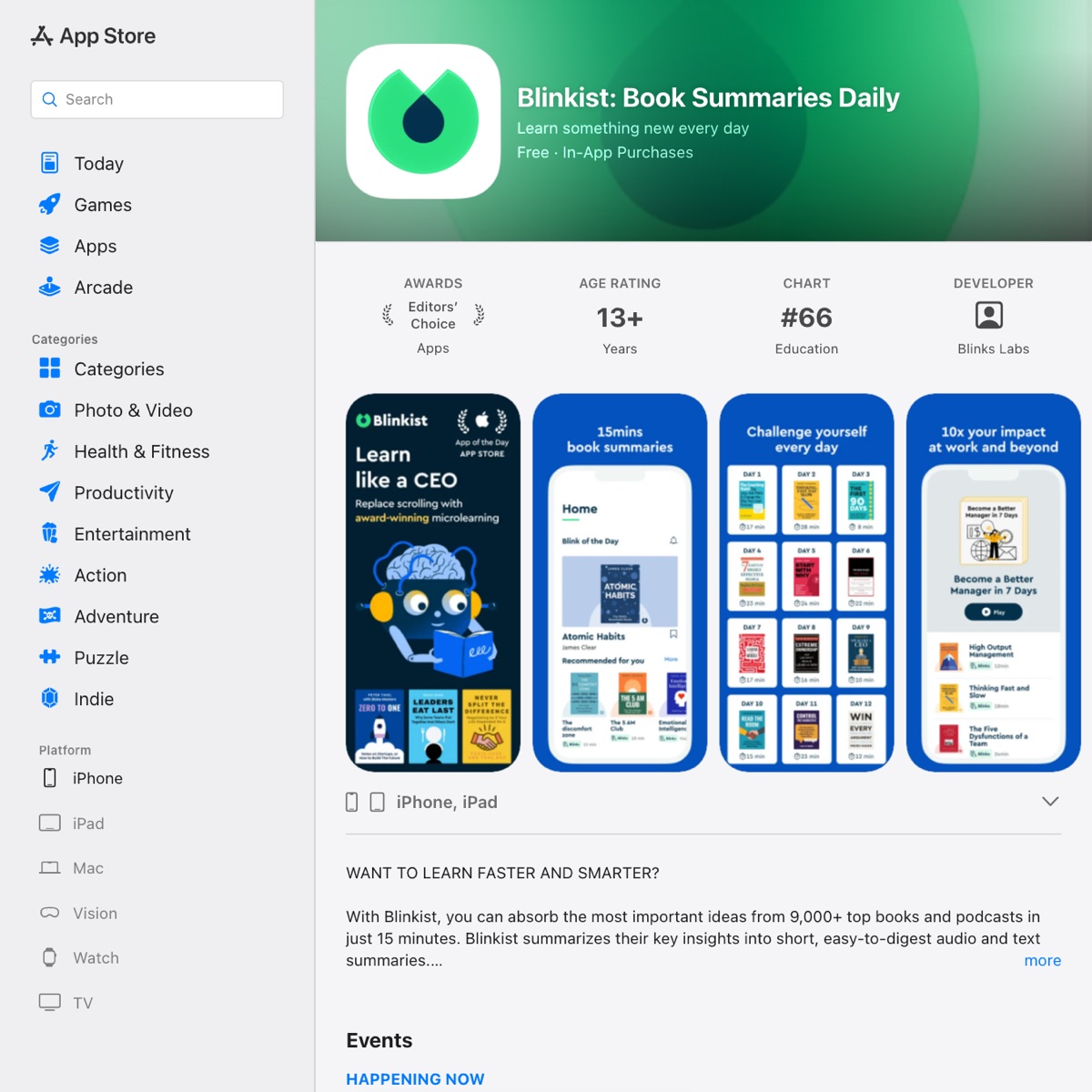
Blinkist's public page for the book lists 12 key ideas and 28 minutes. Key idea 1 is open in full, 285 words. The other eleven show two or three paragraphs and a link marked "Unlock the full key idea". The claim is there. The evidence is two everyday cases from Kahneman's own lists, turning toward a loud sound and looking for a woman in a crowd. No experiment survives. The caveat is gone, and the text reads "System 1 is the part of our brain that operates intuitively and suddenly". This one is a full summary of the chapter's idea, at 7% of the chapter's length.
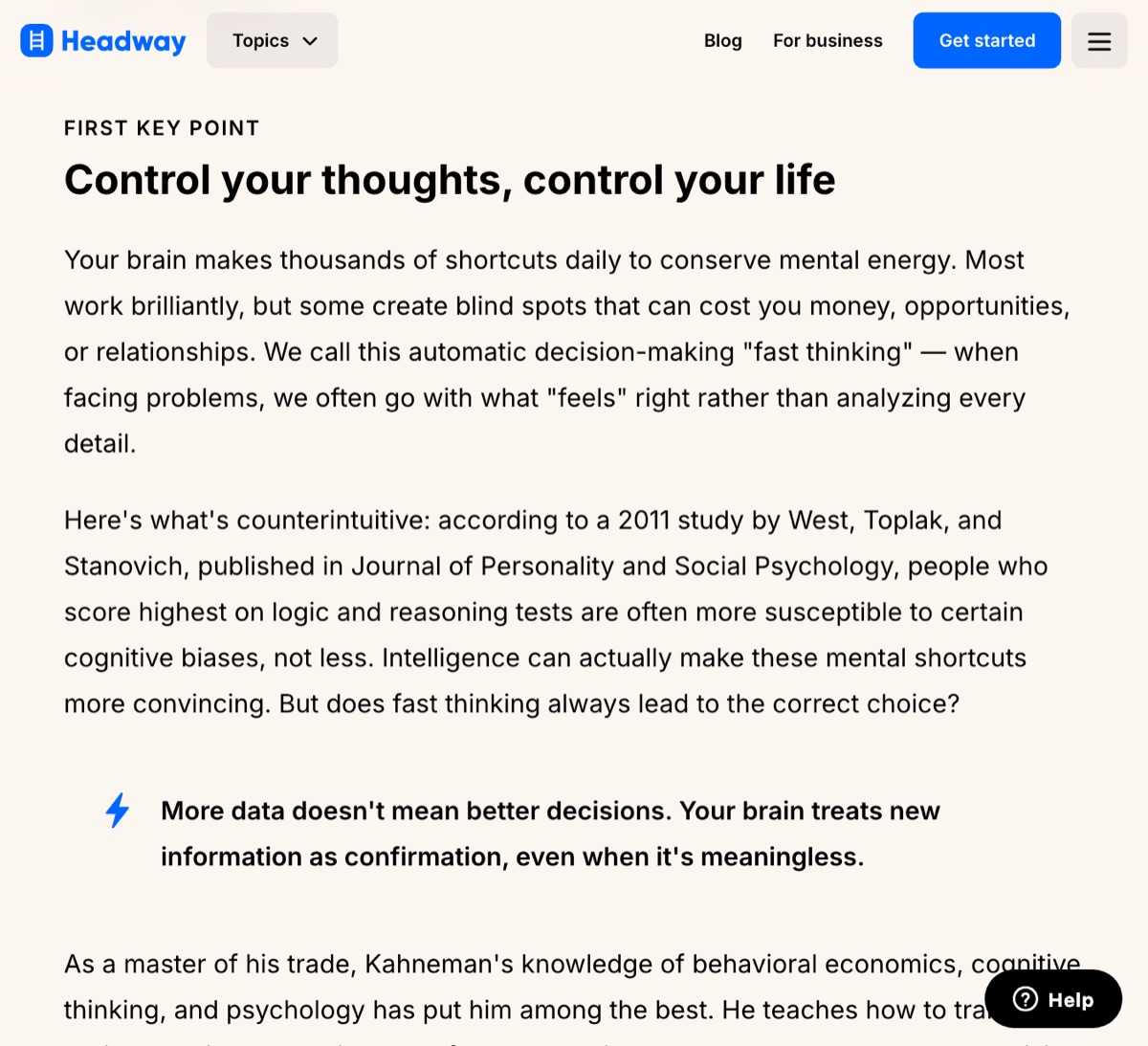
Headway's public page gives 12 minutes for the whole book. The first key point is open, 178 words, and the second runs 355 words before the page says "Full summary is waiting for you in the app". It is a preview. The claim is there, credited to Keith Stanovich and Richard West, whose terms Kahneman says he adopted. So are two of his examples, 2 + 2 and 17 × 24. It also says "System one handles about 95% of your daily decisions". The chapter contains no such figure and the page gives no source for it.
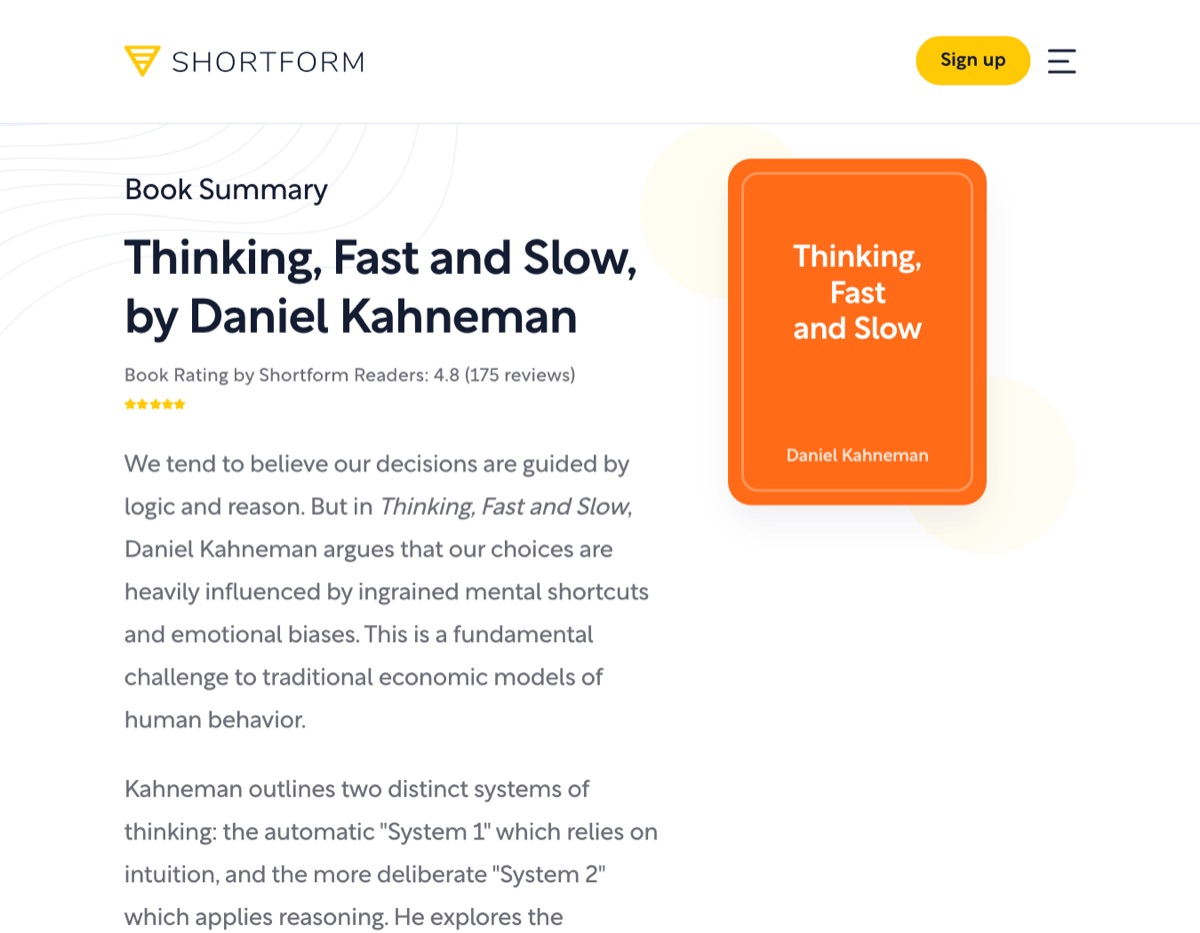
Shortform's public summary page shows 180 words of its two-systems section before the sign-up prompt, and a longer excerpt on its blog runs 1,332 words before "End of Preview". Both are previews. Shortform is the only one of the five that prints an objection. A note on the summary page says some psychologists consider the two-system model an oversimplification and links Keren and Schul's 2009 paper, "Two Is Not Always Better Than One". The blog excerpt carries three more notes that connect Kahneman to other books. Kahneman's own caveat is not in either preview.
Deepstash's site answered my browser with a bot check, so I read the Wayback Machine's copy of its book page from 16 April 2026. The page holds sets of cards written by users. The first set has 37 ideas and 589,400 reads, and three cards of each set are visible before "Sign up to read for FREE". It is also a preview. The two cards on the two systems are 84 and 72 words. Neither gives evidence. One says: "System 1 comprises the oldest parts of the brain", and that System 2 "is a newly evolved part of the brain". Kahneman wrote the opposite sentence.
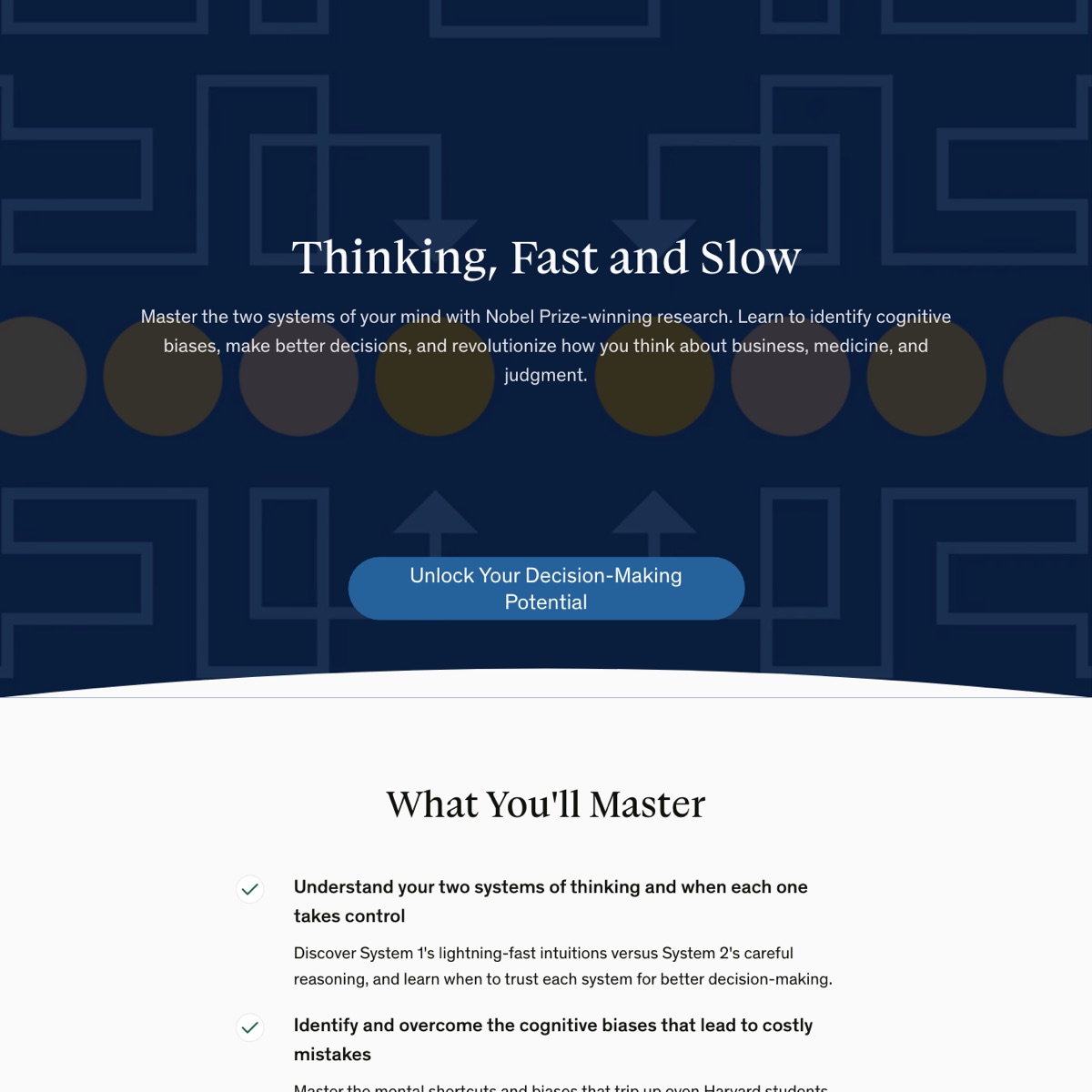
Imprint's course page shows no lesson at all. It has 278 words describing what the lessons will do, including "revolutionize how you think about business, medicine, and judgment". Imprint's lessons are pictures, and I cannot judge pictures I have not seen.
Across the four with text, the pattern is the same. The claim survives every time. The experiments are replaced by an everyday example. The author's warning about his own metaphor is dropped, and once reversed.
One citation, traced
Headway's first key point adds a study that is not in the chapter. It says that "according to a 2011 study by West, Toplak, and Stanovich, published in Journal of Personality and Social Psychology", people who score highest on reasoning tests "are often more susceptible to certain cognitive biases, not less".
PubMed has two papers that fit halves of that sentence. Toplak, West and Stanovich (2011) appeared in Memory & Cognition and is about the Cognitive Reflection Test. West, Meserve and Stanovich (2012) appeared in the Journal of Personality and Social Psychology. Its abstract reports that the bias blind spot, the habit of seeing bias in others more readily than in oneself, was not reduced by cognitive ability: "If anything, a larger bias blind spot was associated with higher cognitive ability."
So the finding is roughly real and narrower than Headway states it. The authors and year belong to one paper, the journal and result to another. PubMed lists one 2011 paper by those three authors, and it is the Memory & Cognition one. I read both abstracts and neither full paper. The 2012 paper went online in June 2012, which would have made it hard to cite in a book published in 2011.
A subscriber cannot check this from inside a 12-minute summary, and has no reason to try.
Format, price and ratings
Prices are US, seen on 4 October 2026. The App Store's in-app purchase list mixes current and older items, and each company can show a different price at checkout than the one I saw.
| Blinkist | Headway | Shortform | Imprint | Deepstash | |
|---|---|---|---|---|---|
| Format | Text and audio | Text and audio | Text guides with audio narration | Illustrated lessons you tap through, with quizzes | Text cards with artwork; audio on Pro |
| Length, as stated | "15 minutes"; this book, 28 | "less than 15 minutes"; this book, 12 | A one-page summary plus a chapter-by-chapter guide; no length given | "a chapter in two minutes or less" | "5 minutes a day" |
| Catalogue, as stated | 9,000+ books and podcasts (App Store); 7,500+ (Google Play) | 2,500+ (its site); 1,700+ (App Store) | 12,000+ books (its site); 10,000+ (Google Play) | Not stated; its sitemap lists 165 course pages | 200,000+ ideas (App Store) |
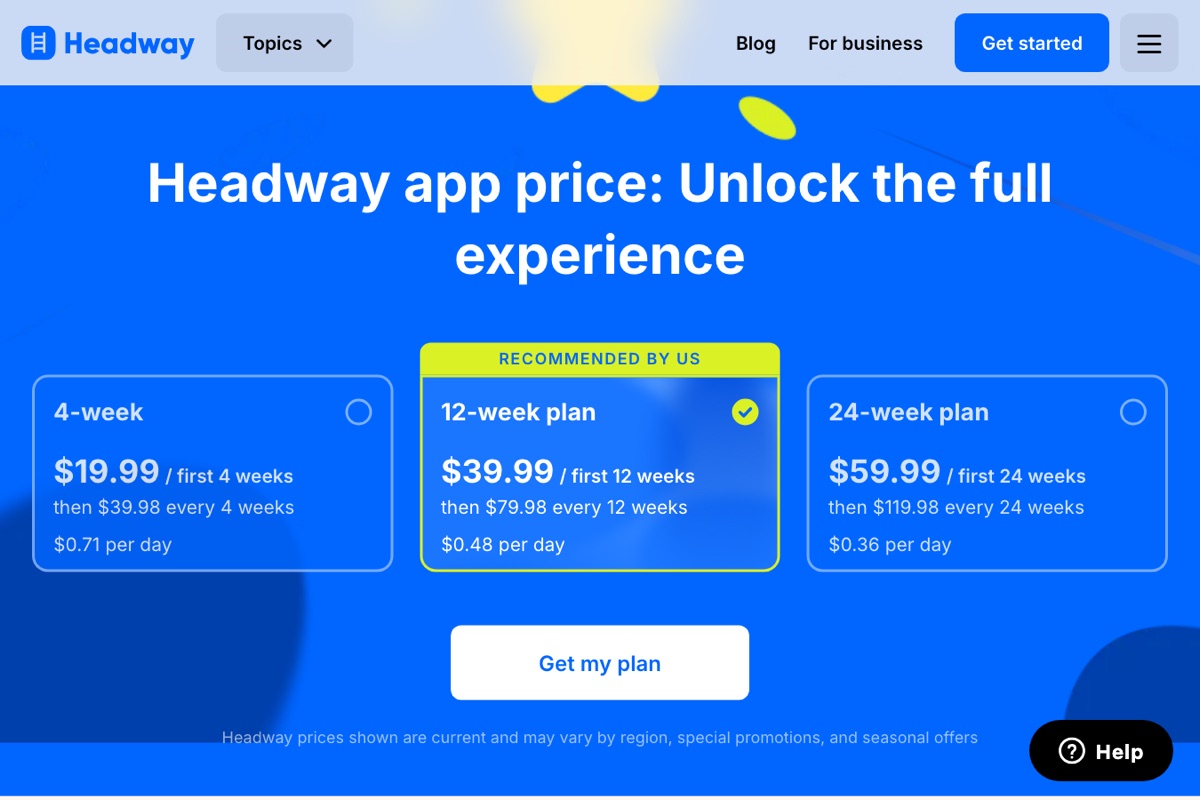
| Price seen | $15.99 a month, $99.99 a year (App Store list). Its pricing page showed my browser a bot check | $19.99 for the first 4 weeks, then $39.98 every 4 weeks (its site) | $24 a month, or $197 a year (its site) | $15.99 a month, $99.99 or $74.99 a year (App Store list). At the paywall I saw a cheapest plan of $12 a month | Pro at $49.99 a year (App Store listing); the list also has $12.99 and $19.99 monthly items |
| Free tier or trial | One free summary a day (App Store); 7-day trial (Google Play) | Free trial; charged unless cancelled 24 hours before it ends (App Store) | Free trial on both plans (its site); 5 days per Google Play | No trial at the paywall I saw, and a money-back guarantee. Reviewers describe a 7-day trial | Free with ads; Pro is optional (App Store) |
| App Store | 4.8 from 156,392 | 4.6 from 117,139 | 4.6 from 1,407 | 4.8 from 56,704 | 4.7 from 75,506 |
| Google Play | 4.6 from 177K | 4.5 from 176K | 4.3 from 1.27K | 4.5 from 13.2K | 4.5 from 187K |
| Trustpilot | 4.3 from 1,538 | 3.9 from 6,645 | 4.3 from 1,002 | 1.7 from 26 | 4.4 from 1,732 |
Shortform costs the most and shows the most for it in this test. Blinkist's own book page lists other titles at 17 to 29 minutes, so "15 minutes" is a floor. If the question is Audible versus Blinkist, they are different products, a whole book read aloud against a summary of it, and I compare the audiobook services in the post on Audible alternatives.
The low-star reviews
Store ratings are high for all five. On Trustpilot I filtered each company to one and two stars and read the first page: 20 reviews each for Blinkist, Headway, Shortform and Imprint, 19 for Deepstash. That is 99 reviews, dated January 2025 to October 2026, chosen to find the commonest complaint. Reviews skew to the angry and the delighted, and these are the angry ones. Trustpilot's own split has 59% of Blinkist's reviews at five stars and 29% at one.
The commonest complaint is the same for all five, and it is about billing.
- Blinkist: 18 of 20 concern auto-renewal, cancelling or a refused refund. One title, from 27 May 2026: "Business dependent on people forgetting about subscription renewal." Blinkist replied to a similar review on 7 May 2026: "We do provide partial refunds as long as you contact within 14 days."
- Headway: 3 of the 20 are about a trading broker with the same name. Of the other 17, 16 describe charges after cancelling or subscriptions the reviewer did not know they had bought. Its App Store listing says you will receive a reminder before a free trial ends.
- Shortform: 12 of 20 are about charges, renewals or refunds, and 5 say the content is not worth the price. Shortform replied on 9 December 2025: "Our free trial automatically converts to a paid subscription unless canceled before the end of the trial period, as noted at signup."
- Imprint: 2 of the 20 are about a credit card company of the same name. Of the other 18, 15 describe being charged after a trial or after cancelling. One, from 2 August 2025, is titled "So hard to cancel" and begins "So easy to subscribe". The profile is unclaimed and I saw no company replies.
- Deepstash: 9 of 19 are about renewals and refunds. Another 5 say the app is not the TikTok-like feed its ads showed. From 3 October 2026: "The sale pitch that Deepstash is somehow like TikTok is untrue." Deepstash replied to one on 20 September 2026 that it "is free to use, and a Pro subscription is entirely optional".
Whichever you choose, put the trial's end date in your calendar and keep the cancellation email. The single-app reviews read 50 or more reviews per app, praise included: Blinkist, Headway, Imprint and Deepstash.
The right job for a summary
A summary is the right tool for deciding whether to read the book. One Blinkist reviewer on Trustpilot put it well on 22 January 2026: "Great for sampling topical books to decide if they're worth a full read". Fifteen minutes to rule out a ten-hour book is a good trade.
It is the wrong tool for understanding the book, and the chapter above shows why. Each version left me able to say "there are two systems". None gave me what I would need to answer someone who replied that System 1 is the old part of the brain. Kahneman's answer to that is in the paragraph every summary cut.
Rozenblit and Keil (2002) asked Yale students to rate how well they understood devices such as a zipper, then to write out how one works, then to rate themselves again. The average fell from 3.89 to 3.10 on a 7-point scale. A summary produces the first rating. I go through that evidence in the post on whether audiobooks count as reading.
If the summary says the book is worth it, read the book. Adler's How to Read a Book is a manual for doing that with a hard one.
Lessons written in advance
All five apps sell lessons that someone wrote before you arrived: this book or that one. Deepstash, when I looked at it, was closer to a TikTok for book summaries, and nothing in it was interactive. What Imprint showed me before its paywall looked like a pretty flashcard app for book summaries.
Most of what I get curious about has no summary. It is a technical question that came up at work, or something odd I noticed on a walk. A feed can only serve what was written in advance, and a summary cannot be asked why.
Understand
Understand is a voice chat with an AI tutor that you can interrupt. It answers directly. When it has explained an idea that is new to you, it asks one question that takes the idea to answer, and builds on what you say. It draws on a board while it talks. It reads a text aloud word for word and stops when you ask a question, and it talks through the links and PDFs you bookmarked. It keeps a record of the ideas you have shown you understand, which you can read and correct.
It has no catalogue of summaries, so it will not tell you in fifteen minutes whether a book is worth reading. Blinkist or Shortform will. It has no courses, no problem sets, no spaced repetition and no Android app, and no trial has evaluated it. It is for adults, and it is free for now.
I would use a summary app to choose the book, and something I can ask once I am reading it.