How to get smarter as an adult: what raises IQ, what doesn't, and what to do with 30 minutes a day
The reliable way to get smarter as an adult is to learn more things and understand them properly, and that works at any age. Raising the raw reasoning that IQ tests try to measure is much harder, and the brain-training games sold for that job make you better at the games and at very little else.
In 2010 a BBC science programme ran the biggest test of brain training anyone had done. More than eleven thousand viewers trained online for six weeks. A control group spent the same sessions answering obscure general-knowledge questions with the help of the internet, and on the reasoning tests at the end they did about as well as the people who trained.
I build Understand, a voice tutor for adults, and before that I built RemNote, a flashcard app. I have no connection to Lumosity, the BBC or any of the researchers. I read the papers below in full unless I say I read only the abstract.
Two kinds of smart
Psychologists split intelligence into two parts. Raymond Cattell named them in 1963, and John Horn and Cattell developed the idea in 1967. Fluid intelligence is, in one standard definition, "the ability to reason and to solve new problems independently of previously acquired knowledge". Crystallised intelligence is what you know: words, facts, methods, explanations.
The two age differently. Joshua Hartshorne and Laura Germine tested 48,537 people online and reanalysed the norms of the Wechsler intelligence tests. Some abilities peaked "around high school graduation", some in the 30s, and others "not until the 40s or later". Digit-symbol coding, a test of processing speed, peaked in the late teens. Vocabulary peaked around 65 in the web data and around 50 in the older Wechsler norms, a gap the authors put down partly to more recent generations learning words for longer. The data are cross-sectional: different people at each age, not the same people followed through life.
So when a 30-year-old asks how to become smarter, there are two questions. Their speed and working memory are about as good as they will get. Their knowledge can grow for another 35 years, and most advice worth taking is about the knowledge.
Brain training makes you better at brain training
The BBC study was run by Adrian Owen and colleagues with the programme Bang Goes the Theory, and published in Nature. Of 52,617 adults aged 18 to 60 who signed up, 11,430 finished. One group trained on reasoning and planning tasks and one on a broader mix. Sessions lasted about ten minutes and people did 24 of them on average.
Both training groups got much better at what they practised, with effect sizes between 0.72 and 1.63, which are large. On the benchmark tests they had not practised, the differences between the training groups and the controls ranged from 0.01 to 0.22, and the control group had improved on all four. The authors wrote that "no evidence was found for transfer effects to untrained tasks, even when those tasks were cognitively closely related."
The obvious objection is dose: about four hours of training in all, by volunteers, most of whom quit. In 2014 more than 70 scientists signed a letter saying brain games did not offer a scientifically grounded way to improve cognition, and 133 scientists and practitioners signed a reply saying the literature was full of benefits. Daniel Simons and colleagues then reviewed every study the companies and the reply cited for Psychological Science in the Public Interest. They found "extensive evidence that brain-training interventions improve performance on the trained tasks, less evidence that such interventions improve performance on closely related tasks, and little evidence that training enhances performance on distantly related tasks or that training improves everyday cognitive performance." Many of the studies had "major shortcomings in design or analysis", and none followed all the practices the reviewers thought necessary.
On January 5, 2016 the Federal Trade Commission announced that Lumos Labs, the maker of Lumosity, would pay $2 million to settle charges that it "deceived consumers with unfounded claims" about its games. The ads had told users to play 10 to 15 minutes three or four times a week. Jessica Rich, then head of the FTC's Bureau of Consumer Protection, said the company "simply did not have the science to back up its ads." Lumosity told Megan Rose Dickey of TechCrunch the next day that "neither the action nor the settlement pertains to the rigor of our research or the quality of the products," that it was "a reflection of marketing language that has been discontinued", and pointed to a randomised trial of its programme published in PLOS One.
Dual n-back, which wikiHow's guide to getting smarter recommends, has the same history. You follow two sequences at once, one seen and one heard, and respond whenever an item matches the one a set number of steps back. In 2008 Susanne Jaeggi and colleagues reported in PNAS that training on it raised fluid intelligence scores, and that more training raised them more. Monica Melby-Lervåg, Thomas Redick and Charles Hulme pooled 87 publications with 145 comparisons in 2016. Working memory training improved working memory tests, and against a control group that also did something, there was "no convincing evidence" of gains in reasoning, verbal ability, reading or arithmetic. Giovanni Sala and Fernand Gobet found the same for chess and music lessons in children: small to moderate effects that shrank as the studies got better, and they concluded that "far transfer of learning rarely occurs." I read only the abstracts of these three.
School is the one that moved IQ
The intervention with good evidence is the oldest one. Stuart Ritchie and Elliot Tucker-Drob meta-analysed studies that could separate the effect of schooling from the fact that brighter children stay in school longer. Some controlled for IQ measured before the extra schooling. Some used changes in the school-leaving age, which kept whole cohorts in school a year longer whatever their ability. Some compared children born just either side of a school-entry cutoff. Across 142 effect sizes from 42 datasets and more than 600,000 people, a year of education added about 1 to 5 IQ points. The effects showed up on every broad kind of ability they looked at and persisted across the life span. They call education the most consistent and durable method yet found for raising intelligence.
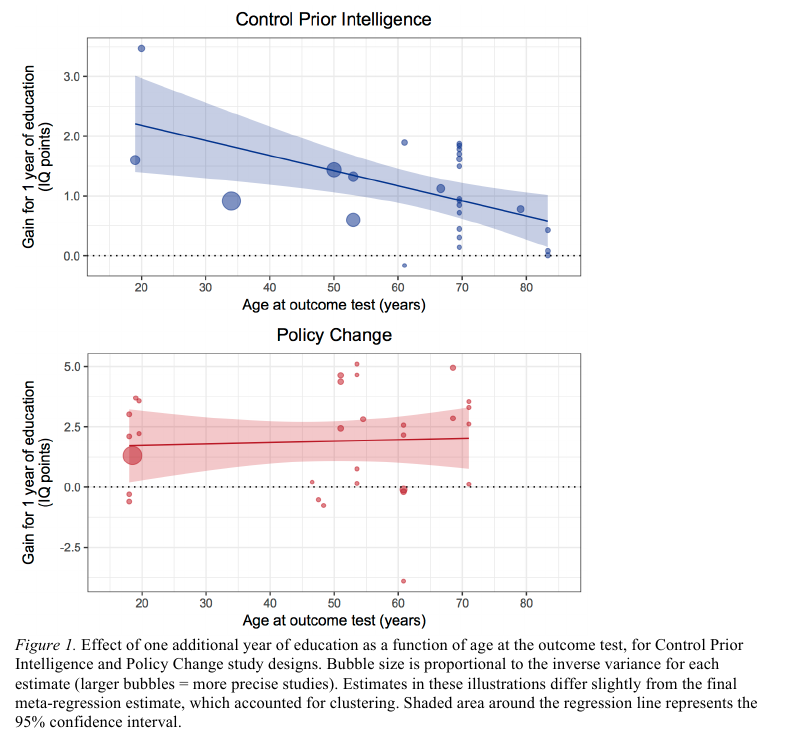
This is the strongest result in the post and it is less use to a reader than it looks. The extra years in these studies came in childhood and adolescence. In the design that controlled for earlier IQ, the gain was smaller the older people were when tested, as the top panel shows. Nobody has measured what a year of evening reading does for a 35-year-old's IQ, and I would not promise points.
The other big movement in IQ was the Flynn effect. James Flynn collected data from 14 nations in 1987 and found gains of 5 to 25 points in a single generation, largest on the tests meant to be free of culture. His conclusion was that IQ tests measure "a correlate with a weak causal link to intelligence". In Norway the rise later turned into a decline, and Bernt Bratsberg and Ole Rogeberg showed with military conscription scores for Norwegians born from 1962 to 1991 that both the rise and the fall happened within families, between siblings. So the causes were environmental, and since nobody yet knows which part of the environment did it, there is nothing here to buy. I read the abstracts of both.
Sleep and exercise protect what you have
Sleep is the clearest case of something that lowers your thinking without you noticing. Hans Van Dongen and colleagues kept 48 healthy adults aged 21 to 38 in a lab and gave them 4, 6 or 8 hours in bed a night for 14 days, against a fourth group kept awake for three nights. Six hours a night for two weeks produced deficits equal to up to two nights without any sleep. The authors wrote that the subjects seemed "largely unaware" of their declining performance. Julian Lim and David Dinges pooled 70 studies of up to 48 hours without sleep and found the largest effect on simple attention and the smallest on reasoning accuracy. I read both abstracts.
Exercise is contested. A 2025 umbrella review in the British Journal of Sports Medicine by Ben Singh and colleagues pooled 133 systematic reviews covering 2,724 trials and found that exercise improved general cognition by 0.42 of a standard deviation, with larger effects in children. But 94 of the 133 reviews were rated critically low in quality, and the benefits were larger in the weaker reviews. A 2023 umbrella review in Nature Human Behaviour by Luis Ciria and colleagues took only randomised trials in healthy people, about 100 of them. The effect was 0.22, fell to 0.13 once they accounted for whether the control group did anything and for differences at baseline, and fell to 0.05, with a confidence interval running below zero, after correcting for publication bias. Walk because it is good for you. The case that it will make a healthy 30-year-old sharper is weak.
| Intervention | Study | Sample | Result | Main limit |
|---|---|---|---|---|
| Online brain games | Owen et al. 2010 | 11,430 UK adults, 6 weeks | Large gains on trained tasks; 0.01 to 0.22 on untrained ones | About four hours of training; volunteers |
| Working memory training | Melby-Lervåg et al. 2016 | 87 publications | Gains on working memory tests only | Mixed ages and programmes |
| Extra schooling | Ritchie and Tucker-Drob 2018 | Over 600,000 people, 42 datasets | 1 to 5 IQ points per year | Mostly young people; no randomised trials |
| Exercise, all groups | Singh et al. 2025 | 2,724 trials | 0.42 SD on general cognition | 94 of 133 reviews critically low |
| Exercise, healthy adults | Ciria et al. 2023 | About 100 trials | 0.22, then 0.05 after bias correction | Healthy people only |
| Six hours in bed | Van Dongen et al. 2003 | 48 adults, 14 days | Deficits up to two nights of no sleep | Lab setting, two weeks |
Knowing more is the part you control
Knowledge makes the next piece of knowledge cheaper. Keith Stanovich and Anne Cunningham tested 268 college students and found that how much they read predicted how much they knew across many subjects, even after controlling for high school grades, a reasoning test, a reading comprehension test and a maths test. It is a correlation. Donna Recht and Lauren Leslie had 64 junior high students read an account of half an inning of baseball. Knowing baseball improved every measure of what they remembered, and it helped poor readers as much as good ones. I read the abstracts of both.
Knowledge is also where most people overrate themselves. In Leonid Rozenblit and Frank Keil's study, 33 Yale undergraduates rated how well they understood things like a zipper or a helicopter on a 7-point scale, at 3.89 on average. After writing out how each worked, they rated themselves 3.10. After answering a question that needed the mechanism, such as how a helicopter goes from hovering to flying forward, they rated themselves 2.49. Independent raters who read their explanations scored them at about the level of the later self-ratings.
That helicopter question is my test for having understood something. David Deutsch argues in The Beginning of Infinity that all progress "has resulted from a single human activity: the quest for what I call good explanations". A person who holds good explanations of how vaccines, interest rates and engines work can reason about cases nobody showed them. In ordinary life, I think that is most of what people mean when they call someone smart.
Study methods that hold up
John Dunlosky and four colleagues rated ten study techniques in 2013. Testing yourself and spreading study out over time were the only two rated high. Rereading and highlighting, which students report relying on, were rated low. Self-explanation, where you stop to say how a new sentence connects to what you already know, was rated moderate: it helped across ages and subjects, but its durability had not been shown and it has "nontrivial time demands."
The best-known testing study, by Roediger and Karpicke, found that students who recalled a passage from memory remembered 56% of it a week later, against 42% for students who read it again. I go through these studies in how to remember what you read, and argue there that for most adult reading, understanding a few ideas matters more than keeping all of them.
Thirty minutes a day
Most people asking this question have a commute, a lunch break or an evening, and no exam. I would split half an hour like this.
- Fifteen minutes of audio on the commute or a walk, about one subject: a whole book on it rather than a feed of episodes on everything. For following an argument, listening does about as well as reading, as I set out in the audiobooks post.
- Ten minutes of a hard book, a few pages at a time with the pen down. A hard book is one where you have to stop and work out what a paragraph means. Adler's How to Read a Book is the best guide I know to reading one.
- Five minutes of conversation. Close the book and explain the one idea you found most interesting to someone, then let them ask you about a case the author did not cover. If nobody is around, say it aloud and write down the question you could not answer.
- Keep eight hours in bed. In Van Dongen's study, six hours a night for two weeks was enough to fall behind.
Fifteen minutes of audio a day is about 90 hours a year. At 150 words a minute that is around 800,000 words, roughly ten long nonfiction books, and the reading time calculator will do the sum for any book. The people in the BBC study trained for about four hours.
The conversation is the easiest part to skip and the one I would keep if I had to drop two. It is the explain-then-diagnose sequence from Rozenblit and Keil, and it is a recall test of the kind Dunlosky rated high. It also tells you which explanation you are missing, which reading alone does not. Nobody has run a trial of this plan, and I do not expect it to move an IQ score by much. I expect it to leave you, a year from now, able to explain several subjects you cannot explain today.
Best learning apps for adults compares the apps, and I have reviewed Duolingo and Brilliant separately. A chatbot can do the explaining for you so completely that you learn nothing, and the post on cognitive debt has the studies on that.
The strongest objection
Knowledge is a different thing from intelligence, the objection goes, and someone who has read a hundred books can still reason badly about the hundred-and-first. That is true, and reasoning tests try to leave knowledge out. If what you want is a higher score on one, Jaeggi's own paper notes that practising the test itself raises it, and I have nothing better to offer.
The evidence gives the objection less room than it seems to, though. The one intervention that has raised scores across the board is a year of school, and school is mostly a year of learning things and being tested on them. I read that as saying general ability grows, where it grows at all, out of learning specific things. That is my reading, and the studies were not designed to test it.
Understand
Understand is built for the conversation part. It is a voice chat with an AI tutor that you can interrupt, so you can ask about the paragraph that lost you on the train. It answers directly. When it has explained an idea that is new to you, it ends on one question that takes the idea to answer, such as predicting a case it did not cover, and builds on what you say. It draws on a board while it talks, reads an article or PDF aloud word for word and stops when you ask something, and can talk through the links and PDFs you have bookmarked.
It also keeps a record of the ideas you have shown you understand, written from your answers in conversation. An idea counts as something to build on only after you have shown it in two different contexts. You can read the record and correct it.
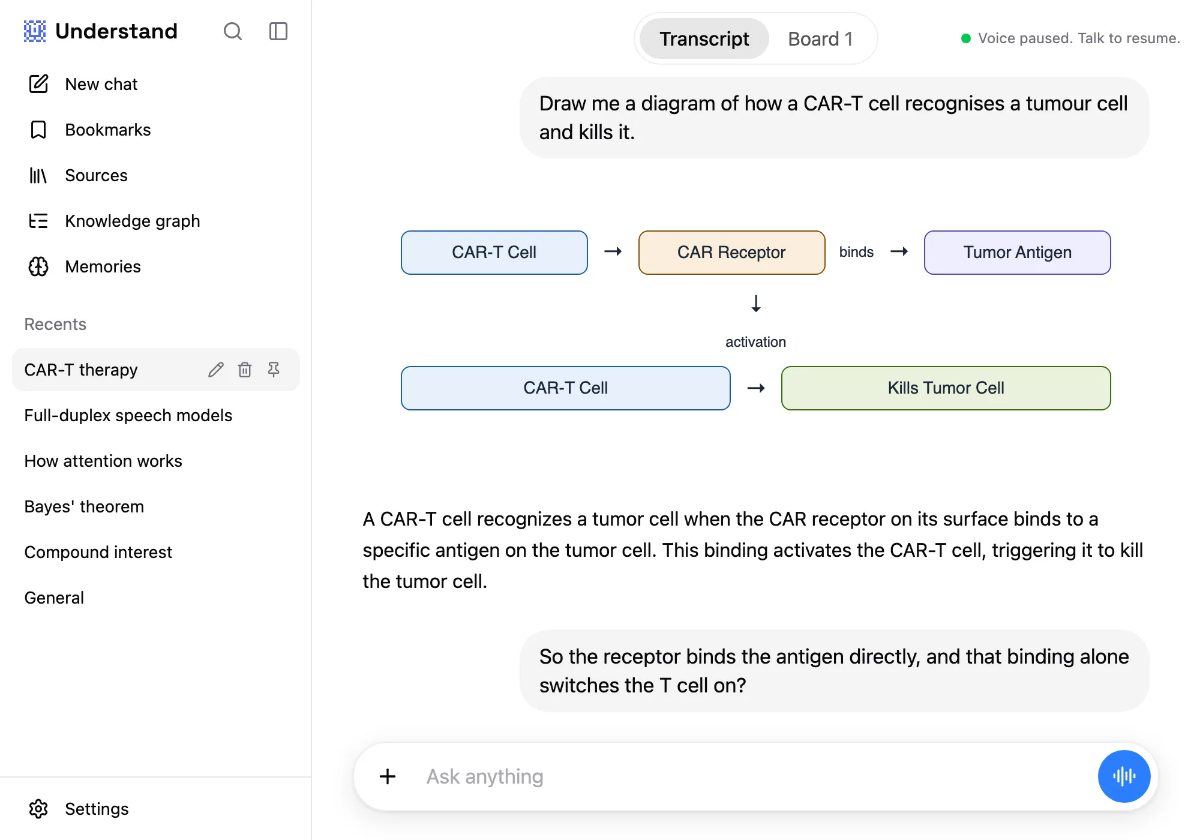
It has no courses, no problem sets, no spaced repetition and no Android app, and no trial has evaluated it. If you need to memorise vocabulary or pass an exam, a flashcard program is the better tool. Understand is for adults, and it is free for now.