Does Duolingo work? The studies and the skill they leave out
Duolingo's researchers tested 340 adults who had worked through seven units of Spanish or French with no other course, and those adults read and understood speech about as well as university students after five semesters. So yes, Duolingo works for reading and listening, and the same paper says "Learners were not assessed in speaking" or writing.
The median learner in that study needed 203 hours to get there. At fifteen minutes a day that is 812 days, a streak of more than two years.
I build Understand, a voice tutor for adults, and I have no connection to Duolingo. I have not studied a language on Duolingo for this post. It rests on the papers and on Duolingo's own pages and filings, plus accounts that writers published under their own names. Where I read only an abstract, I say so.
Duolingo's own studies
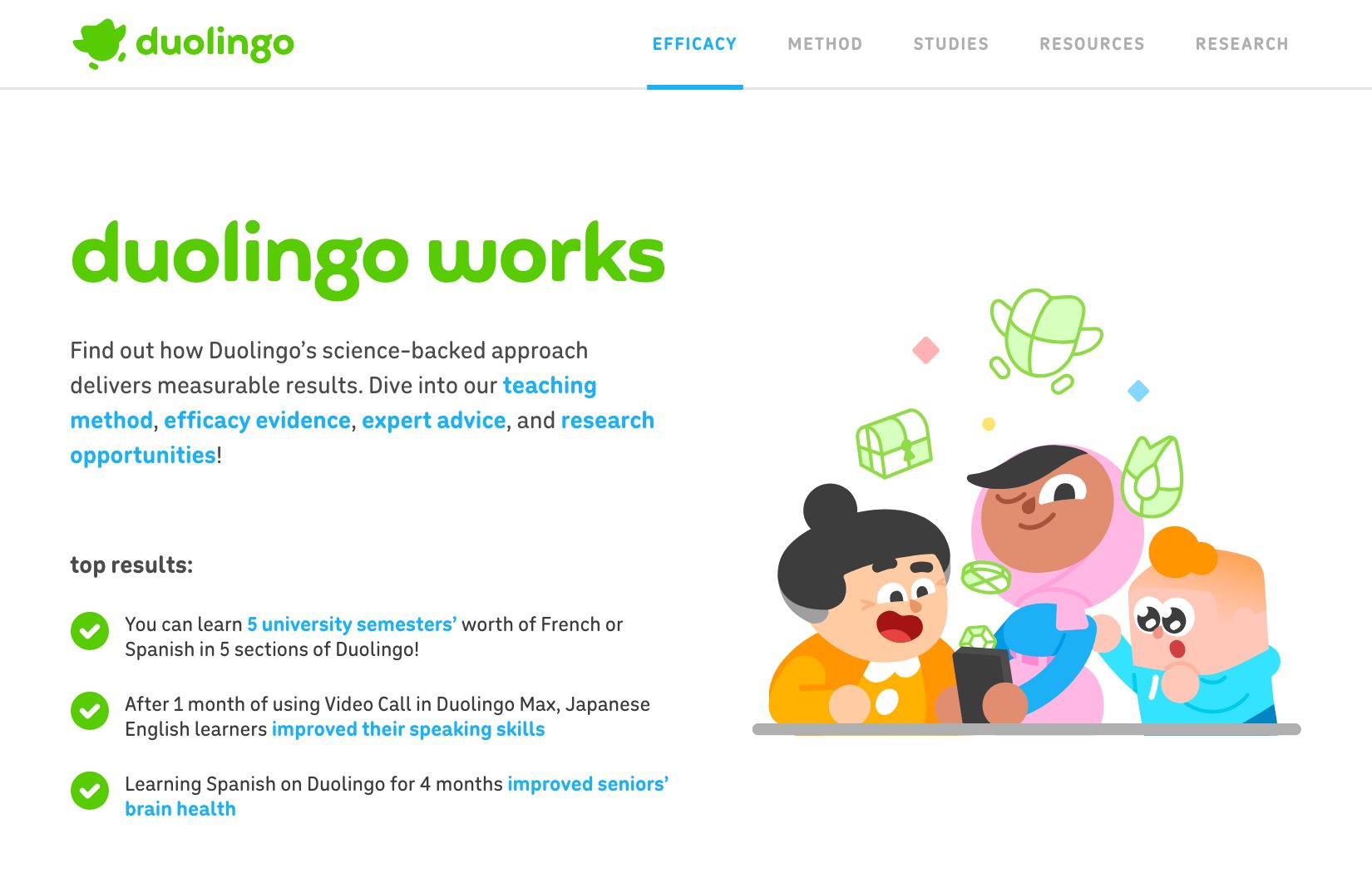
Duolingo keeps an efficacy page headed "duolingo works". Its homepage describes the app as "100% free, fun, and scientifically proven to work."
The strongest paper behind the page is Jiang and colleagues (2021) in Foreign Language Annals, a peer-reviewed journal. Four of its five authors worked at Duolingo and the fifth, Luke Plonsky, is a professor at Northern Arizona University. I read it in full.
They emailed American adults who had just finished the beginner sections of Spanish or French, kept the ones who said they had started near zero and used nothing else, and gave 225 of them the ACTFL reading and listening tests. The learners averaged Intermediate Low in reading and Novice High in listening, which matches published scores for university students after four semesters. The median learner had spent 112 hours. The abstract says: "No other skills were assessed."
A company report from November 2021, DRR-21-03, repeats the design further along the course. It is the study in my first paragraph. The learners beat fifth-semester students in Spanish reading by 0.47 standard deviations and in listening by 0.18 to 0.26, and tied them in French reading. The authors call these effect sizes small.
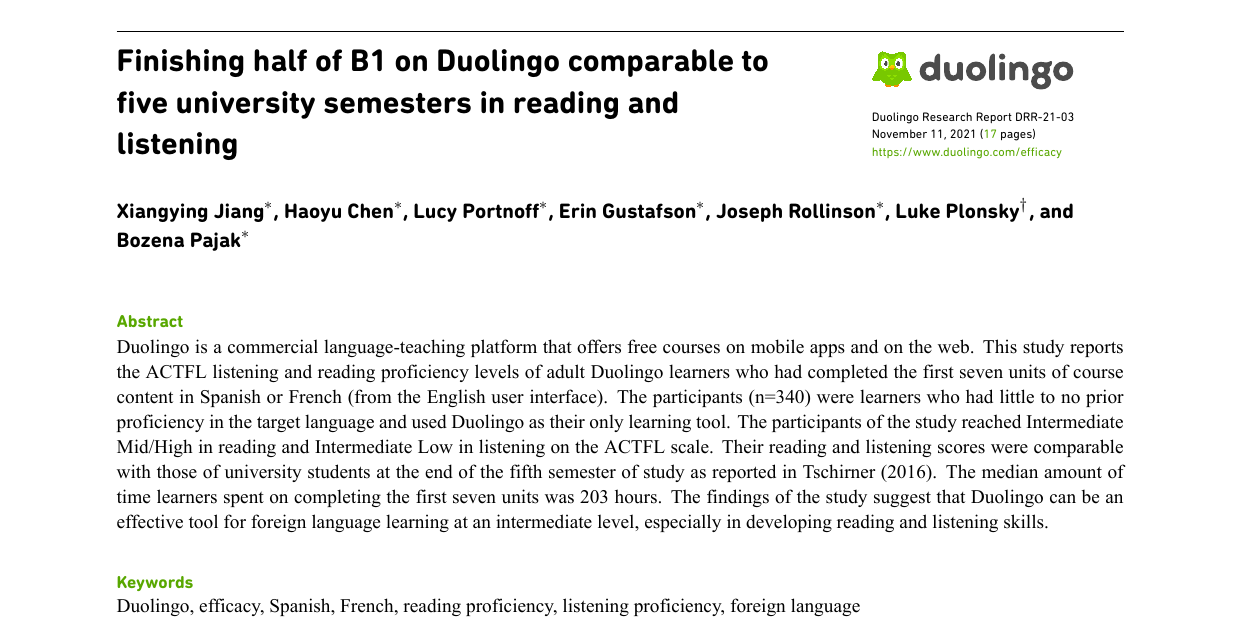
Both studies tested people once, after they had finished. Nobody was tested at the start, so prior knowledge is whatever the learner reported on a scale from 0 to 10. The comparison group is a set of students aged about 20 to 22 from another study, and the Duolingo group averaged 38 to 42 years old, 87% of them with a degree. The authors list all of this themselves and add that the comparison "should not be interpreted as competition" with university courses. More hours did not predict better scores, and in Spanish they predicted slightly worse ones.
The larger gap is the people who never reached the end of unit 7. A study of finishers says what finishing is worth and nothing about the odds of finishing.
Duolingo has one study of speaking, a June 2021 company report. Learners who had finished five units took Pearson's Versant test, which is scored by a machine. Of 156 Spanish learners, 66% scored at CEFR level A2 or above, and of 102 French learners, 53% did. The report quotes the definition of A2 fluency: "Can make him/herself understood in very short utterances, even though pauses, false starts, and reformulation are very evident."
Those 258 valid tests came out of 11,544 emails. The machine also could not score 43 of the completed French tests, and the authors suspect the learners' pronunciation.
The efficacy page makes two more claims. A trial with 76 adults aged 65 to 75 found that 16 weeks of Duolingo Spanish improved two measures of executive function about as much as a brain-training app did. The abstract reports nothing about their Spanish. The page also says Japanese learners of English spoke better after a month of Video Call, and the link to that paper returned an access error when I tried it on October 4, so I cannot describe it.
The 34-hour study
The oldest number quoted about Duolingo is that 34 hours on it equal a university semester of Spanish. It comes from Vesselinov and Grego (2012). The report says: "This study was funded by Duolingo but the data collection and the analysis were done independently by the Research team."
The first placement test was taken by 196 American adults, who were then asked to use Duolingo for two months. Only 88 finished with more than two hours of study and a second test, a loss of 55%. The 88 studied for 22 hours on average, and the median was 16.9.
Nobody in the study did 34 hours and then passed a semester exam. The figure is the test's cut-off for second-semester placement, 270 points, divided by the average gain of 8.1 points per hour. The median gain was 3.9 points per hour. Run the same division on the median and a semester takes 69 hours. That sum is mine.
The test was WebCAPE, a written multiple-choice placement exam, and the authors recommended that future studies add "some test of spoken proficiency." There was no comparison group. Stephen Krashen pointed out in 2014 that the report never claimed Duolingo beat a university course, although Duolingo's website then said it "trumps university-level language learning." Duolingo's own researchers later wrote in the Jiang paper that such hours-per-semester estimates "can also be seen as making unwarranted claims."
Independent studies
There are few, and the Jiang paper says why this matters: "Even more trustworthy evidence might come from researchers who are completely independent of commercial entities."
Loewen and colleagues (2019) in ReCALL had nine people learn Turkish on Duolingo for a semester. I read the abstract, which reports improvement, a moderate correlation between study time and gains, and "frustration with instructional materials." The Jiang paper describes the rest: the nine were a professor and eight graduate students, they averaged 29 hours, and one of them reached 70% on the exam for a first-semester Turkish class. Duolingo's speaking report adds that they did worse on oral tasks than on vocabulary and grammar.
Kessler, Loewen and Gönülal (2023) put 59 adults on Turkish for eight weeks, 32 with Duolingo and 27 with Babbel. Both groups made progress and their gains did not differ significantly. I read only the abstract.
Shortt and colleagues (2021) reviewed the Duolingo literature from 2012 to early 2020 and kept 35 studies out of 367 records. Most studied the app's design, with samples that were not drawn at random. Again I read the abstract.
For phone apps in general, Burston and Giannakou pooled 84 experiments from 1994 to 2019 and found a large average effect, 0.72 standard deviations against control groups. They also found "obvious publication bias", and a third of the outcomes measured were vocabulary. I read it in full, and it does not mention Duolingo.
| Study | Run and paid for by | People | Design | Measured | Main limit |
|---|---|---|---|---|---|
| Vesselinov and Grego, 2012 | Two outside academics, funded by Duolingo | 88 of 196 | Spanish for 8 weeks, tested before and after | Written placement test | 55% lost, no comparison group |
| Jiang et al., 2021, journal | Duolingo staff and one professor | 225 | Tested once after the beginner course | ACTFL reading and listening | Finishers only, no speaking |
| Jiang et al., 2021, report | Duolingo staff and one professor | 340 | Tested once after unit 7 | ACTFL reading and listening | Finishers only, no speaking |
| Jiang et al., 2021, speaking report | Duolingo staff and one professor | 258 | Tested once after unit 5 | Machine-scored speaking test | 258 valid tests from 11,544 emails |
| Loewen et al., 2019 | University researchers, who were the learners | 9 | Turkish for 12 weeks | A first-semester exam | Nine people |
| Kessler et al., 2023 | University researchers | 59 | Duolingo against Babbel, 8 weeks | Six skills at the end | No group without an app |
| Burston and Giannakou, 2021 | University researchers | 84 studies | Meta-analysis of phone learning | Mostly vocabulary and reading | Publication bias |
People who tried it
David Freedman used Duolingo Italian for about fifteen minutes a day for most of a year and wrote about it in The Atlantic in 2018. He could say that he was hiding a knife in his boot. A week before his trip to Rome his wife asked him how he would get from the airport to the city, and he "gaped like a fish":
The app had made me a master of multiple-choice Italian. Given a bunch of words to choose from, I could correctly assemble impressive communiqués. But without a prompt, I was as speechless in even the most basic situations as any boorish American tourist. And this in spite of 70-plus hours of study.
He spent the week with a self-study book and a phrase book, and found the grammar and vocabulary came easily because Duolingo had already shown him the words. In Rome he managed "simple, fractured semi-conversation."
He then asked Luis von Ahn, Duolingo's chief executive, whether this was normal. Von Ahn told him the app had done what it was built to do. "We prefer to be more on the addictive side than the fast-learning side," he said. "If someone drops out, their rate of learning is zero."
Eric Ravenscraft reached a streak of more than 500 days, which he wrote in The New York Times "has now come to define my self-worth." His verdict was that you can learn some things from an app, but for anyone who wants to become fluent "or even conversational" apps "won't be enough." He admitted to redoing the earliest lessons on busy days to keep the streak alive.
Alex Bresler did 90 days of French, fifteen minutes a day, and then spent four days in Brussels for Matador Network. She hailed a taxi and ordered moules-frites, lost the thread when the driver started on Belgian politics, and understood about a third of a museum audio guide. She switched to English only a few times and called that a success. She had spent time in Paris years earlier, so she was not starting from nothing.
Speaking is a separate skill
Duolingo's report describes its lessons as teaching "vocabulary and grammar at the sentence level." Freedman found that it mostly asked him to translate, with multiple-choice answers.
Robert DeKeyser (1997) taught 61 people the rules of an artificial language and then gave them eight weeks of practice, some rules through comprehension and others through production. From the abstract: "the learning of morphosyntactic rules is highly skill-specific." I read only the abstract. As I read it, practice at understanding a rule made people better at understanding it and did less for producing it.
Merrill Swain's output hypothesis offers a reason. In Swain and Lapkin (1995), whose abstract I read, learners who have to produce the language notice what they cannot say, and that noticing pushes them to work out the grammar in a way that comprehension lets them skip. It is a hypothesis with supporting data, and Krashen, quoted above, holds the opposite view that input does the work.
Feedback matters too. Shaofeng Li's meta-analysis (2010) of 33 studies found a medium effect of corrective feedback, and it lasted.
Karl Popper described learning as guessing and then having the guess corrected. A word bank does the guessing for you. Freedman's seventy hours bought him recognition, and one week of producing sentences turned it into speech.
The product in 2026
Duolingo's second-quarter letter to shareholders reports 58.7 million daily users, 140.6 million monthly users and 12.7 million paid subscribers. That makes about nine in a hundred monthly users paying. In June the company let people restore their longest-ever streak by doing three lessons, and 15.4 million did.
The free tier has ads. In 2025 Duolingo began replacing Hearts with Energy, a battery that each lesson drains and that refills in about a day. Super removes the ads and the limit, and a family plan covers six accounts.
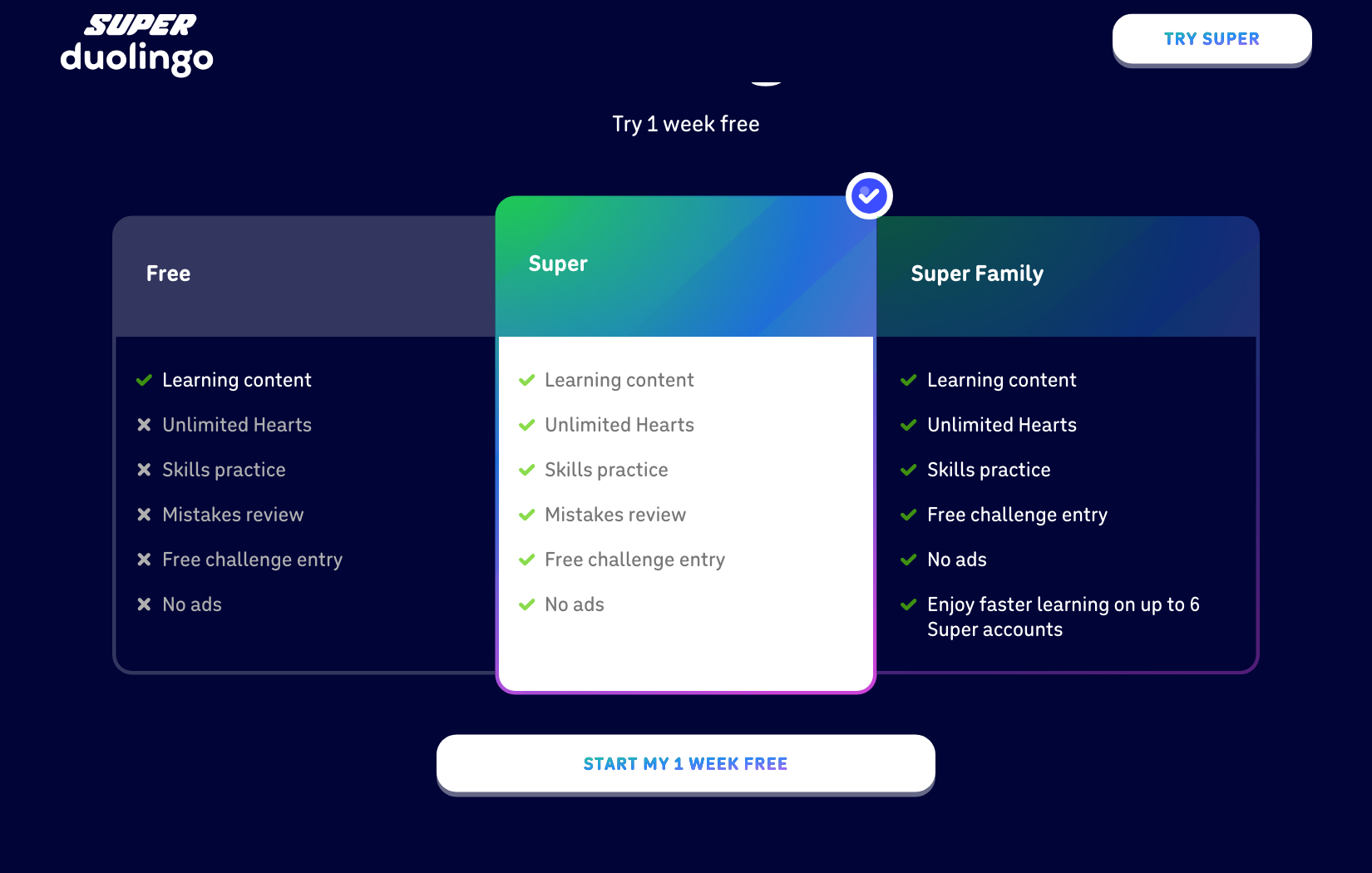
The page shows no price to a visitor who is not signed in. The App Store lists Super Duolingo purchases at $9.99, $12.99, $83.99, $95.99 and $119.99 without saying which plan each is, and I found no price for Max.
Duolingo Max adds the two features that involve speaking: Video Call, a conversation with a character called Lily, and Roleplay, a guided scene with feedback afterwards. English speakers get both in Spanish, French, German, Italian and Portuguese, and Video Call alone in Japanese, Korean and Chinese. The shareholder letter says most new Super subscribers now get Video Call too.
On course depth, Duolingo said in 2024 that "our most advanced courses currently cover content through 129 (the end of the CEFR level B2)." That describes the material. The tested outcomes above stop at A2 for speaking and half of B1 for reading.
In April 2025 von Ahn told staff the company would be "AI-first" and would "gradually stop using contractors to do work that AI can handle," as Jay Peters reported in The Verge. The same memo said "this isn't about replacing Duos with AI." I found no study of whether lessons written this way teach better or worse.
Using Duolingo so it works
- Count hours. The tested learners needed a median of 112 hours for the beginner course and 203 for seven units.
- Say every sentence aloud before you tap anything, and type answers where the app allows it.
- Add a speaking tool from the first week. Pimsleur makes you answer out loud and costs $20.99 a month on the App Store. Speak is conversation with an AI in six languages at $17.99 a month or $83.99 a year. A human tutor once a week gives you the correction the app cannot. I compare these in the best learning apps for adults.
- Test yourself the way Freedman's wife tested him: a situation, no word bank, out loud.
- Stop repeating easy lessons to save a streak.
- If you have a trip, start when you book it. That advice is from Cindy Blanco of Duolingo, in Bresler's article.
Questions people ask
Is Duolingo effective?
For reading and listening in Spanish and French, yes, in Duolingo's own studies of people who finished the units. For speaking, about two thirds of tested Spanish finishers reached A2.
Can you become fluent with Duolingo alone?
No study shows it. The best measured result is intermediate reading after about 200 hours, and no long-term user has been tested in conversation.
Is Duolingo Max worth it?
It adds the speaking practice the free app is short of. The only evidence for it is a Duolingo paper I could not open.
Understand and languages
Understand does not teach languages, and it is the wrong tool for Spanish. It is relevant here only for the general point in this evidence, that producing beats receiving: it asks adults to explain an idea aloud in their own words and keeps a record of what they said. For a language, use the tools above.