The Beginning of Infinity: a guide to David Deutsch's book
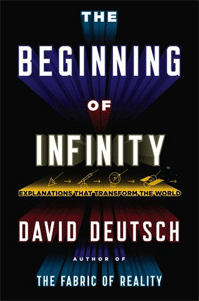
David Deutsch is an Oxford physicist whose 1985 paper described the universal quantum computer. The Beginning of Infinity (2011) is his second book. Its introduction states the thesis in one sentence: "all progress, both theoretical and practical, has resulted from a single human activity: the quest for what I call good explanations." The eighteen chapters that follow argue that this progress has no upper limit, by way of physics, mathematics, evolution, voting systems and the history of Athens.
I build Understand, a voice tutor whose design rests on one idea in this book, so read the last two sections with that in mind.
Good explanations are hard to vary
Chapter 1, "The Reach of Explanations", starts with stars. No human has been to one, yet astronomers know what makes them shine. The usual account of that knowledge is empiricism, the doctrine that we derive theories from what the senses report. Deutsch rejects it in the opening pages: "scientific theories are not 'derived' from anything. We do not read them in nature, nor does nature write them into us." He calls them guesses. Experience keeps a narrower job: "Its main use is to choose between theories that have already been guessed."
A second standard answer is that science differs from myth by being testable. Deutsch answers with the Greek myth of the seasons. Hades kidnaps Persephone, and her mother Demeter negotiates a contract that compels Persephone to return to him once a year. Demeter's sadness during those visits is winter. The myth is testable, since a goddess's sadness should chill the whole Earth at once, and Australia refutes it. But a Greek who learned about the southern summer could have repaired the story in a sentence. In his 2009 TED talk Deutsch supplies the repair: Demeter banishes heat from her vicinity into the other hemisphere.
Nothing in the myth ties its details to the seasons, so any detail can be swapped for another. Deutsch's term for such an explanation is "easy to vary". The glossary at the end of the chapter defines a bad explanation as one "that is easy to vary while still accounting for what it purports to account for."
The modern explanation says the Earth's axis is tilted, so each hemisphere leans toward the sun for half the year. Deutsch calls it "hard to vary, because all its details play a functional role." Change the tilt, or the claim that tilted surfaces receive less heat, and the explanation stops explaining.
He builds a claim about history on this. The chapter summary says that the search for hard-to-vary explanations, "not experimental testing, was the decisive factor in the scientific revolution".
Conjecture and criticism
The theory of knowledge in the book is Karl Popper's, and Deutsch says so. Knowledge starts as a guess. Criticism, which includes experiment, removes the guesses that fail. Nothing ever confirms the ones that remain.
Deutsch names the positions this rules out. Inductivism holds that theories come from generalising repeated observations, on the assumption that the future will resemble the past. His reply, in chapter 1: "in reality the future is unlike the past, the unseen very different from the seen."
Justificationism he defines as "the misconception that knowledge can be genuine or reliable only if it is justified by some source or criterion." Its opposite is fallibilism: "the recognition that there are no authoritative sources of knowledge, nor any reliable means of justifying knowledge as true or probable."
Fallibilism could be read as a counsel of doubt. Deutsch reads it as good news, because an error that can be found can be corrected. Chapter 3, "The Spark", shows two sentences as inscriptions on stone tablets: "Problems are inevitable" and "Problems are soluble". He qualifies both. "It is inevitable that we face problems, but no particular problem is inevitable." And: "By 'soluble' I mean that the right knowledge would solve them."
The argument for the second tablet is in the same chapter. A physical transformation is either forbidden by the laws of nature or achievable given the right knowledge. If some third kind of transformation existed, permitted by physics yet out of reach of any knowledge, that limit would itself be a regularity in nature calling for an explanation.
Reach and the jump to universality
Reach is Deutsch's word for the way a good explanation solves problems it was not created to solve. A hard-to-vary theory is not its author's to adjust. "It has an autonomous meaning and an autonomous domain of applicability. You cannot confine its predictions to a region of your choosing."
Chapter 6, "The Jump to Universality", follows reach to its end point. Early writing used a pictogram for each word, so a new word needed a new symbol. An alphabet can spell words that do not exist yet. Tally marks and Roman numerals needed new symbols or new rules as numbers grew, and the Indian numerals we use now write any number with ten digits. Charles Babbage's Difference Engine did one kind of calculation. The Analytical Engine he designed next would have been a universal computer, as he and Ada Lovelace understood. The genetic code is Deutsch's biological case. Its evolution stopped, he writes, "at a point when it had already attained enormous reach."
He calls this pattern the jump to universality: "the tendency of gradually improving systems to undergo a sudden large increase in functionality, becoming universal in some domain." In most of his examples nobody was aiming at universality.
People, optimism and the Enlightenment
The universality Deutsch cares about most belongs to people. Humans can create explanations about anything, which makes them, in his terms, universal explainers and universal constructors. "People" in the book means any entity with that ability, wherever it comes from.
Chapter 3 uses this against the metaphor of Spaceship Earth. The biosphere does not sustain humans. Knowledge does, in the form of clothing and farms, and he writes that Oxfordshire, where he lives, might in its primeval state kill him in a matter of hours. On the spaceship metaphor he writes: "we have never merely been its passengers, nor (as is often said) its stewards, nor even its maintenance crew: we are its designers and builders."
Chapter 9, "Optimism", states the principle of optimism: "All evils are caused by insufficient knowledge." It is easy to mistake for a forecast. Deutsch says otherwise: "Optimism is, in the first instance, a way of explaining failure, not prophesying success." He reserves the word prophecy "for anything that purports to know what is not yet knowable", and the future growth of knowledge is the main thing that is not yet knowable. Malthus's forecast of famine failed for that reason. I leaned on the same distinction in an earlier essay on LLMs.
The political version is Popper's. He replaced the question "Who should rule?" with the question of how bad rulers and bad policies can be removed without violence.
Chapter 15 sorts societies by how they treat new ideas. A static society is "one whose changes happen on a timescale longer than its members can notice", and nearly every society in history has been one. Deutsch describes Athens and Renaissance Florence as short-lived exceptions. The Enlightenment is the exception that lasted, and he defines it as "a way of pursuing knowledge with a tradition of criticism and seeking good explanations instead of reliance on authority."
Memes, creativity and artificial intelligence
Deutsch takes the word meme from Richard Dawkins and divides memes by how they get copied. A rational meme is "an idea that relies on the recipients' critical faculties to cause itself to be replicated." An anti-rational meme is "an idea that relies on disabling the recipients' critical faculties to cause itself to be replicated." Static societies are dominated by the second kind. "Because I say so" is his example of the device.
Chapter 16, "The Evolution of Creativity", takes up a puzzle. If humans were creative all along, the long ages in which almost nothing changed need explaining. His answer is that a meme cannot be copied by imitation. The same behaviour is consistent with endless different ideas, so a child has to guess the idea behind what the adults do. Creativity was needed to receive a culture accurately. The chapter concludes: "replicating memes unchanged is the function for which creativity evolved." The faculty that kept static societies static is the one that later produced science.
Chapter 7, "Artificial Creativity", applies this to machines. Deutsch reviews chatbots from Eliza to the 2008 Loebner prize winner and concludes in the summary that the field "has made no progress because there is an unsolved philosophical problem at its heart: we do not understand how creativity works." He does not think the goal is impossible. In a 2012 essay for Aeon he wrote that "AGI must be possible", because of the universality of computation, and that "what is needed is nothing less than a breakthrough in philosophy".
The book predates large language models by a decade. I have argued that they leave Deutsch's point standing, since predicting the next token from a corpus is induction and induction does not create explanations.
The chapters people skip
Chapter 5, "The Reality of Abstractions", borrows Douglas Hofstadter's computer built from dominoes. One domino stays standing, and the explanation is that 641 is prime. The chapter summary states the claim: "Abstract entities are real, and can play a role in causing physical phenomena."
Chapter 8, "A Window on Infinity", covers Georg Cantor's mathematics through Infinity Hotel, Deutsch's version of the thought experiment usually named after David Hilbert. A full hotel with infinitely many rooms can still take new guests by moving everyone up. The chapter then argues that mathematical proof is a physical process, so what we can prove depends on the laws of physics.
Chapter 10, "A Dream of Socrates", is a play. Hermes visits Socrates in a dream at Delphi and they talk about epistemology and about Athens and Sparta. Socrates then tells his friends, and the young Plato garbles what he hears. The Economist's reviewer called it "both amusing and insightful."
Chapter 11, "The Multiverse", is the longest and the hardest. It builds the many-universes reading of quantum theory from a science-fiction story about a starship's transporter, using the idea of fungible objects. Chapter 12 calls the Copenhagen interpretation bad philosophy, which Deutsch defines as "philosophy that is not merely false, but actively prevents the growth of other knowledge."
Chapter 13, "Choices", goes through the paradoxes of apportioning seats in the US Congress and then Arrow's theorem, which seems to show that no rational way of combining preferences exists. Deutsch's answer is that good decisions come from creating new options, and Arrow assumed a choice among fixed ones. He then judges electoral systems by Popper's criterion. Proportional representation hands power to small parties and makes governments hard to remove, and the chapter's last line says that ease of removal "designates the plurality voting system as best in the case of advanced political cultures."
Chapter 14, "Why are Flowers Beautiful?", argues that beauty is partly objective. Flowers and insects have to signal across a gap between species that share no conventions, and humans find the result beautiful because each human is, in knowledge, like a species: "Signalling across the gap between two humans is analogous to signalling across the gap between two entire species."
Chapter 17, "Unsustainable", sets Jacob Bronowski's reading of Easter Island against David Attenborough's. Deutsch points out that "sustain" has two nearly opposite meanings, "to provide someone with what they need, and to prevent things from changing."
The Fabric of Reality and Deutsch's other work
The Fabric of Reality (1997) argues that our deepest theories form four strands that only make sense together. Deutsch's page for the book lists them: quantum physics with its many universes, evolution, computation, and the theory of knowledge. It has more physics than the later book, including the interference experiments behind the multiverse, quantum computers and time travel. I quoted its first chapter in the history of tutoring systems, and this site's manifesto quotes it too.
Read The Beginning of Infinity first unless you came for the quantum theory. It restates the epistemology from the start and needs no physics. If chapter 11 leaves you unconvinced, the earlier book makes the many-universes case at length.
Deutsch's best-known physics is in two papers. "Quantum theory, the Church-Turing principle and the universal quantum computer" appeared in the Proceedings of the Royal Society in 1985. The Deutsch-Jozsa algorithm of 1992, with Richard Jozsa, was among the first shown to beat any deterministic classical algorithm exponentially. Deutsch shared the 2023 Breakthrough Prize in Fundamental Physics for this line of work.
Since 2012 he has worked on constructor theory, which tries to express physics as statements about which transformations are possible and which are impossible. He works on it with Chiara Marletto, and they published "Constructor theory of information" together.
The book's official site lists an "Upcoming Book: Irrationality" with a teaser video. I found no publication date.
Objections from reviewers
David Albert, a philosopher of physics at Columbia, wrote the New York Times review in August 2011. He called the book "brilliant and exhilarating and profoundly eccentric" and then objected to its central claims. Of the claim that knowledge-creating beings will come to shape the cosmos, he wrote: "I have no idea how one might go about investigating whether it is true or false." He treats it as a mood, "not even remotely, a live scientific hypothesis." Deutsch's insistence that Everett's many universes are the only explanation of quantum phenomena is, to Albert, "simply, wildly, wrong", since other proposals are on the table. Albert also found him "too little moved by actual contemporary human suffering."
Doug Johnstone, in The Independent, complained of "long passages of almost impenetrable waffle". He thought Deutsch strong on physics and "on shakier ground" in aesthetics and moral philosophy.
Peter Forbes, in the same paper five days later, wrote the opposite review and called Deutsch "a modern Voltaire". The Economist ended with "He is provocative and persuasive. Who knows? Perhaps he is also right."
The "hard to vary" criterion has critics of its own. Richard Ngo argued in 2021 that it "seems very similar to the standard criterion of simplicity", and that purely predictive theories such as Newton's inverse-square law have been valuable without explaining a mechanism. I would add that the book gives no procedure for measuring how hard an explanation is to vary.
The principle of optimism depends on the dichotomy from chapter 3. A reader who doubts that everything permitted by physics is achievable given knowledge will doubt the principle, and Albert lists "everything is explicable" among the tenets Deutsch holds as inviolable while preaching fallibilism.
A reading order
For a first pass, read the introduction and chapters 1 to 4, then 9 and 10, then 15 and 16, then 7, 17 and 18.
Leave 8 and 11 for a second pass, and take 11 slowly. Chapters 5, 12, 13 and 14 each stand mostly alone. Every chapter closes with a glossary and a summary, and for the hard chapters I read the summary first.
Deutsch's TED talks cover parts of the book in his own voice. "A new way to explain explanation" (2009) is chapter 1 with the Persephone myth. "Chemical scum that dream of distant quasars" (2005) is close to chapter 3.
Brett Hall's ToKCast goes through the book chapter by chapter, reading passages and commenting on them. Naval Ravikant recorded a series with Hall called "The Beginning of Infinity" in 2021 and interviewed Deutsch in two parts in 2023. The Oxford Karl Popper Society, a student society, posts its talks on YouTube.
For Popper himself, Conjectures and Refutations (1963) is a collection of essays and the easier way in. The Logic of Scientific Discovery (1959 in English) is the technical work. Deutsch's bibliography puts Jacob Bronowski's The Ascent of Man (1973) at the top of the list everyone should read, and the book says it "was one of the inspirations for this book." His video page links the first episode.
Learning, by the book's account
Deutsch does not write about tutoring. The following is my inference from his premises.
If understanding is having good explanations, then finishing the book and understanding it are different events. Chapter 15 says why in one line: "A meme cannot be downloaded like a computer program." That holds for a reader as much as for a child in a static society. I receive sentences and guess what they mean, and a wrong guess feels the same as a right one until something criticises it.
The cheap test is to explain the idea without the page. Say why the Persephone myth is a bad explanation. The tempting answer is that it cannot be tested, which is the answer chapter 1 was written to correct. Popper wanted a school with no "unwanted answers to unasked questions", as I noted in the Math Academy review, and the evidence that recalling beats re-reading is in the post on audiobooks.
A tutor built on these premises should ask the learner to explain the idea back, and then criticise the attempt. A lecture, however clear, leaves the learner's guess untested.
Understand
Understand does that by voice. It reads an article or a PDF aloud, stops when you ask a question, asks you to explain an idea back, and keeps a record of what you have explained that you can read and correct.
It does not come with The Beginning of Infinity. It can read a PDF with real text in it that you own, or an article such as Deutsch's Aeon essay. It needs a connection the whole time, there is no Android app, and nobody has run a trial of it.