Blinkist review: one Blink read against its book, and 150 user reviews counted
Blinkist sells the 15-minute book summary. The free Blink on its site on 4 October 2026 ran 24 minutes, and of the 100 Blinks listed on one of its public book pages, six were 15 minutes or under. The average was 22.
Blinkist is worth paying for if you want to decide which books deserve your hours, or to refresh one you have read. Take the cheaper plan and put the renewal date in your calendar. It will not make you understand a book you have not read, and Blinkist says so itself.
I have not paid for Blinkist. This review rests on the company's own pages, the store listings, 150 user reviews and four Reddit threads, and one free Blink that I read in full and compared with an excerpt of its book. I build Understand, a voice tutor for adults, and I have no connection to Blinkist.
Blinkist in brief
Blinkist is the classic business book summary app. A Blink is a summary of a nonfiction book as text and audio, split into "key ideas", each a few hundred words. You pick a title, then read or listen.
Its About page says it was "founded in 2012 by four friends". A company post names them as Holger Seim, Niklas Jansen, Tobi Balling and Sebastian Klein, and says the Berlin startup raised more than $35 million. In May 2023 the Australian workplace-learning company Go1 announced it had acquired Blinkist. Blinkist's own announcement said the team would stay in Berlin under the Blinkist name. Neither post gives a price.
Blinkist has between 26 and 44 million users, depending on which of its pages you ask. The 2023 announcement and the current "What is Blinkist" page say 26 million. The home page says "31+ million", the App Store listing 42 million, a June 2026 company post 43 million, and the About and pricing pages 44 million. The catalogue is "9,000+" titles on the home page and "more than 7,500 books" on the About page.
One Blink against its book
Blinkist gives away one Blink a day at blinkist.com/daily with no sign-up. The whole text opened in a browser without an account. On 4 October the title was The Power of Pressure by Dane Jensen, a 2021 book that HarperCollins lists at 320 pages.
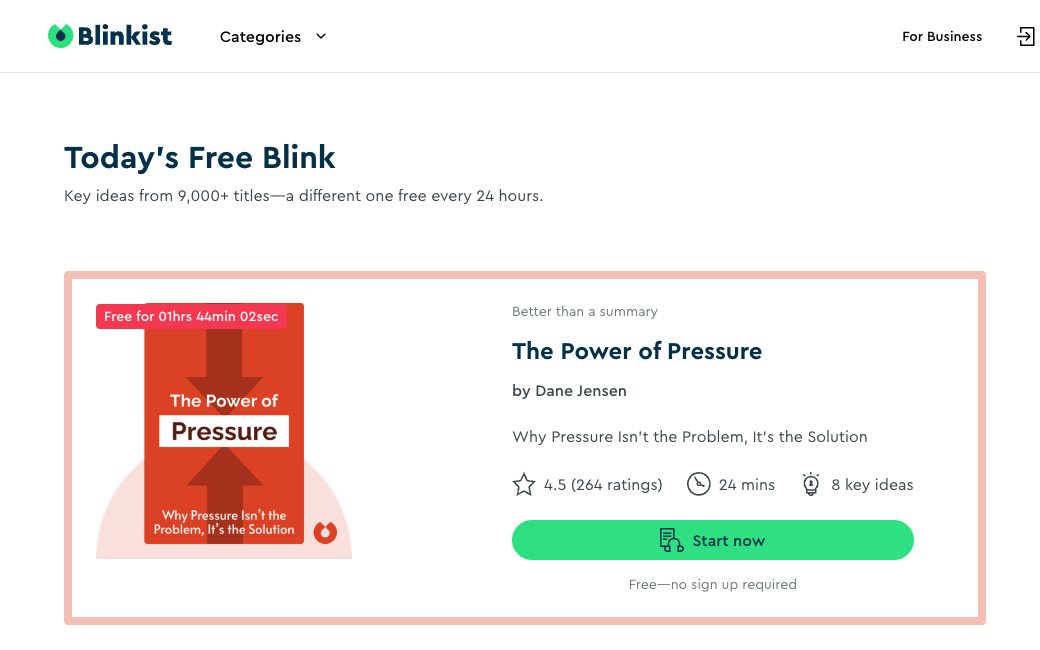
The Blink has an introduction, eight key ideas and a final summary. I counted 3,606 words. It is clearly written and follows the book's scheme: pressure comes from importance, uncertainty and volume, and arrives as a peak moment or over a long haul.
For the book's side I used the excerpt that Smith Magazine at Queen's University published in 2021. It runs 3,311 words and covers one point: the difference between those two kinds of pressure. The Blink covers the same point in 46:
There are two main types of pressure. A short-term pressure situation, called a peak pressure moment, is a high-stakes event like a sports competition or job interview. And then there's long-term pressure, called pressure over the long haul, that usually builds toward a peak pressure moment.
The definitions survive and the case for them is gone. Jensen builds the distinction on Jeremiah Brown, who watched Canada's men's eight win gold in 2008 from his parents' couch, promised himself a podium in four years, and had "never set foot in a rowing shell". He won silver in London, having closed the blisters on his hands with Krazy Glue every day. Brown's name is not in the Blink. Other stories are, and a summary has to select.
The claims that go missing matter more than the story. Jensen writes that "the pressure of anticipation is worse than the pressure of performance" and concludes that "managing anticipation is managing pressure". The word "anticipation" does not occur in the Blink. He also concedes something a book called The Power of Pressure might have skipped: we may hope to enjoy the long haul, and "often, however, it's not realistic". The Blink's introduction promises that pressure "can actually be incredibly helpful". And where the Blink's first key idea is headed "Pressure comes from a blend of highly important and highly uncertain circumstances", the excerpt says volume can do it alone, "even if each individual item isn't hugely important to us".
Nothing the Blink says is wrong, as far as one excerpt can show, and I finished it knowing whether I wanted the book. I could not have defended the book's argument, because the places where Jensen qualifies it were the places cut. This is one Blink and one excerpt chosen by a magazine.
Humans, AI and the Blinks
Its help article on creating Blinks, dated 24 June 2025, says writers, editors and field experts read the book, and adds: "We're currently experimenting with different AI tools, to find out how can they can support us best in making great Blinks."
On 5 May 2026 the company replied to a three-star review on Google Play: "We do use AI for select titles, as it allows us to produce even more content for you each week. But we'll continue to use our human narrators as well."
On 3 June 2026 a company post said Blinkist had tested AI narration on some new releases for two years and was ending it. Existing AI-narrated Blinks stay in the library, and a help article of 12 August says a robot icon marks them. The June post also says that every Blink, "regardless of how it's voiced", "is written and edited by humans". The "What is Blinkist" page puts it flatly: "Blinkist does not use AI to generate its summaries."
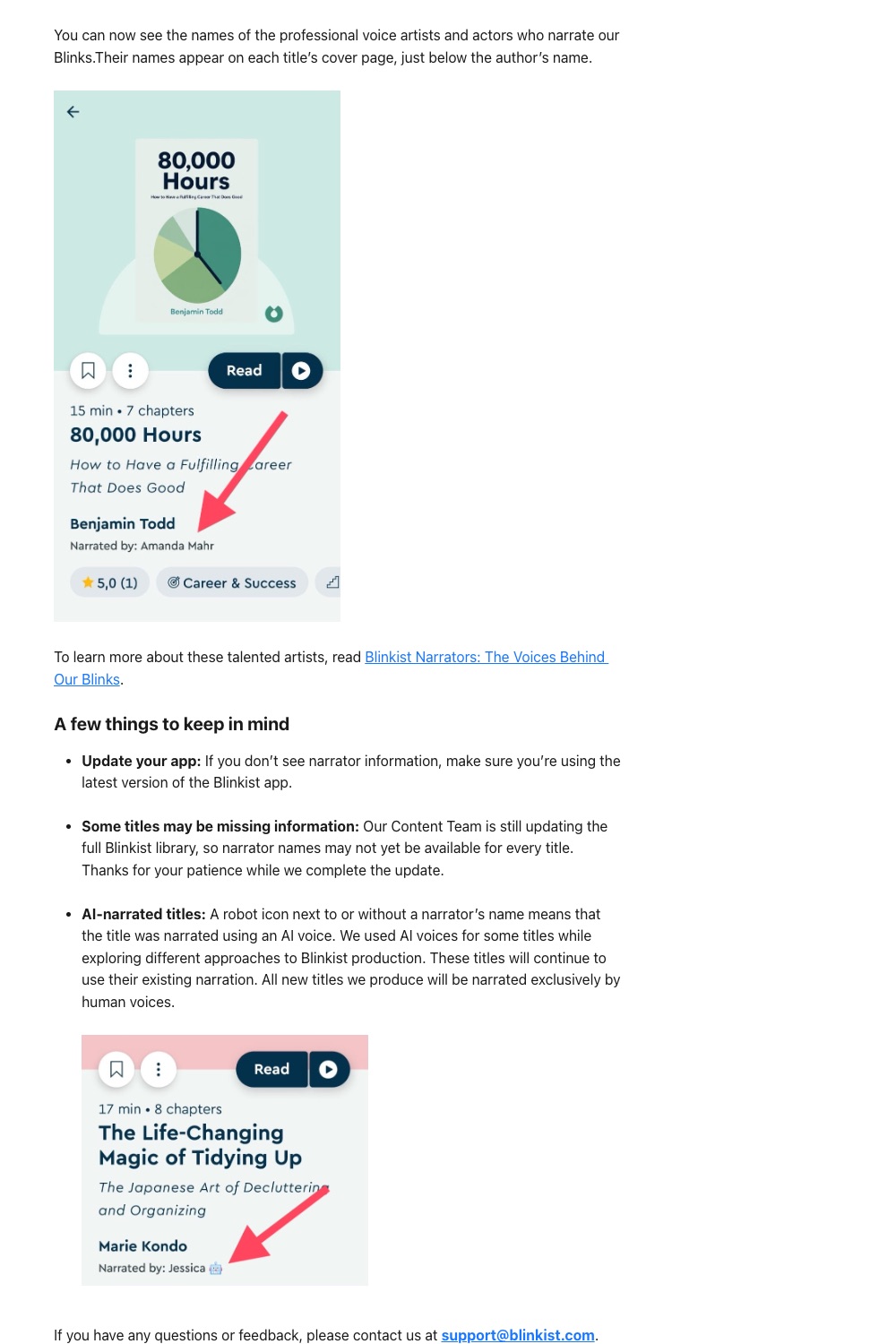
The company's current position is human writers and editors, and human voices for new titles. The May reply does not say whether "AI for select titles" meant voices or text, and I found no statement from Blinkist that settles it.
Price, the trial and renewal
I loaded blinkist.com/en/pricing on 4 October 2026 from a US connection in a fresh browser session. It showed two plans, both for 12 months. Premium was $79.99, with $99.99 struck through. Pro, which adds Blinkist AI, was $139.99, with $174.99 struck through. A coupon named "blink20" had been applied without my asking, beside a countdown that began near ten minutes both times I loaded the page.
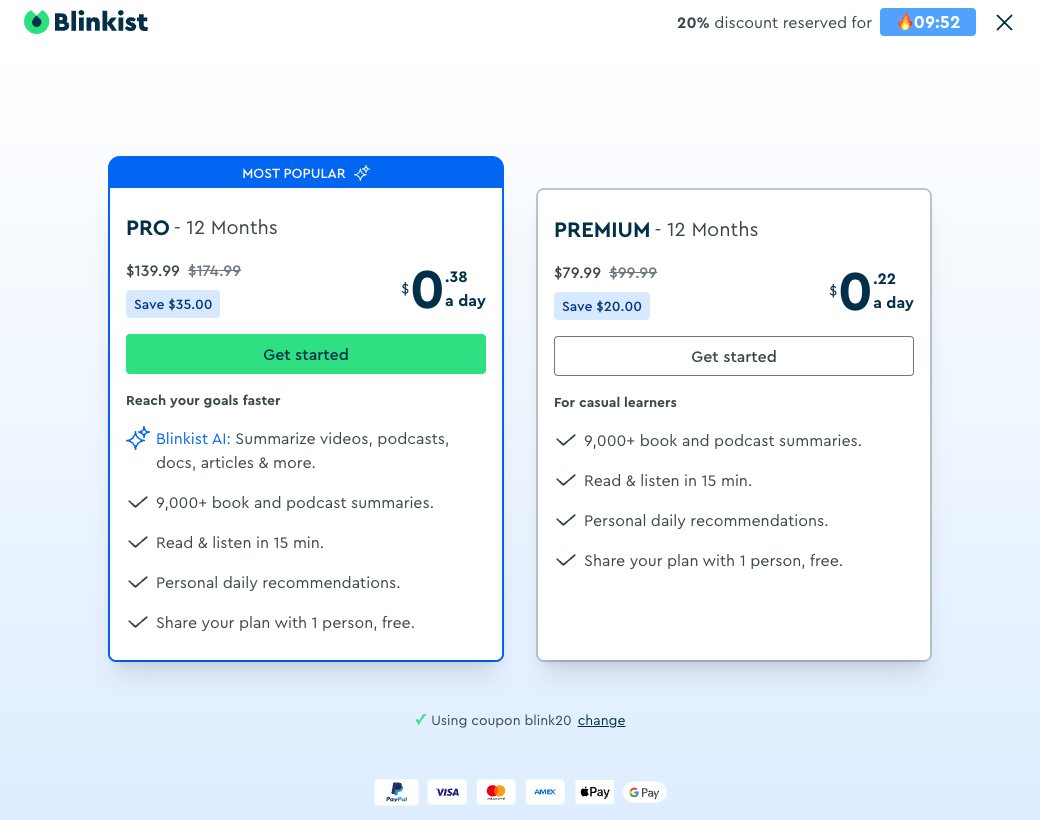
Under the plans it says: "$139.99 is processed as an intro offer, then $174.99 will be billed every 12 months automatically." A Blinkist reply on Trustpilot on 25 September 2026 says the same: "Discounts are usually available for the first payment only and don't apply to renewals". The price you are shown may differ from mine.
The App Store's list of in-app purchases shows more prices, among them Premium for a year at $79.99 to $119.99 and for a month at $12.99 to $15.99. I cannot tell which a new customer is offered. The pricing page showed me no monthly plan, and Blinkist told a Google Play reviewer on 11 August 2026: "We currently don't offer monthly subscriptions".
Without paying you get the one daily Blink. The free trial is not guaranteed. The help page says: "In some cases we offer a 7-day free trial with our yearly plan." You can use it once. To avoid the charge you must cancel "up to 24 hours before the end of the trial period", which makes it a six-day trial for planning purposes.
Subscriptions renew automatically. The money-back guarantee covers "the first 14 days of your initial purchase date" for purchases on the website or Google Play. For App Store purchases Blinkist says it cannot guarantee a refund and sends you to Apple. You cancel wherever you bought, and for web purchases there is a public cancellation form that needs no login.
150 user reviews, counted
I read the most recent reviews each source would show me. Reviews skew to the angry and the delighted, and these are no exception.
| Source | Read | Dates (2026) | 5 stars | 4 | 3 | 2 | 1 star | Complaints about charges, cancelling or refunds |
|---|---|---|---|---|---|---|---|---|
| App Store (US) | 50 | 25 May to 3 Oct | 24 | 3 | 4 | 2 | 17 | 11 |
| Google Play | 40 | 11 Jul to 15 Sep | 16 | 6 | 6 | 4 | 8 | 3 |
| Trustpilot | 60 | 13 Jul to 4 Oct | 49 | 4 | 1 | 0 | 6 | 5 |
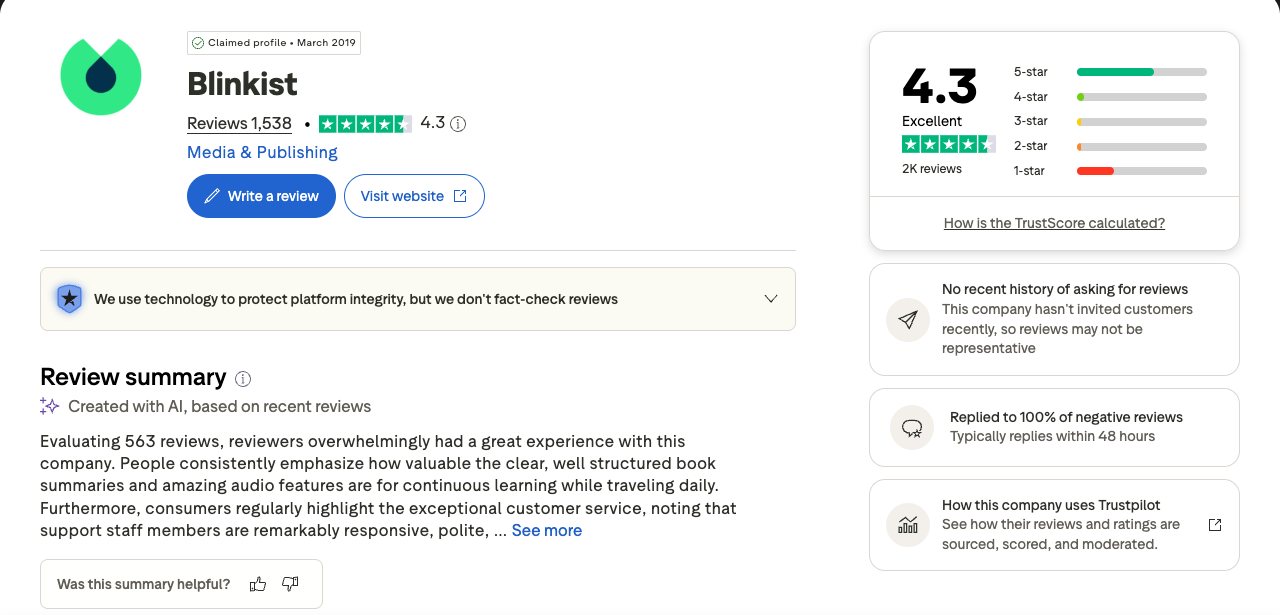
The overall ratings are high: 4.8 from 156,392 ratings on the App Store, 4.6 on Google Play, and 4.3 from 1,538 reviews on Trustpilot, where 59% are five stars and 29% are one.
The complaint that recurs is money. Nineteen of the 150 are about a charge, a renewal, a refused refund or the cancel flow, and they account for 17 of the 31 one-star reviews. On the App Store, @sififo wrote on 29 September that a trial sign-up "was charged $151.19 on the spot for a full year of Pro" and that "Support did refund 50% after I complained." @DakotaDoz wrote on 2 October: "I had requested to cancel my subscription about 17 days after I purchased it and my request was denied because I contacted them outside the 14 day window." Three App Store reviewers say they were charged during a trial or after cancelling one. Six reviewers across the sources describe being offered half back or half off.
Seven reviewers name the amount they were charged. The figures run from $130 to $151.19, all near the Pro price and none near Premium's $79.99. Pro is the plan the pricing page lists first.
Blinkist replied to 59 of the 60 Trustpilot reviews. To a reviewer charged for a second year, it wrote on 7 September: "we're unable to make exceptions to our refund policy based on subscription usage, as applying this differently would be unfair to other members who accepted the same terms." The same reply says a reminder goes out before renewal. One App Store reviewer reports "no auto-renewal reminders", and a Google Play reviewer wrote on 31 August of having "no problem stopping the subscription 12 months later".
Of the 60 Trustpilot reviews, 46 are about an exchange with customer support, often naming the agent, and 12 say anything about the summaries. Several five-star reviews describe a refund granted. That page tells you support answers and little about the product.
The praise is mostly for how a Blink fits a commute or a sink of dishes. About a third of the App Store reviews are a reaction to a single Blink just finished, such as @Calf4niagirl on the Atomic Habits Blink, 6 June: "Just trying to figure out how to move my piano to the side of my bed!" One five-star Trustpilot review of 19 September is the fairest sentence I read: "It obviously lacks some of the key context and depth of the full titles, but you can't have it all!"
On Google Play, 12 of the 40 are about the app itself, mostly the queue and audio that starts when you tap a notification. Eleven of the 150 mention AI, five of them a support chatbot that stood between the reviewer and a person; Blinkist's replies say you can ask for a human. A two-star Google Play review of 29 August says the app "is becoming more of book teasers instead of book summary".
Reddit blocked most of my requests. I read four threads from February to August 2026, 41 posts and comments. In one, the account u/blinkist wrote on 15 April 2026: "a summary can't replace the full experience of reading a book. Think of Blinkist as a powerful starting point or a way to refresh what you've already read, not a substitute for the original."
A summary's proper job
I agree with u/blinkist. The June company post makes the same pitch: before buying a book "you can spend 15 minutes with the Blink and find out whether the ideas actually land for you". Twenty-four minutes to rule out a 320-page book is a good trade, and a Blink of a book you read three years ago will bring its outline back.
The trouble starts when the summary stands in for the book. Rozenblit and Keil (2002) asked Yale students to rate how well they understood devices such as a zipper, then to write out how one works, then to rate themselves again. The average fell from 3.89 to 3.10 on a 7-point scale. A summary leaves you at the first rating. The post on Audible alternatives has my longer argument about summaries.
A second limit applies to every app of this kind. A catalogue holds what someone chose to summarise in advance. My questions mostly arrive in the middle of something else, a term in a paper or a mechanism I cannot picture, and no Blink exists for them. Blinkist AI may reach further, since it summarises what you give it. I have not used it.
If a Blink convinces you to read the book, Adler's method is how I would read it, and the post on remembering what you read covers what to do afterwards.
Blinkist and Shortform
Shortform writes longer guides and adds commentary. The sample guide on its home page, for Atomic Habits, promises to examine "how other psychologists and experts approach habit formation" and where Clear's theories "align with or differ from theirs". It costs $24 a month, or $16.42 a month billed yearly, against Blinkist Premium's $79.99 for the first year.
Blinkist's own page is candid about the difference. It says Blinkist is "less suited to people who want deep, chapter-by-chapter analysis of a single text" and that "a platform like Shortform may serve you better". Choose Blinkist to survey many books and Shortform to stay with one. The comparison post runs one chapter through five such apps, and the Headway review covers the app most like Blinkist.
Understand, and its limits
Understand is a voice chat with an AI tutor that you can interrupt. It answers directly, and after explaining an idea that is new to you it asks one question that takes the idea to answer. It draws on a board while it talks, reads an article or PDF aloud word for word and stops when you ask something, and talks through the links and PDFs you bookmarked. It keeps a record of the ideas you have shown you understand, which you can read and correct.
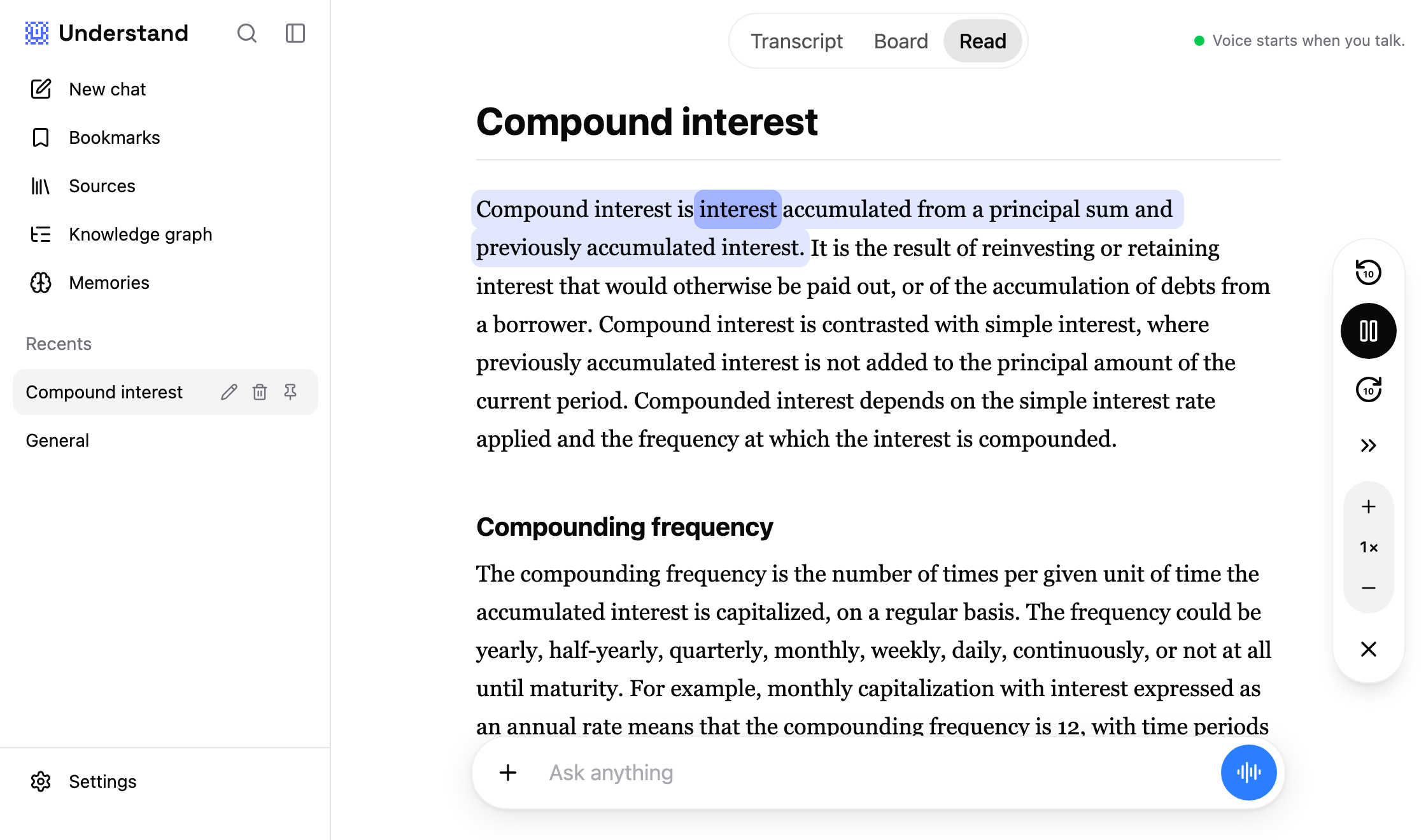
It has no catalogue of summaries, so it cannot tell you in 24 minutes whether a book is worth reading. Blinkist can. It has no courses, no problem sets, no spaced repetition and no Android app, and no trial has evaluated it. It is for adults and it is free for now.
Questions people ask
Is Blinkist worth it?
For choosing what to read and for refreshing books you know, yes, at the Premium price. For learning a subject from summaries alone, no, and Blinkist's own account on Reddit agrees.
How much does Blinkist cost?
On 4 October 2026 its site showed me Premium at $79.99 for the first year, with $99.99 as the regular price, and Pro at $139.99, then $174.99 a year. Check which plan is selected before you pay.
Does Blinkist have a free trial?
Sometimes. Blinkist says a 7-day trial is offered "in some cases" with the yearly plan, and you must cancel at least 24 hours before it ends. One Blink a day is free with no account.
How does Blinkist work?
You pick a book and read or listen to a summary of its main ideas. The ones I saw listed ran from 5 to 46 minutes.