Is there an Alpha School for adults? No, but the parts are sold separately
No. Alpha School enrols children from pre-kindergarten to twelfth grade, and on October 3, 2026 I could not find any Alpha product that an adult can buy for their own use. Most of what the method does can be assembled by an adult from tools that are sold to anyone, for about $50 a month.
I build Understand, a voice tutor for adults, and I have no connection to Alpha. I have not visited a campus. What I say about Alpha comes from its own pages, read on October 3, 2026, and from a newsletter written by one of its students.
Alpha's products, checked as an adult buyer
Alpha's FAQ says the grades depend on the campus: Alpha Austin serves PreK-8 and Alpha High serves grades 9-12. Scientific American reported in August 2026 that tuition at most campuses runs from $40,000 to $75,000 a year.
Alpha Anywhere is the version for home. Its page is addressed to parents ("Excellence, Personalized For Your Child"), shows no price, and says: "New enrollments are temporarily paused". Alpha's FAQ adds that enrollment is "paused through the end of 2026".
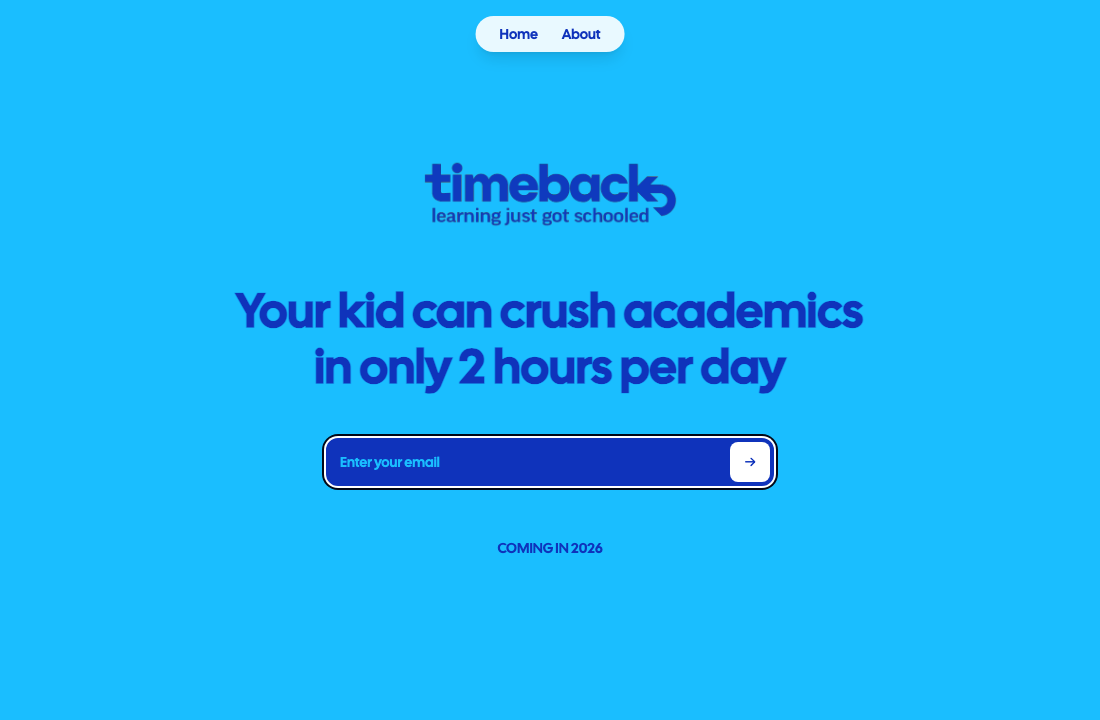
Timeback is the software underneath. Its home page is a waitlist that promises to notify you "when we launch in 2026". The form asks for an email address and nothing else, so an adult can join it. The headline above the form begins "Your kid".
Alpha's method, stated plainly
Academic work takes about two hours of a full school day. The FAQ: "Students typically spend about two hours per day on academic learning software." The afternoon goes to workshops on things like public speaking and entrepreneurship. Alpha's program page says the two hours are run with "time management techniques like Pomodoro".
Software chooses the level. Alpha calls this an AI tutor and says it means "every student learns at the right level for them". Grades do not cap anyone: "a 2nd grader ready for 5th-grade math will engage with that level".
A student moves on at a threshold. The FAQ puts it at 90%: "Students achieve 90% mastery in each concept before they move on."
The adults in the room are called guides, and they do not teach the material. Alpha's video about the school day describes them as "not lecturing, but coaching, mentoring, and motivating". The FAQ says they start at $100,000 a year.
Students are rewarded. 2 Hour Learning, the company that sells the model, has a heading that reads "Motivation with the right reward". Alpha's FAQ lists what students can earn: time outside, or "Alphas", a school currency they can spend on prizes "or larger rewards such as a laser tag party".
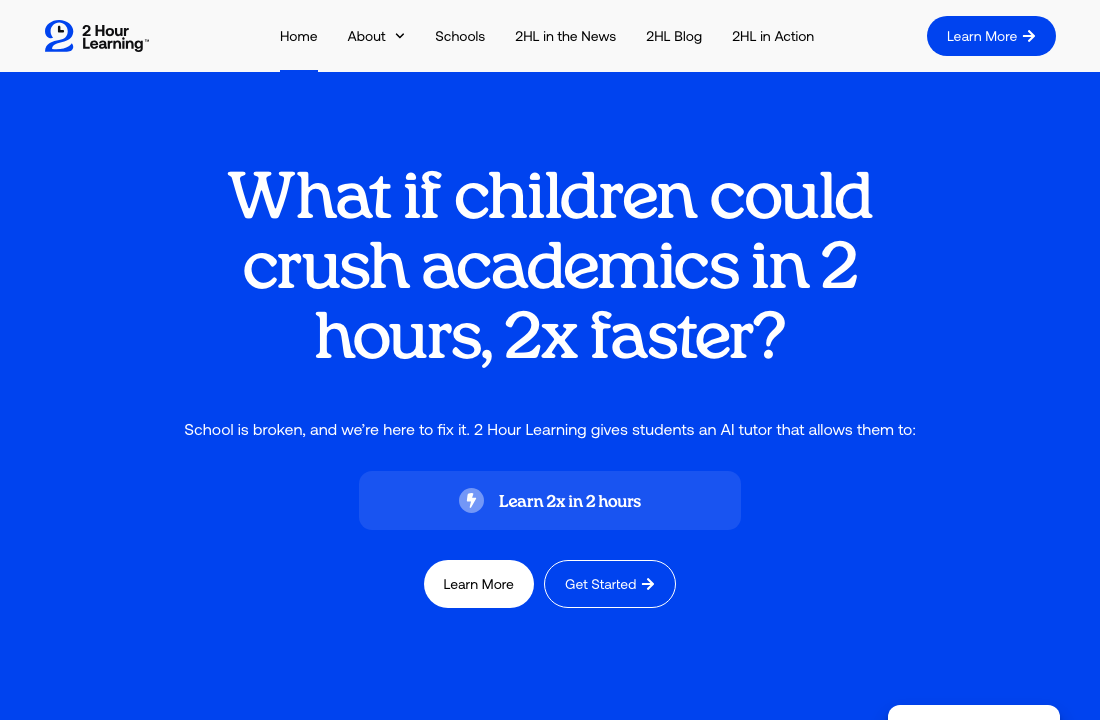
Alpha's pages do not name the apps. The best list I found is in Austin Scholar, a newsletter by an Alpha student, from August 2025. Math in grades 4 to 12 is Math Academy, and science in grades 6 to 8 is Khan Academy. Vocabulary is Membean, and from third grade reading and writing run on apps Alpha built itself. Progress is counted in XP, where one XP is one minute of productive work and the daily target is 120. I found no newer list, so the stack may have changed since.
The same newsletter tells parents where the effect comes from: "Don't focus on the app, focus on the motivation."
Alpha's program page says its students "grow 2.6 times faster than peers on nationally normed MAP tests". That is Alpha's own figure. Scientific American wrote that Alpha "has not released the underlying data behind its claims", and I found no independent evaluation of the school. I go through the claims and the evidence in my Alpha School review.
The parts with independent evidence
Mastery learning is older than Alpha by half a century. Benjamin Bloom proposed it in 1968. Kulik, Kulik and Bangert-Drowns (1990) pooled 108 controlled evaluations and found that mastery programs "have positive effects on the examination performance of students in colleges, high schools, and the upper grades in elementary schools", with stronger effects on the weaker students in a class. The same abstract carries a warning for anyone studying alone: "self-paced mastery programs often reduce the completion rates in college classes."
Alpha's 90% has a history too. In the experiments behind Bloom's 2 sigma paper, the tutored students had to score 90% before moving on and the mastery class 80%. Kurt VanLehn's 2011 review attributes most of Bloom's number to that criterion. I went through those studies in my history of intelligent tutoring systems, along with the more sober estimates of what one-to-one tutoring adds: 0.79 standard deviations in VanLehn's review, and 0.37 in a 2020 meta-analysis by Nickow, Oreopoulos and Quan.
Retrieval and spacing are well supported. Students who tried to recall a passage remembered 56% of it a week later, against 42% for students who reread it. A review of 317 experiments on spaced practice found that the best gap between reviews grows with how long you want to remember. The sources are in my posts on audiobooks and reading and on learning apps for adults. Math Academy, the app Alpha uses for math, schedules its reviews this way.
Two hours is a defensible length for hard practice. Anders Ericsson's 1993 paper on deliberate practice summarises training studies that compared one to eight hours a day and found "essentially no benefit from durations exceeding 4 hr per day and reduced benefits from practice exceeding 2 hr". Those studies were about skills such as typing, and his best violinists practised alone for 3.5 hours a day. The paper supports a short daily block of full attention. It says nothing about a school finishing its academics by lunch.
The parts an adult lacks
Nobody is paid $100,000 to notice that you skipped Tuesday. There are no classmates doing the same thing at the next desk either.
A child's two hours sit inside a day that someone else organised. Yours come out of a day that already has a job in it.
The laser tag you would have to fund personally, as the person who also approves the budget. A reward you can grant yourself at any time is a weak reward.
This is where self-study usually fails. In MIT's and Harvard's online courses, about 3% of participants finished in 2017-18, and 46% of those who had paid for a certificate did. Kulik's warning about self-paced courses points the same way.
The adult version, part by part
| Alpha's part | Adult equivalent | Cost |
|---|---|---|
| Two-hour academic block | The same two hours on your calendar every weekday, in 25-minute or 50-minute sessions | Free |
| Adaptive software, math | Math Academy | $49 a month, no free trial |
| Adaptive software, other school subjects | Khan Academy | Free |
| Mastery threshold | Math Academy's timed quizzes; Khan Academy's mastery levels | Included |
| Spaced review | Math Academy schedules it for math; Anki for everything else | Free; $24.99 once on iPhone |
| Guide | A study partner, or Focusmate, which pairs you with a stranger on video for 25, 50 or 75 minutes | Free for three sessions a week; $8 to $12 a month unlimited |
| Rewards | A stake someone else holds, such as a friend who expects a weekly report | Free |
| Someone who asks you to explain | ChatGPT Study Mode, or Understand | Free; free for now |
I read Focusmate's prices on October 3, 2026. The others are from my earlier posts, where each is sourced. The total is $49 to $61 a month, against tuition that starts at $40,000 a year at most campuses.
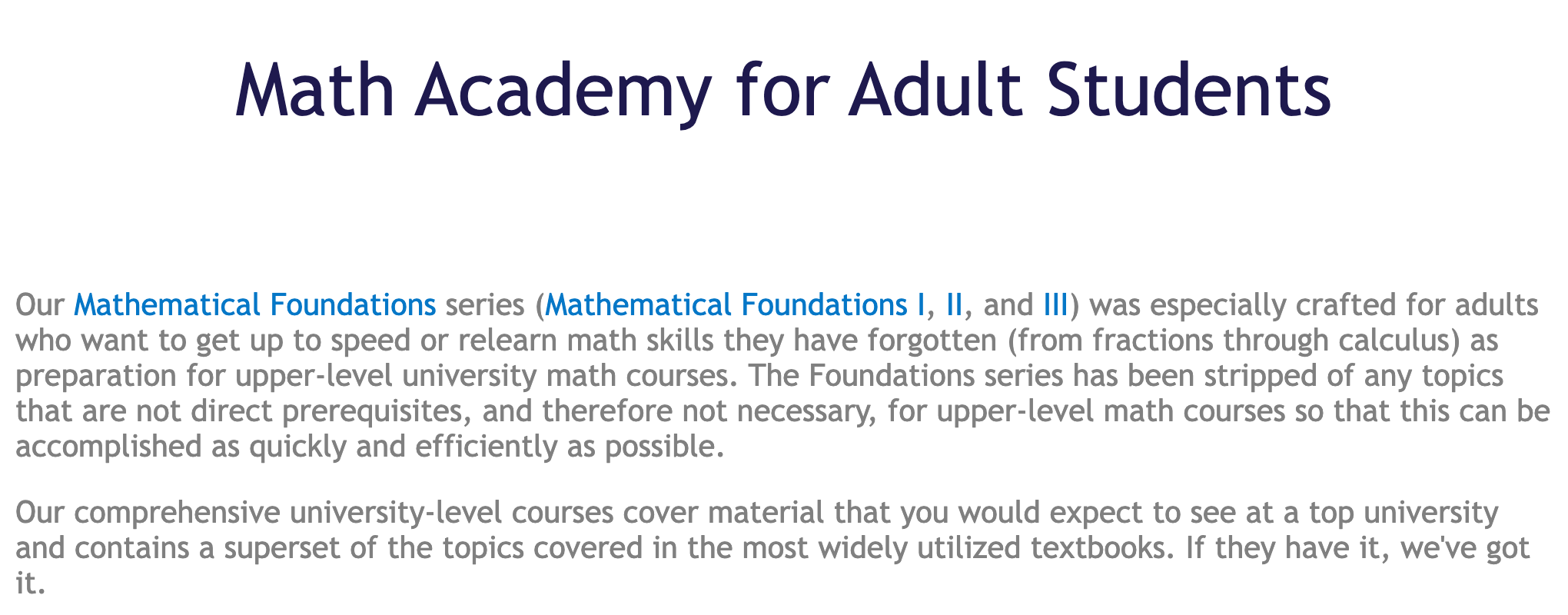
Math Academy is the one piece that is literally the same product. It has courses built for adults, and I collected what adults report after months of it in my Math Academy review.
A curriculum someone else chose
The table copies the mechanics. I do not think an adult should copy the premise.
A child at Alpha is taken through a school curriculum, grade level by grade level, and measured on a standardised test. Somebody else chose the content, and the test says when it is done. For a twelve-year-old who has to cover seventh-grade math, a system that covers it in two hours has a clear job.
An adult rarely wants a curriculum and has no test. What an adult usually has is a question: why interest rates move bond prices, or what an eigenvector is doing in the paper open in the next tab. I argued in the Math Academy review that the question should set the order. Karl Popper wanted a school "in which no unwanted answers to unasked questions would have to be listened to". David Deutsch follows him in holding that knowledge grows by conjecture and criticism, and a conjecture is an attempt on a problem somebody actually has.
The counter-argument is strong in subjects that stack. Justin Skycak of Math Academy writes that math is a subject "where each advanced skill requires many simpler skills to be applied in complex ways". Someone who asks how backpropagation works without knowing what a derivative is will stall within minutes.
So I would keep both. Start from the question, find out which fluent skills it needs, and hand those skills to the mastery software. The question tells you why you are doing the drills, and for an adult with no guide and no Alphas, that reason is most of the motivation available.
A two-hour day for one adult
Take someone who writes software and wants to understand why backpropagation works. They know single-variable calculus. Math Academy's Mathematics for Machine Learning course is about 70 hours for a person like that, by Skycak's 2024 estimate.
At 7:00 they open a Focusmate session and tell the stranger on the screen what the next 50 minutes are for. This is the nearest thing to Alpha's morning launch that an adult can book online.
From 7:00 to 7:50 they do Math Academy until they have earned 50 XP. The software picks the tasks. Their only decision is to keep going.
From 7:50 to 8:00 they stand up and leave the room. Alpha gives its students a movement break between the two hours, and the adult version is a kettle.
From 8:00 to 8:30 they work on the question itself. They read the section of the paper or the textbook chapter that raised it, with a pencil, and write down the first sentence they cannot follow. The reading time calculator says how many pages fit in half an hour.
From 8:30 to 8:45 they close everything and explain one idea aloud: today's, and the one from a week ago. A voice memo will do, and a tutor or a patient colleague is better because they can ask what you meant. Each sentence they cannot finish goes on a list.
From 8:45 to 9:00 they turn the definitions from that list into Anki cards and clear the cards that are due.
At 50 XP a day, five days a week, 70 hours is about 17 weeks, if an XP is the minute Math Academy means it to be.
The adult has no MAP test and nobody is going to hand over a certificate. I would set the threshold this way: you have mastered an idea when you can explain it aloud a week later with nothing open, to someone who is allowed to interrupt. That is the 56%-against-42% experiment turned into a habit, and it catches a failure the quizzes miss. Michael Pershan, a math teacher, aced Math Academy's quizzes on probability and reported: "I still don't know what a geometric distribution is."
Understand
Understand is built for the 8:30 slot. It is a voice call with a tutor on any subject. It asks you to explain an idea in your own words before it explains anything, and it files what you said under that concept in an outline you can read and correct. It also reads an article or a text PDF aloud and stops when you ask a question.
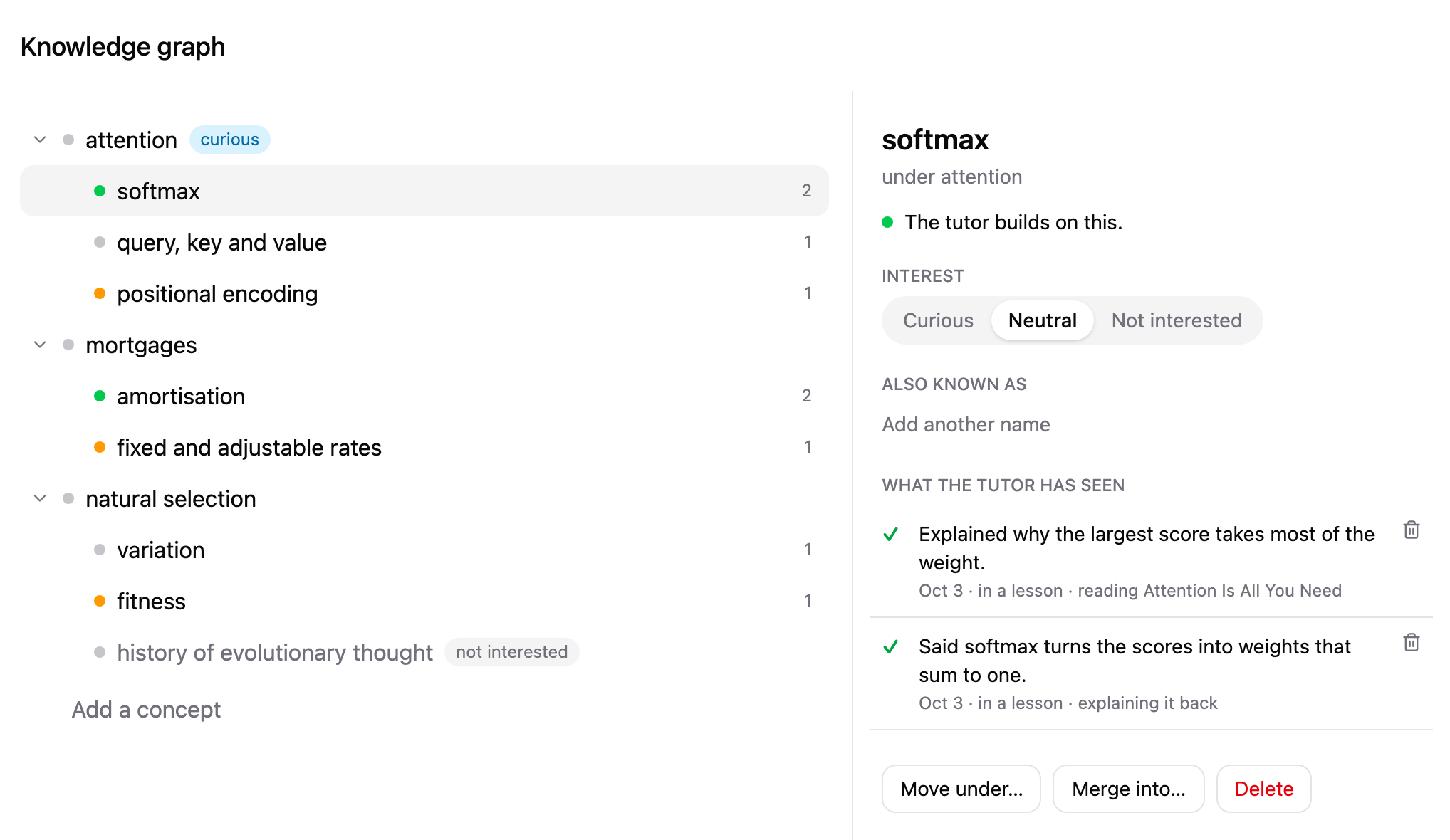
It covers none of the other rows in the table. It has no curriculum, no problem sets and no spaced repetition, so it will not make anyone fluent at computing a gradient. There is no Android app. Nobody has run a trial of it, so I can offer no more independent evidence for it than Alpha offers for its school.
If you only buy one thing from the table, buy the one that matches your question. For a question that needs calculation, that is Math Academy.