Alpha School review: tuition, the AI tutor and the evidence for 2 Hour Learning
Alpha School charges $75,000 a year in San Francisco and $10,000 in Brownsville, Texas. Its program page says students "complete core subjects in just two hours daily" and "grow 2.6 times faster than peers on nationally normed MAP tests". I have never visited an Alpha campus. This review comes from Alpha's own pages, a state charter decision, and the reporters, teachers and parents who have written about it at length. I build Understand, a tutor for adults, and I have no connection to Alpha.
Alpha School in brief
MacKenzie Price started the school in Austin in 2014 with Brian Holtz, in Holtz's house, with 16 children and the name Emergent Academy. That is Jeremy Stern's account in his profile of Joe Liemandt for Colossus, August 2025. WIRED reports that it became Alpha School in 2019.
Liemandt founded the software company Trilogy in 1989, sent his daughters to the school, and now holds the title of principal. Stern, who interviewed him, writes that since 2022 Liemandt "has taken $1 billion out of Trilogy/ESW in order to fund and incubate proprietary AI software products at Alpha School". I found no filing that confirms the figure. Alpha's blog calls its software platform "a $100 million project".
2 Hour Learning is the name of the model. Timeback is the software, and since November 2025 also the new name for the model. Alpha's site menu lists "Specialty Schools": GT School, Montessorium, NextGen Academy, Nova Academy, Texas Sports Academy and Waypoint Academy. Unbound Academy is a tuition-free virtual charter school in Arizona for grades 4 to 8. Its charter application named Price as board president, according to Dan Meyer, who read it. Alpha Anywhere is the at-home version, and Alpha's FAQ says its enrollment "is paused through the end of 2026".
Campuses and tuition
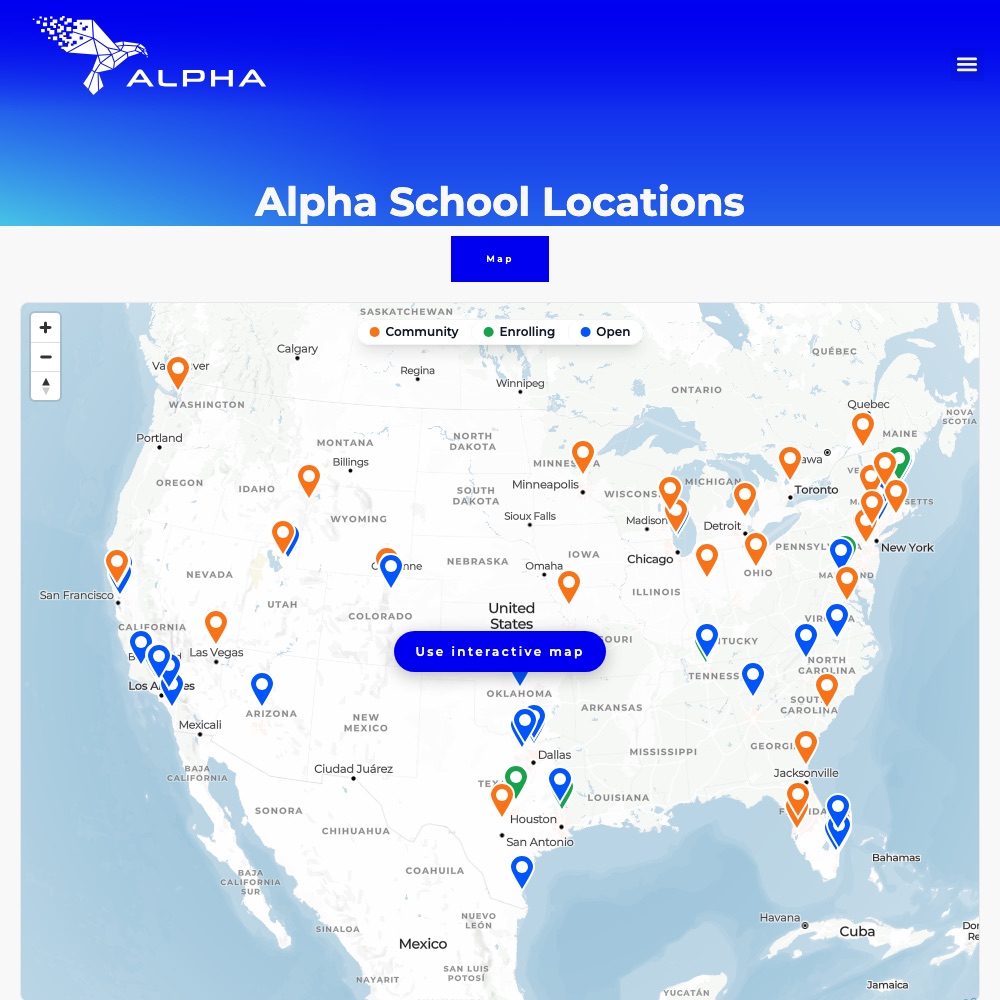
Alpha's locations page listed 47 campuses when I read it on October 3, 2026, of which 13 take applications only for a 2026-27 waitlist.
| Tuition per year | Campuses |
|---|---|
| $10,000 | Brownsville, TX |
| $40,000 | Austin, Alpha High (Austin), The Woodlands, Fort Worth, Houston Heights, Southlake, Scottsdale, Oklahoma City, Tulsa |
| $45,000 | Raleigh, Charlotte |
| $50,000 | Santa Barbara, Orange County, La Jolla, Miami, Palm Beach, Plano, Lake Travis, Carrollton, Dorado, Atlanta, Park City, Nashville, Franklin, Denver |
| $55,000 | Chicago, Kirkland, Boca Raton |
| $60,000 | Highland Park (Dallas), Malibu, Jamaica Plain |
| $65,000 | New York, Chantilly, Bethesda, Boston, Lexington, Greenwich Armonk, East Bay, Santa Monica, South Bay LA, Miami Beach |
| $75,000 | San Francisco, Palo Alto |
| "Contact for pricing" | San Juan, Alpha Austin Founders, Alpha Anywhere Center Founders |
The admissions page adds a $100 application fee, a $1,000 deposit credited toward tuition, and a 5% discount for a second child. The FAQ says tuition covers every activity, "like a trip to Formula 1 or Poland", and that Alpha "will never EVER ask parents for additional fundraising".
The page gives no enrollment numbers, and I found no total for the network on any Alpha page.
A day at Alpha
Alpha's own description has the morning start with a group "launch" led by guides. Students then open the Timeback dashboard, pick a subject and work in short cycles with a movement break between the first hour and the second. Afternoons go to workshops on public speaking, entrepreneurship and other "life skills". The FAQ says students "achieve 90% mastery in each concept before they move on".
The adults in the room are called guides. The FAQ says they are chosen for "their ability to motivate and engage with students" and paid a starting salary of $100,000. The 2 Hour Learning site says of them: "they do not teach academics".
The most detailed account by a parent is the Astral Codex Ten guest review of June 27, 2025. Its author was anonymous at publication and had children at GT School. Drop-off was at 8:30. The children started on the platform between 9 and 9:30 and were "occupied with academics until noon-1230pm". The reviewer's summary: "They really are spending roughly 2 hours learning, it just takes half the day to get that 2-hours of focus in."
Each child had 8 to 12 required lessons a day, called minimums. A child who kept stumbling was told to book a video call with a remote coach. The reviewer put the ratio at five students to one guide. Chad Aldeman, writing in The 74 in January 2026, put it at one for every eight.
Then there are the rewards, which the reviewer calls the part "that doesn't get mentioned in the PR copy". Finishing the minimums earned about 10 "GT Bucks", worth 10 cents each and spendable at a school store. A summer experiment paid $1 per lesson in real dollars. The FAQ now describes the currency itself: students earn "Alphas" toward prizes "or larger rewards such as a laser tag party". WIRED found one Alpha worth 25 cents at the Brownsville campus.
The reviewer adds that a home pilot of the same software, without guides or rewards, produced about 1x growth.
The AI tutor
In 2024-25 the software was mostly other companies' courseware behind one login. The reviewer lists IXL for math, language and science, with Rocket Math, Duolingo, Amira and Lalilo beside it, and estimates IXL at 80% of academic work. On the question of AI the review says: "There is no 'generative AI' powered by OpenAI, Gemini or Claude in the platform the kids use". Its description is a "turbocharged spreadsheet checklist with a spaced-repetition algorithm".
IXL told WIRED that it deactivated Alpha's account in July 2025 and that Alpha is "no longer an IXL customer due to violating our terms of service".
The 2025-26 stack is described in Austin Scholar #177 of August 2025, a newsletter about Alpha that Piper, cited below, describes as written by alumni. Math from fourth grade runs on Math Academy, which I reviewed for adults. Science for grades 6 to 8 uses Khan Academy, the library behind Khanmigo. Alpha builds the reading and writing apps itself.
Generative AI enters in two places, by Stern's account of a demo he was given. An engine called Incept wraps commercial large language models to produce lessons, reading passages and videos. Timeback's "primary tool is the vision model that monitors and records a student's 'anti-patterns'", such as rushing or socializing, and feeds a "waste meter" shown to the student.
This is a different thing from an LLM tutor. ChatGPT's study mode and Khanmigo are conversations, in which the student types a question and a language model replies. I compared those products in the best AI tutors. At Alpha the child works through exercises, the software grades them and chooses the next one, and a language model may have written the passage. Liemandt told Stern:
"Not chatbots. If you deploy ChatGPT to every student in America, we will become the dumbest country on the planet."
He has a study on his side. Bastani and colleagues gave high school students plain GPT-4 for math practice and found they scored 17% below their peers once it was taken away. The study is in my history of intelligent tutoring systems, along with the older adaptive courseware that IXL descends from.
The label "AI tutor" on the 2 Hour Learning home page therefore describes adaptive practice software, a content generator and a monitoring system. A student who is stuck gets a human on a video call.
The claims and the evidence
| Claim | Alpha's published data | Independent findings |
|---|---|---|
| "Learn 2x in 2 hours"; students "grow 2.6 times faster" on MAP | The figure on the program page, with no dataset. A mid-year post of February 2026 with the heading "Math Growth: 1.7x to 5.0x the National Average" | Kelsey Piper: the multiple is a ratio against expected gains that are close to zero for older, high-scoring students. Peter Naimoli, an Alpha parent: "2.6 is an erroneously computed and meaningless number" |
| "Top 1-2% nationally"; 99th percentile | The same post: 99th percentile achievement "in virtually every grade", on about 407 math growth events, with grade cohorts of 42 to 50 | Andrew McEachin of ETS, in Scientific American: the scores may reflect "who's attending the school, not the experience of the kid attending" |
| SAT scores | Stern was shown data with an average of 1535 for 11th graders and 1410 for 9th graders. The mid-year post gives a projected average of 1500 to 1560, computed from MAP scores | I found no independent source for either number |
| "The top 20% of students show 6.5x growth" | The sentence on 2hourlearning.com, footnoted "Based on data collected from our flagship campus, Alpha School" | Nothing |
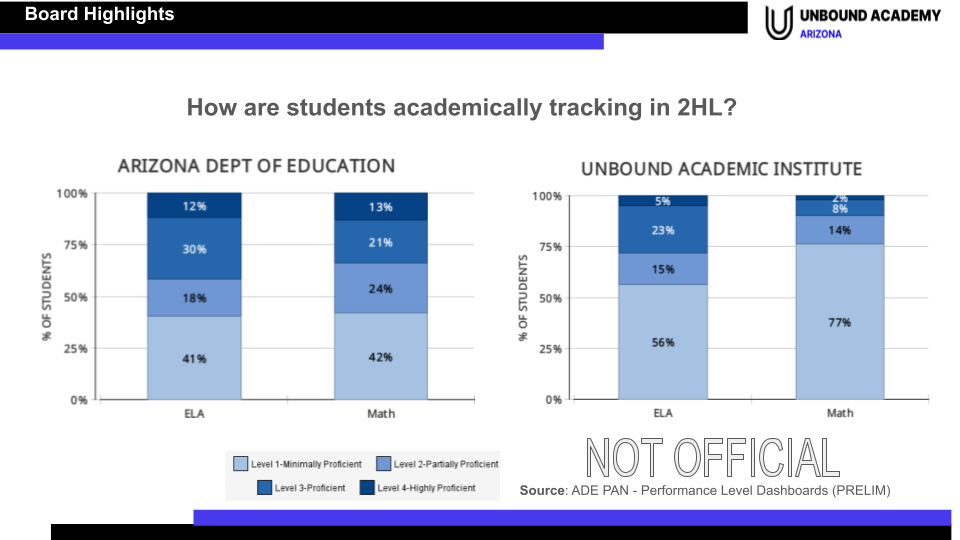
| The model works without private-school admissions | Unbound Academy's charter application projected 60% proficient in math and 65% in English after year one, as quoted by Dan Meyer | Unbound's own board slide: 10% and 28%, against Arizona's 34% and 42%. Preliminary |
The mid-year post is the fullest data Alpha has released. By its own account, the principal "fed our Fall 2025 to Winter 2026 NWEA MAP dataset into both Gemini and Claude" and asked how Alpha compares to elite private schools. The post is the two chatbots' replies. Both were complimentary. Gemini's closes with advice for the principal: "This report is your strongest asset for retention." The underlying dataset is not attached.
Piper's analysis in The Argument, August 25, 2026, explains the multiple. Alpha compares each student's MAP gain with the median gain expected for a student at that grade and percentile. Her example is a ninth grader at the 90th percentile in reading, expected to gain 0.23 points from fall to spring. A gain of two points, which she calls "within normal random variation", counts as about 9x. Averaging such ratios over small groups yields the school-wide figure. Naimoli, who worked through the same arithmetic in July 2025, adds: "I love the school". Piper's own guess is that the gains over a conventional program "are real if the program is a good fit", at a size well short of 2x. She writes that Alpha did not respond before publication.
Piper also relays a number from Matt Bateman, the principal of Montessorium: "the actual statistically precise effect of Alpha on student performance is 1.4 sigma." No analysis behind it has been published. For scale, Kurt VanLehn's review of human tutoring found an average of 0.79.
Dylan Kane, a math teacher, compared the figures before and after the new platform: 2.6x on mostly IXL, then about 2.5x in math and 2.8x in reading on Timeback. His conclusion: "Motivation is doing most of the work."
Unbound Academy is the nearest thing to a test on students Alpha did not select. Meyer found the result in the school's public board materials in August 2026. I opened the slide. It is marked "NOT OFFICIAL", cites the Arizona Department of Education's preliminary dashboards, and another slide reports MAP growth of 1.8x for the same school. Meyer notes that the students may have arrived below the baseline the application assumed. The school counted 202 active students in March. Its website now says certified teachers are on screen all morning and that "our students go to them first, not the software".
I found no independent evaluation of Alpha, by which I mean a randomized trial or an outside audit of its MAP data. Scientific American wrote on August 28, 2026 that "Alpha School has not released the underlying data behind its claims." WIRED says Price initially said Alpha would share its data and did not.
Selection
A school that charges $40,000 to $75,000 enrolls children whose parents can pay it and chose to. Alpha's admissions page describes a shadow day, followed by a meeting to "review the MAP exam results" and the feedback from that day before an offer is made. Meyer quotes the application as asking that students be "functioning within a typical range of ability and independence". Any private school with an admissions process gets high average scores this way, and none of it requires bad faith. A 99th-percentile average then says little about what the school added. Growth figures handle selection better, which is why the arithmetic behind 2.6x matters. Cohorts of 42 to 50 per grade make any average jumpy. The reviewer's 5x figure for GT School rested on five children who took both tests.
The parts with evidence behind them
Mastery learning is old and reasonably well supported. In Bloom's 1984 experiments, a class that had to pass each unit before moving on scored about one standard deviation above a conventional class. VanLehn attributes most of Bloom's famous tutoring result to the mastery criterion, which was 90% for the tutored students. Alpha's FAQ uses the same number.
One-to-one tutoring works, at a smaller size than the slogan. The meta-analyses I cited in the history post put it at 0.33 to 0.37 standard deviations on average. Good tutoring software also works, and shrinks at scale: RAND's trial of Cognitive Tutor Algebra found about 0.2 standard deviations in the second year and nothing in the first.
Software helps only students who use it. The two-year trial of Khanmigo that I described in my Khanmigo review found small gains, with the median student messaging the tutor on a third of practice days. Alpha's bet is that adults and prizes fix this. Roland Fryer's 2011 experiments in more than 200 urban schools are the usual citation, and they are weaker support than they sound. He paid students to read books in Dallas, for test results in New York and for grades in Chicago, and estimated the effect on achievement as "statistically 0, in each city". The one significant result was for English-speaking students in Dallas, the city that paid for reading. Paying for the work has more behind it than paying for the score, and neither has much.
A room with one adult for every five to eight children is a rare thing in any school. It is also the part of Alpha that costs the most to copy.
Reported problems and regulatory decisions
Todd Feathers reported in WIRED on October 27, 2025 on families who left the Brownsville campus. One mother told him her nine-year-old daughter was required to repeat a multiplication lesson in IXL more than 20 times without an error, that the school informed the parents the girl was not eating lunch, and that the girl said staff told her she would not get her snacks until she met her learning metrics. A former student described pulling her hair and going without food while trying to meet her goals. The same student said she received a notification at home with webcam video of herself, flagged as an "anti-pattern". WIRED describes school documents that allow recording of screens, mouse and keyboard use, and eye tracking, with a home setting parents must opt out of. Alpha's lawyers told WIRED: "Allegations that Alpha has mistreated, punished, or caused harm to any student are categorically and demonstrably false." Alpha also said it holds records that "materially contradict key elements" of the reporting. Price told WIRED that Alpha is not for everyone.
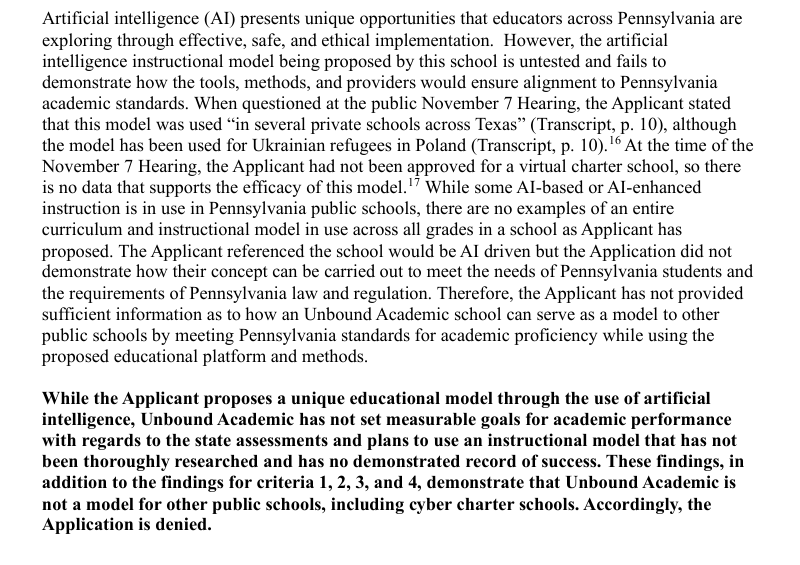
The Pennsylvania Department of Education denied Unbound's cyber charter application on January 29, 2025, finding deficiencies in all five statutory criteria. Most of the 25 pages concern an incomplete application, such as missing board policies and no evidence of support from parents or teachers. On the model it wrote that the applicant "plans to use an instructional model that has not been thoroughly researched and has no demonstrated record of success". A footnote says the MAP results supplied "cannot be substantiated or used as a suitable measure of potential performance". To decide whether the school could be a "model" for others, the department consulted Merriam-Webster.
Lexi Churchill of ProPublica and The Texas Tribune reported on September 2, 2026 that at least nine states have rejected Alpha-linked charter applications and that Arizona alone approved one. She also reported on Texas Preparatory School, an Austin charter that used the platform and received a third consecutive F rating. An Alpha spokesperson answered only her questions about other outlets' reporting.
Feathers reported on June 4, 2026 that the New York State Education Department had declined to incorporate the Manhattan campus as a school, describing instruction "with little to no supervision or competent teacher". Alpha's statement: "Our New York location is a homeschooling learning center, not a school, and every parent whose child participates in that program knows it." A group of parents sent WIRED a joint statement, with 13 named signatories, saying they knew it. A new application was pending.
Questions for a campus
- How many students are enrolled here this year, and how many per grade?
- Is this campus incorporated as a school in this state, and who accredits it?
- What is my child's expected MAP growth in points, and what did students at their percentile gain here last year?
- What rewards are attached to lessons and to test scores, in dollars?
- What happens when a child falls behind their daily targets, and who decides?
- Who helps with content when a child is stuck, how fast, and what is that person's training?
- What does the software record on a school laptop, at school and at home, and which parts can I switch off?
- How many families left this campus last year?
- Which whole books will my child read this year?
The last question comes from Michael Pershan, who watched Alpha's promotional videos and, as Piper quotes him, "struggled to find footage of a student reading a book".
Test scores and understanding
Every result Alpha publishes is a score on MAP, which the reviewer describes as entirely multiple choice. I believe the careful critics that the growth is real for many of its students and smaller than advertised. The reviewer who admires the school most also lists what the test leaves out, starting with writing essays and "making connections between two disparate concepts or ideas".
My interest is in that remainder. I trust one kind of evidence that a person understands an idea, which is their explanation of it in their own words when asked. A percentile on MAP records something else.
Understand is for adults. It has no courses and no curriculum, and it has not been evaluated in any trial. An adult who wants Alpha's method can assemble most of it from tools sold to anyone, which I describe in Alpha School for adults. It keeps a record of what you managed to explain, concept by concept, and you can read and correct it.