Acton Academy vs Alpha School: cost, daily model and the evidence for each
Acton Academy tells people who want to open one of its schools to hire a guide who is "100% committed to never answering a question (and we mean never) from Day One". Acton is a network of about 300 small private schools, each owned by the people who started it, where children learn core skills from software and the adults run Socratic discussions. Alpha School was started in Austin five years later with an Acton parent as co-founder, also uses software and guides, and charges $40,000 a year in the city where Acton's original campus charges $14,894. I have visited neither. This comparison rests on each network's own pages, a public Acton document for prospective owners, and reporting by named journalists. I build Understand, a tutor for adults, and I have no connection to either school.
Acton Academy in brief
Jeff and Laura Sandefer opened Acton Academy in Austin in 2009, in a rented house, with their two sons and a handful of neighborhood children. That is the account on Acton's story page. EdSurge gave the year as 2008 and Forbes as 2010, so I am going with the people who were there.
Jeff Sandefer made his money in oil and then taught entrepreneurship. Ralph K.M. Haurwitz profiled him in the Austin American-Statesman in May 2011, when the school had 18 students aged 6 to 10 in a converted law office. The school is named after Lord Acton, the historian who wrote that power tends to corrupt. One of its promises to families is "a deep respect for economic, political, and religious freedoms".
The first affiliates opened in 2012 in Venice Beach and Guatemala City. Laura Sandefer told the story in Courage to Grow: How Acton Academy Turns Learning Upside Down, published in 2017. In 2024 the Sandefers handed leadership of the network to Jake Thompson, who had built an Acton of his own.
The home page says "300+ schools" in 30 countries and 42 US states. The campus finder counted 287 when I read it on October 4, 2026, and 84 of those were marked "Coming Soon". The page for the book says 314.
The other press I could open is by Christina Quattrocchi in EdSurge (November 2013), Tom Foster in Inc. (March 2017, opening at the Acton Children's Business Fair on the Sandefers' lawn), and Kerry McDonald in Forbes (December 2021). The EdSurge and Forbes pieces are friendly portraits. I found no critical reporting on Acton by a named outlet. Anonymous posts exist on Reddit and elsewhere, and I have left them out.
A day at Acton
Acton calls its classrooms studios and its adults guides. Studios mix ages: Spark for 4 to 7, Elementary for 7 to 11, Middle School for 11 to 14 and Launchpad for 14 to 18.
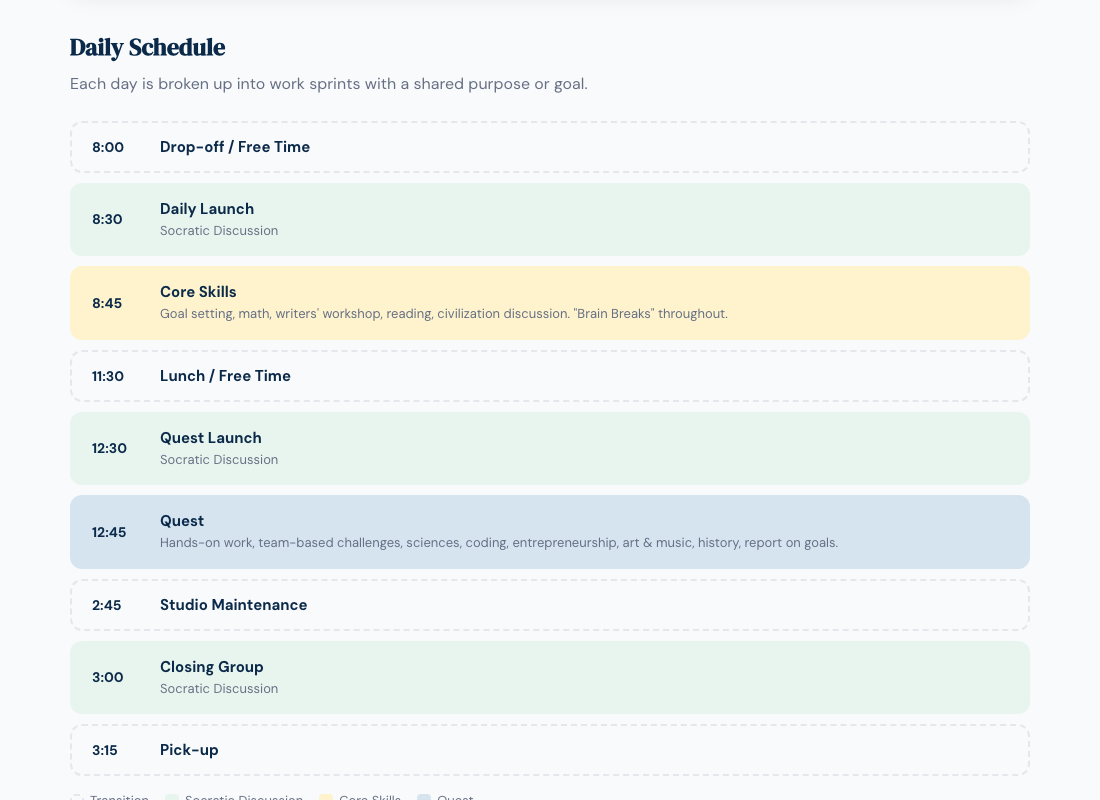
The model page gives the day. A Socratic discussion at 8:30 is followed by "Core Skills" from 8:45 to 11:30, which covers goal setting, math, writing and reading. After lunch comes a quest, which is hands-on project work, and learners present what they made in public at the end of each four to six week sprint. Two more Socratic discussions open the quest and close the day at 3:00.
Core skills run on software. The network's pages say only "the latest in educational technology for self-paced mastery" and put screen time at 1 to 1.5 hours a day, less for the youngest. Individual campuses name the products. Acton Academy Northwest Austin lists "Khan Academy, DreamBox, IXL, Lexia, etc." and Acton Academy Silicon Valley lists "Khan Academy, IXL, Aleks, and others". At the affiliate north of Boston that McDonald visited for Forbes, the children used Khan Academy for math, Lexia for reading and Night Zookeeper for writing. I have reviewed IXL separately.
There are no grades. Learners earn badges for mastery and review each other at the end of each session. The original campus adds that learners earn "points for effort", and Acton's document for owners mentions "Eagle Bucks" among the optional systems.
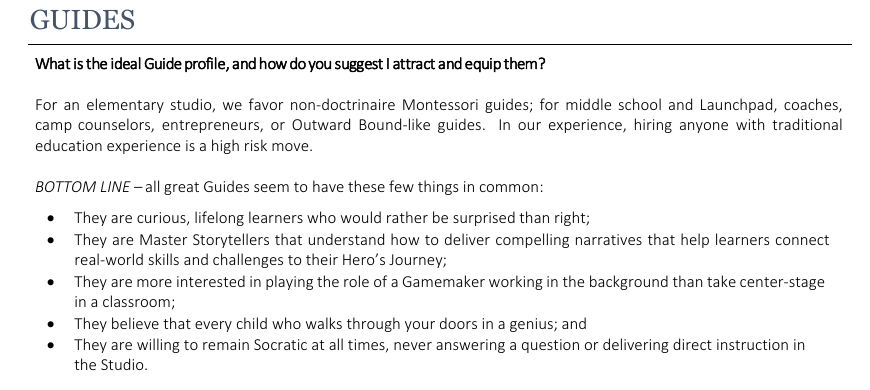
The adults do not teach. The model page describes them as "Guides who ask questions, not give answers". The Affiliate FAQ, a PDF linked from Acton's resource library, says great guides are "willing to remain Socratic at all times, never answering a question or delivering direct instruction in the Studio". It adds that "hiring anyone with traditional education experience is a high risk move".
Self-governance is the other half. Learners write and sign a contract of promises that sets the consequences for breaking it. They pair up as "running partners" who hold each other to their goals.
The licence and the tuition
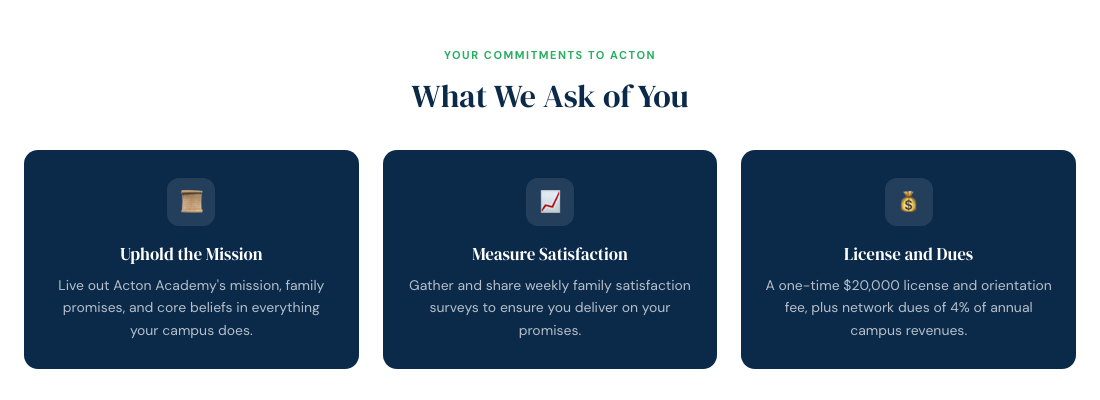
Every Acton is "locally owned and independently operated". Anyone who passes the audition pays the network "a one-time $20,000 license and orientation fee, plus network dues of 4% of annual campus revenues". A guide who works at an Acton for two years has the fee waived. The Affiliate FAQ, whose file dates from 2019 with edits in 2023, gives the dues as 3% and describes what the money buys as "a do-it-yourself kit with a strongly committed tribe, rather than any sort of cookie-cutter franchise".
Owners set their own tuition, so there is no network price. These are the figures campuses publish on their own sites:
- Acton Academy Albuquerque: $10,450 a year for all ages.
- Acton Academy NW Indianapolis: $11,490 for 2026-27, supplies included.
- Acton Academy North Broward, Florida: $14,500.
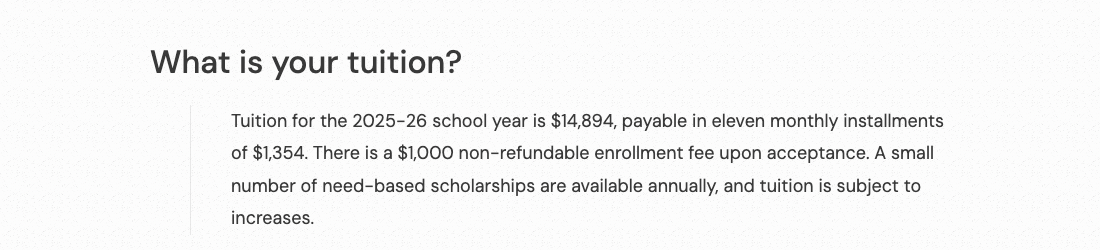
- Acton Austin Main, the original campus: $14,894 for 2025-26, plus a $1,000 enrollment fee.
- Acton Academy Northwest Austin: $1,350 a month, billed 12 months a year, which is $16,200.
- Acton Academy Silicon Valley: $27,500 for 2026-27.
The original school charged $850 a month in 2011-12, according to a Christensen Institute profile that Jeff Sandefer submitted. EdSurge reported in 2013 that Acton hoped to bring tuition down to $1,500 to $2,000 a year once the model covered every grade. It went the other way.
Alpha School in brief
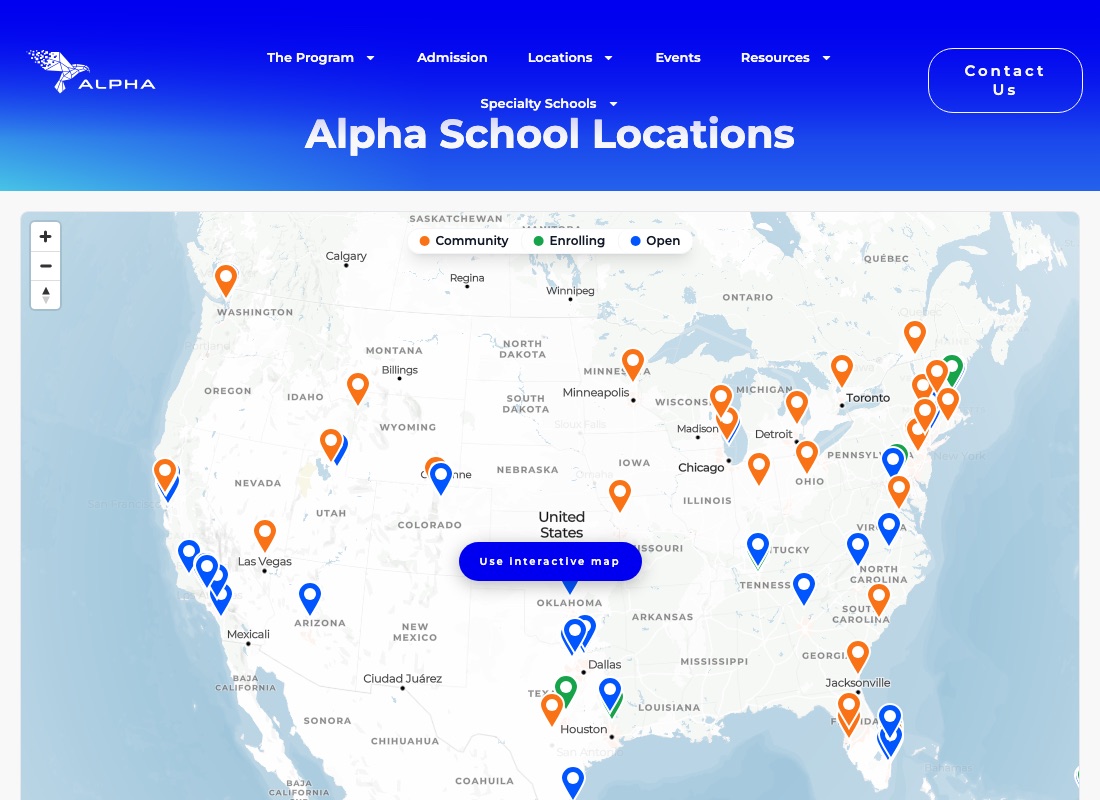
I covered Alpha at length in my Alpha School review. MacKenzie Price started it in Austin in 2014, by Jeremy Stern's account below. The rest of this paragraph is from Alpha's pages as they read on October 4, 2026. The locations page lists 47 campuses, and the 44 with a price run from $10,000 in Brownsville to $75,000 in San Francisco, with Austin at $40,000. The FAQ says students "typically spend about two hours per day on academic learning software" and reach "90% mastery in each concept before they move on". Guides are paid from $100,000 and are chosen for "their ability to motivate and engage with students". Students earn "Alphas", a school currency spent on prizes.
The two schools are related. Stern's profile of Joe Liemandt for Colossus says Price started the school with Brian Holtz, "then a parent at Acton Academy", in Holtz's house with 16 children. The early days Stern describes sound like Acton: Khan Academy, ALEKS and DreamBox in the morning, then "Hero's Journey performances", the Hero's Journey being Acton's organizing story.
Alpha keeps an eye on its ancestor. A post on Alpha's site from March 2025 ranks the alternative private schools of Austin. Alpha comes first. Acton comes fourth, and the first of its two listed cons is "Minimal direct instruction may overwhelm some learners".
Acton and Alpha side by side
| Acton Academy | Alpha School | |
|---|---|---|
| Founded | 2009, Austin, by Jeff and Laura Sandefer | 2014, Austin, by MacKenzie Price with Brian Holtz |
| Campuses | "300+" on the home page; 287 in the finder, 84 of them "Coming Soon" | 47 listed, 13 of them waitlist only |
| Tuition | Set by each owner; $10,450 to $27,500 at the six campuses above | $40,000 to $75,000 at most campuses; $10,000 in Brownsville |
| Daily structure | Core skills 8:45 to 11:30, a quest in the afternoon, Socratic discussions at the start, middle and end | About two hours of academic software in the morning, life skills workshops in the afternoon |
| Role of adults | Guides ask questions and never answer them; pay is set by each campus | Guides motivate and run workshops; starting salary $100,000 |
| Software | Other companies' products, varying by campus: Khan Academy, DreamBox, IXL, Lexia, ALEKS | Alpha's own Timeback platform, which in 2025 included Math Academy and Khan Academy |
| Motivation | Badges, exhibitions, peer reviews, points for effort | School currency and prizes; a vision model that records the student and feeds a "waste meter", by Stern's account |
| Published evidence | Family satisfaction "9/10"; no test data on network pages | "2.6 times faster" on MAP; no dataset released |
| Independent evaluation | None found | None found |
| Ownership | Each campus independently owned; $20,000 licence plus 4% of revenue | One organization, with one admissions process and one price list |
Acton hands the day to the children and the school to whoever paid the $20,000. Alpha schedules the day itself and keeps the schools.
Evidence for either
Acton's network pages publish no test results. The Affiliate FAQ answers the question of how success is measured with "Mainly, customer satisfaction ratings", and owners are asked to run weekly family surveys. The number on the home page is "9/10".
The claims about achievement that turned up come without data. The Christensen profile, written from the school's own submission in 2012, says students take the Stanford 10 and "are progressing 3-5 grade levels above students their age". EdSurge wrote in 2013 that students "gain an average of three grade levels each year" and gave no source. Northwest Austin's FAQ says it is "not uncommon" for Acton students to reach two to three grade levels above their age. I found no dataset and no independent evaluation of any Acton campus.
Selection would complicate any such number. At the original campus a family fills in an audition form and meets the school before it is invited to join, and the Affiliate FAQ advises new owners to "over qualify your first group of parents so you only accept the most committed".
Alpha publishes more and has been checked more. Its headline figure rests on a ratio that Kelsey Piper and an Alpha parent, Peter Naimoli, have both taken apart, and Scientific American wrote in August 2026 that Alpha "has not released the underlying data behind its claims". Lexi Churchill of ProPublica and The Texas Tribune reported in September 2026 that at least nine states have rejected charter applications tied to Alpha. The review covers that and the other critical reporting, with Alpha's responses. On independent evidence the two schools are level at zero.
Research on a tutor who never answers
Acton's rule interests me more than its software, because a tutor has to decide many times an hour whether to answer.
Paul Kirschner, John Sweller and Richard Clark argued in 2006 that "minimally guided instruction is less effective and less efficient" than guided instruction, and that the advantage of guidance recedes only when learners have "sufficiently high prior knowledge". It is a review and an argument from cognitive load theory with no pooled effect size, and I read only the abstract. Cindy Hmelo-Silver, Ravit Duncan and Clark Chinn replied in 2007 that the paper lumped problem-based and inquiry learning in with unguided discovery, when both are "highly scaffolded".
Louis Alfieri and colleagues put numbers on it in 2011 with two meta-analyses of 164 studies. Across 580 comparisons, explicit instruction beat unassisted discovery (d = -0.38, 95% CI -0.44 to -0.31). Across 360 comparisons, "enhanced" discovery beat other forms of instruction (d = 0.30, 95% CI 0.23 to 0.36). They conclude that "unassisted discovery does not benefit learners, whereas feedback, worked examples, scaffolding, and elicited explanations do". The studies span ages and subjects, so the averages hide a lot, and again I read the abstract.
On tutoring itself, Michelene Chi and colleagues ran a study in 2001 in which tutors "were suppressed from giving explanations and feedback" and told to prompt instead. The abstract reports that students "learned just as effectively". It gives no sample size, and it notes that what the students learned from reading on their own "was limited" by their reading ability. Kurt VanLehn and colleagues analyzed about 125 hours of expert physics tutoring in 2003 and found that learning was uncommon unless the student had first reached an impasse. Once the student was stuck, explanations were sometimes associated with learning. The study is correlational.
The newest evidence is about chatbots. In the Bastani experiment I describe in my history of intelligent tutoring systems, nearly a thousand high school students practiced math with GPT-4. Those given plain answers scored 17% below their peers once the tool was taken away, and for those given hints the harm was "largely mitigated".
Read against this, Acton is less radical than its slogan, because a studio has plenty of guidance in it. The software explains and grades, which is explicit instruction delivered by a screen. The quests come from the network. The guide's questions are a form of scaffolding, and older children explain things to younger ones. The adult is the one party in the room who will not answer.
Karl Popper wanted a school "in which no unwanted answers to unasked questions would have to be listened to". Acton has built roughly that. Its rule goes a step further and withholds wanted answers to asked questions, and here the research parts company with "never". In VanLehn's transcripts, explanations sometimes helped once the student was stuck. Popper and David Deutsch hold that knowledge grows by conjecture and criticism. A learner who has tried, got stuck and asked has already made the conjecture, and an answer at that point is criticism they requested. I think the right rule for a tutor is to ask first and answer at the impasse. Acton's own con, as listed by its competitor, is the Kirschner abstract in seven words.
For an adult
Neither school takes adults, and an adult can borrow from both.
From Acton I would take the exhibition and the running partner. Explain what you learned to people who can ask questions, on a date you fixed in advance, and have one person who asks each week whether you did what you said. Ask yourself the question before you look up the answer.
From Alpha I would take the clock and the threshold: a fixed block of practice on software that will not let you move on at 60%. I laid out a version built from tools anyone can buy in Alpha School for adults.
Understand
Understand is a voice tutor for adults that you can interrupt, and unlike an Acton guide it answers. It reads a text aloud word for word and stops when you ask a question. It asks you to explain an idea back and keeps a record of what you explained that you can read and correct. It has no courses, no problem sets, no spaced repetition and no Android app, no trial has evaluated it, and it is free for now.