IXL review: worth it for drill, and a comparison with Khan Academy
IXL's own guide to its scoring says that once a child's score on a skill passes 90, a right answer adds 1 or 2 points and a wrong one takes away 3 to 8. That rule explains most of the praise and most of the complaints I found. IXL is worth $9.95 to $19.95 a month for a child who needs graded practice that follows the school's standards, and it is the wrong purchase for anyone who wants a subject explained. Khan Academy explains more and costs nothing. I have not used IXL as a student or as a parent, so this review rests on IXL's public pages, the studies on its research page, and accounts by parents, teachers and students who put a name or a handle on what they wrote.
I build Understand, a voice tutor for adults, and I have no connection to IXL or to Khan Academy.
IXL in brief
IXL is a library of practice questions for school subjects, sorted into narrow topics it calls skills. Schools license it for their classes, and families can subscribe on their own. Its membership page counts more than 20,000 skills, with math from pre-K to calculus and language arts from pre-K to grade 12. Science, social studies and Spanish come with the larger plans. The same page adds more than 1,300 video tutorials and 120 games.
The company's history page dates it to 1998, when it released a quiz-making site called Quia. IXL itself arrived in 2007 as a math product. The company says 18 million students use it, one in four students in the United States. Along the way it bought Rosetta Stone, Wyzant, Teachers Pay Teachers, Dictionary.com and Thesaurus.com, so the firm that grades your child's vocabulary also owns the dictionary.
Family pricing
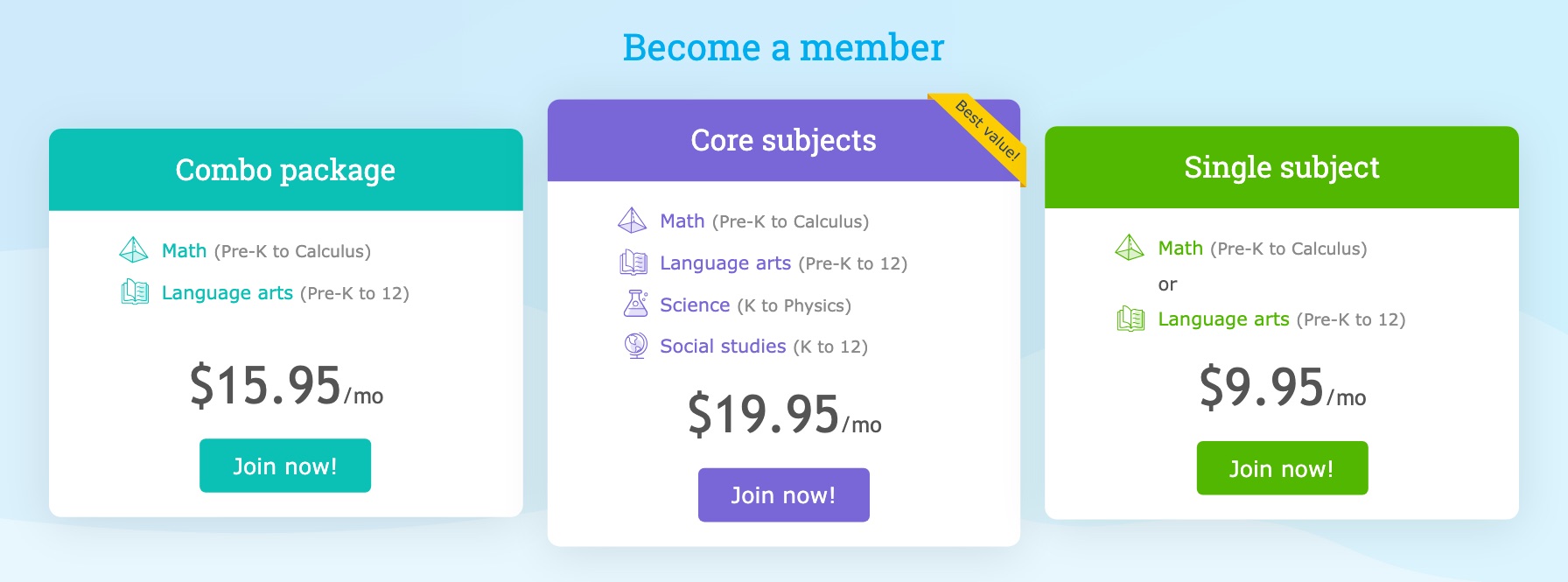
One subject, math or language arts, costs $9.95 a month. Both together cost $15.95, and the plan with science and social studies costs $19.95. The sign-up form adds $4 a month for each further child and $5 a month for Spanish. Paid yearly, the plans cost $79, $129 and $159, with $40 for each further child.
Common Sense Media's review says a child without a membership can try the exercises but is "limited to a small number of problems per day".
There is an adult edition too. IXL's home page links to IXL for independent learners with the line "Yes, IXL is for adults, too!" It costs $15.95 a month or $129 a year and offers practice plans for the GED, HiSET, ACCUPLACER, ASVAB and ACT.
Skills, the SmartScore and the Challenge Zone
A child opens a skill and answers questions. Each right answer raises a number called the SmartScore and each wrong answer lowers it. After a miss, IXL shows "a step-by-step explanation of the correct answer". Most of the teaching happens there, after the mistake.
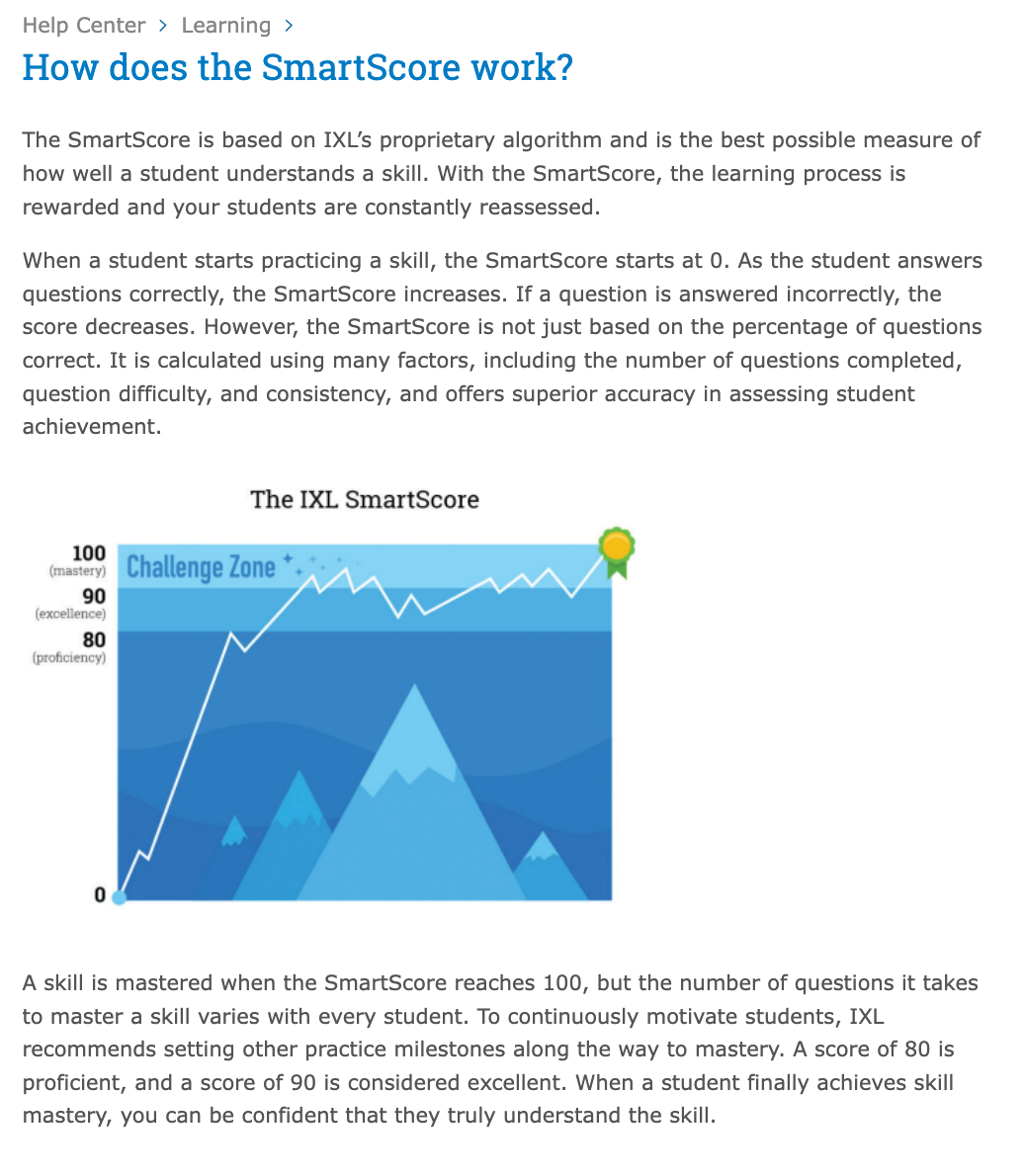
The help article calls the SmartScore "the best possible measure of how well a student understands a skill", a strong claim for a number the same sentence calls proprietary. It starts at 0. IXL treats 80 as proficient, 90 as excellent and 100 as mastered.
The guide for teachers and parents gives the mechanics. Up to 70 there are "large SmartScore increases for correct answers, and low penalties for incorrect answers". At 90 the child enters the Challenge Zone, where gains shrink to 1 or 2 points and penalties grow to 3 to 8. The guide says students "will need to answer as many as 10 questions correctly in a row to achieve mastery".
By those numbers, one slip in the Challenge Zone can cost between two and eight correct answers to win back. A score of 97 is one typo away from 89.
IXL does not ask every child to reach 100. The same guide calls 80 a "great goal" that "could be the perfect stopping point", and a post on IXL's blog says of mastery that "it's not always the right goal for every skill or every student". The adult who sets the target decides how much of the Challenge Zone a child sees.
The diagnostic
IXL's diagnostic page says it "pinpoints your child's knowledge levels in math and English language arts in just 45 minutes per subject" and then builds a list of skills to practice.
Christine Keys, a homeschooling mother of three, reviewed IXL in July 2025 in a post IXL sponsored, which she discloses. Her fourth-grader "tested at a 6th-grade level in one area and a 2nd-grade level in another", which matched what she already suspected. Lampros, a high school freshman who wrote about IXL on Medium and dislikes much of it, calls the diagnostic and its recommendations the benefits.
Reports from parents, teachers and students
The favourable accounts come from parents who wanted practice with instant marking. Keys uses IXL as a supplement and writes "I wouldn't personally use it as our main curriculum"; her eldest daughter asks for it. On Hacker News, gnicholas started a daughter on Khan Academy, found it "didn't have enough practice", and added IXL because it "requires more thorough demonstrations of mastery". Stephen duBarry, who homeschools his children, wrote under an Astral Codex Ten post that he used to grade Kumon workbooks by hand, too rarely to be useful, and that IXL "gives them immediate feedback when they make mistakes".
Erin Brereton's review for Common Sense Media rates IXL for ages 5 and up and calls it "a comprehensive learning resource". She also warns that some children "could feel they need to focus on getting the answer right every time, instead of viewing each exercise as a learning experience".
The users on the same site are harsher. As of October 2026 the page carries 1,649 reviews from parents and 6,564 from kids, and Common Sense's own summary of the parent reviews begins: "Parents say that the educational platform is overwhelmingly frustrating and demotivating for children". A teacher posting as Mrs. Dina writes that the point system is unfair, that fifth-graders in her class have cried over it, and that students tell her the explanations do not show them their mistake. A parent, waffledog, sat down to help a daughter and reports that above 70 a right answer earned a couple of points and a wrong one sent them back about 10.
Lampros puts the drop at 15 points and describes what it does to a student: they hurry to the next question "to quickly regain lost SmartScore points" and skip the explanation. If that is common, the penalty works against the explanation that follows it.
These figures are larger than the 3 to 8 points in IXL's guide. I cannot test which is right. The guide's range describes the Challenge Zone only, and the reviewers may be describing other score ranges or an older version, or misremembering.
IXL's reply is a 2023 report by Christina Schonberg of its research team. In one suburban district, students whose scores went up and down on the way to 80 grew more than students whose scores rose steadily. The study counted only skills in which the student reached 80, so anyone who quit after a drop is missing from it, and growth was measured with IXL's own diagnostic.
The evidence
IXL's research page linked to 212 reports when I counted on October 4, 2026. It says "IXL schools score as much as 15 percentile points higher in math and 17 percentile points higher in language arts on state assessments."
Most of those reports are by IXL's own researchers. Many validate the diagnostic against state tests. The efficacy reports mostly compare schools or grades that used IXL with ones that did not, or show that students who practiced more scored higher. The New York State report, by Xiaozhu An of IXL, is typical.
A student who does more practice problems is usually a student who does more of everything. Khan Academy's researcher Bogdan Yamkovenko describes the problem well: comparing "high-usage students, who are typically high-performing students, to low-usage students" and claiming success is "not good science". By Karl Popper's standard a claim is tested only by a study that could have come out against it, and a comparison of heavy and light users rarely can.
The US Every Student Succeeds Act grades evidence in tiers. Tier 1, strong, takes a randomized trial. Tier 2, moderate, takes a well-matched comparison. IXL has two reports it presents as Tier 2. A 2019 report by IXL matched about 4,000 students in one virtual charter school over a semester and found a gain of about 1 point on the NWEA MAP tests. A 2021 report by Bozhidar Bashkov of IXL matched 179 Oklahoma schools that used IXL Math with 179 that did not and found proficiency rates 3.6 points higher, an effect of 0.23 standard deviations at the school level. SRI Education reviewed it under contract with IXL and agreed it meets Tier 2.
There is one randomized trial. The Center for Research and Reform in Education at Johns Hopkins, under contract with IXL, ran it in Holland, Michigan, in spring 2023. Teachers of 21 classes in grades 3 to 5 were assigned by lot to use IXL Math or carry on as usual, and 545 students were analysed. Students used IXL for 7 to 10 hours in total. On the district's Renaissance Star Math test the IXL classes gained about 10 points more, an effect of 0.13 standard deviations. On Michigan's state test the difference was 2 points, an effect of 0.03, and not statistically significant. The authors name the limit themselves: "one small school district".
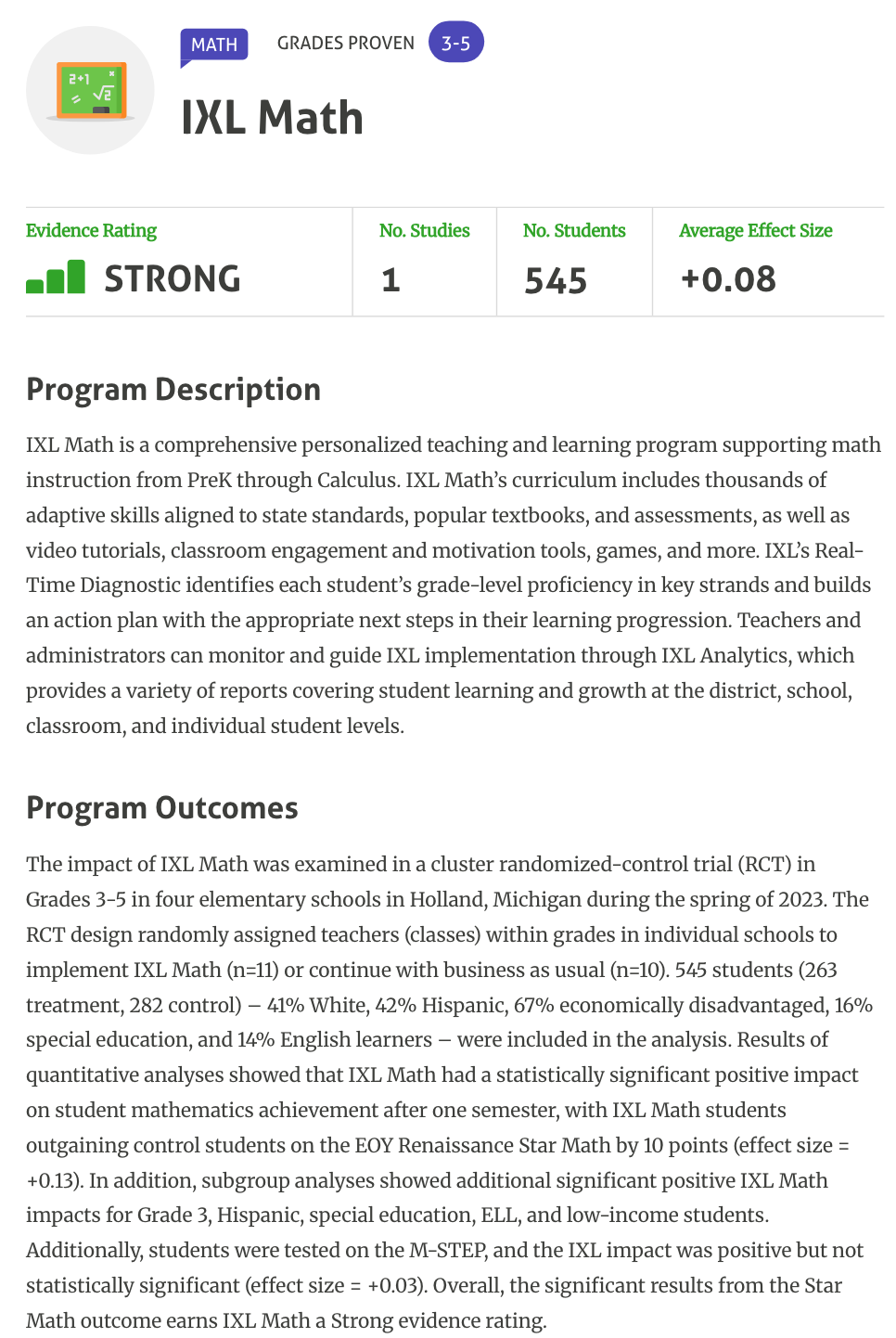
Evidence for ESSA rates IXL Math "Strong" on that one study, with an average effect of +0.08. The site belongs to the same Johns Hopkins center that ran the trial. The What Works Clearinghouse returned no results when I searched its reviewed products for IXL.
The randomized evidence is a small positive effect on one of two tests after a semester in one district. That is roughly what the trial of Khan Academy with Khanmigo found, 0.06 to 0.08 standard deviations over a school year, as I describe in my Khanmigo review. Neither number resembles 15 percentile points.
IXL and Alpha School
IXL was most of the academic software at Alpha School in 2024-25. The parent who reviewed the school for Astral Codex Ten called IXL "the tool that Alpha students use for 80% of their academic work". In the comments Matt Bateman, whom my Alpha review describes as the principal of Montessorium, one of Alpha's specialty schools, wrote that IXL's mastery standards were "far too low" and that their platform set "the smartscore minimum to 100".
Todd Feathers reported in WIRED on October 27, 2025 that one mother said her nine-year-old had to repeat an IXL multiplication lesson more than 20 times without a mistake. IXL told WIRED it deactivated Alpha's account in July 2025, that Alpha is "no longer an IXL customer due to violating our terms of service", and that IXL "is not intended" as a replacement for "trained, caring teachers". The rest is in my Alpha School review.
IXL's own guide treats 80 as a good place to stop. A school that requires 100 puts every child through the Challenge Zone on every skill.
IXL vs Khan Academy
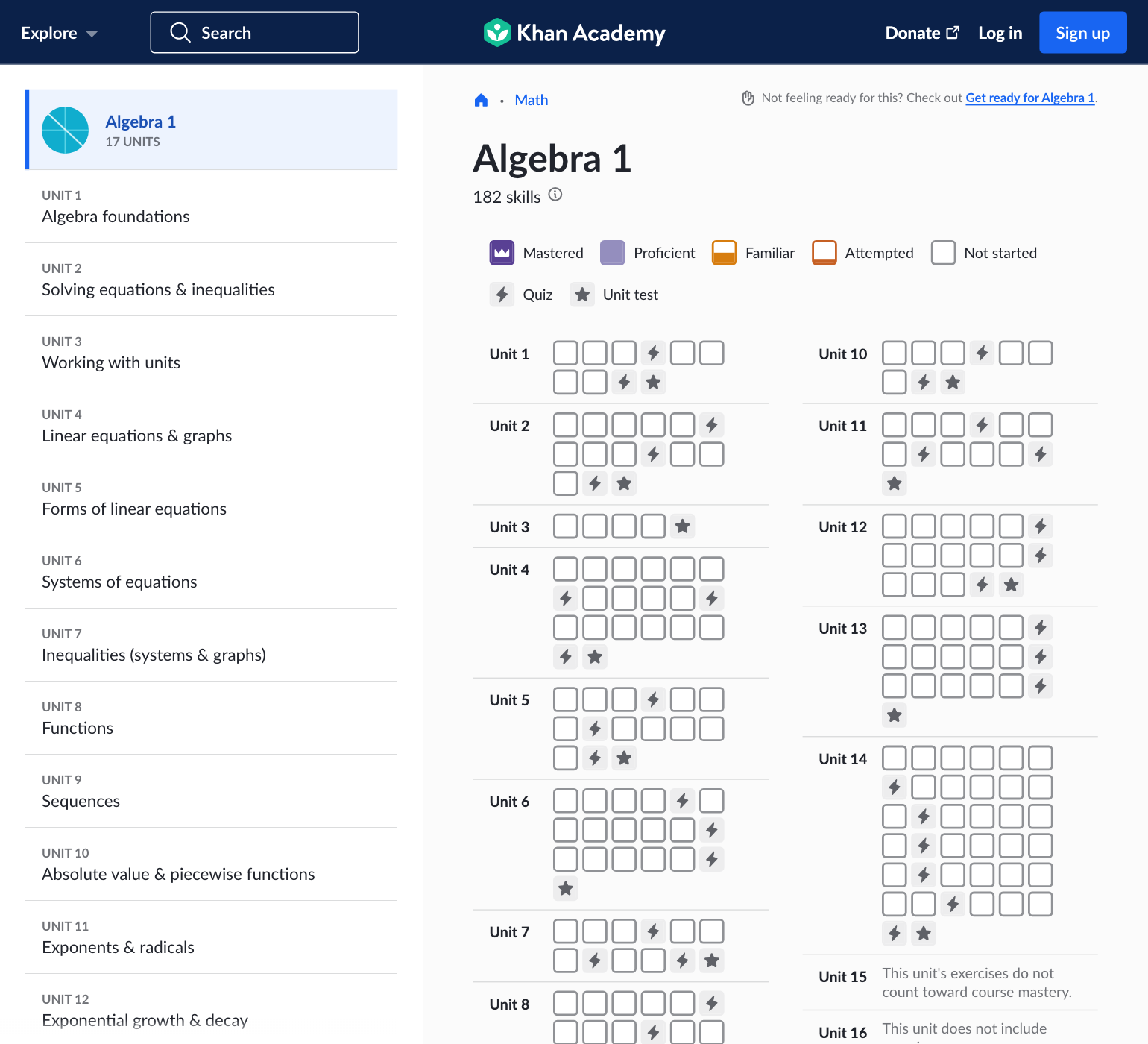
Khan Academy is free and lists more than 840 courses for school and early college. A course is a sequence of videos, articles, exercises, quizzes and unit tests. Its Algebra 1 page shows 182 skills in 17 units.
Khan's mastery levels have names where IXL has a number. Scoring 70% to 99% on an exercise makes a skill Familiar and 100% makes it Proficient. Mastered comes only from getting the skill right again later on a mixed quiz or test. A miss moves the skill down one level.
Khan teaches before it asks. IXL asks first and explains after a miss, though it now has videos too. Khan is the place to learn a topic. By gnicholas's account, IXL is where the child then gets enough practice on it.
| IXL | Khan Academy | Math Academy | Khanmigo | |
|---|---|---|---|---|
| Price | $9.95 to $19.95 a month, $4 per extra child | Free | $49 a month | $4 a month, US only |
| Grades | Pre-K to 12 | K-12 and early college | Fourth grade to university math | Khan Academy's courses |
| The student | Answers questions in one skill until a target score | Watches, reads, then does exercises and unit tests | Reads a worked example, solves problems, takes timed quizzes | Chats with a tutor beside a Khan exercise |
| Mastery | SmartScore from 0 to 100, with larger penalties above 90 | Four named levels, the top one earned on a later mixed test | Two right in a row per step, then spaced reviews | None of its own |
| Evidence | One randomized trial, 0.13 SD on one test and 0.03 on the other | Khan's own three-year panel study in Newark | No trial that I have read; named users' reports | Randomized trial, 0.06 to 0.08 SD a year |
The Math Academy and Khanmigo columns come from my reviews of Math Academy and Khanmigo.
IXL alternatives and Khan Academy alternatives
For a child who needs explanation, start with Khan Academy and add Khanmigo if you live in the United States and want a tutor that withholds the answer.
For serious math from fourth grade up, Math Academy costs more than twice as much as IXL and schedules spaced reviews, which I did not find described on the IXL pages I read.
IXL says its skills are "matched to educational standards in all 50 U.S. states, the Common Core, and widely used textbooks". For drill tied to this week's chapter, that mapping is the case for paying.
The fit: is IXL worth it
IXL suits a child whose school already teaches the material and who needs more graded repetitions than a worksheet provides. It suits a homeschooling parent who wants marking done for them and a list of gaps. Set the goal at 80, as IXL suggests, and treat 100 as optional.
It does not suit a child who is lost. The explanation arrives after the wrong answer, when by Lampros's account a student is least inclined to read it.
For an adult, the independent learner plan makes sense before the GED or the ASVAB, where the syllabus is fixed and the task is repetition. An adult who wants to understand why something is true will get a score and a worked solution.
Understand by comparison
Understand is a voice call with a tutor that you can interrupt. It reads a saved article or PDF aloud word for word and stops when you ask a question. It asks you to explain an idea back, and it keeps a record of what you explained that you can read and correct.
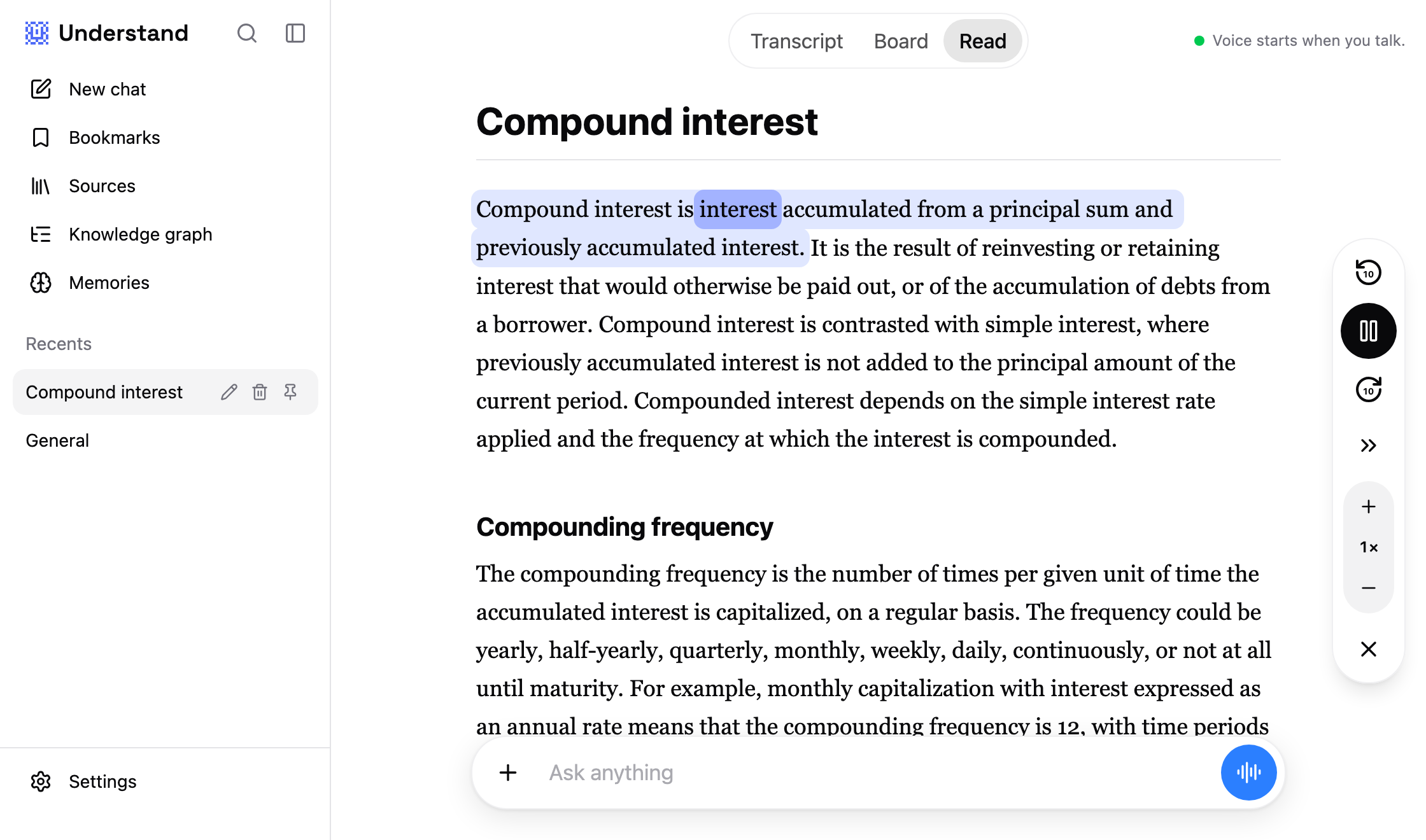
It is for adults and is free for now. It has no courses, no problem sets, no spaced repetition and no Android app. No trial has evaluated it, so on evidence IXL is ahead by one small randomized study.
If the goal is 200 graded fraction problems, Understand is the wrong tool and IXL is a reasonable one. If the goal is to find out why dividing by a fraction means multiplying by its inverse, ask someone, and keep asking until you can say it back.