What is unschooling? The evidence, the critics and the adult version
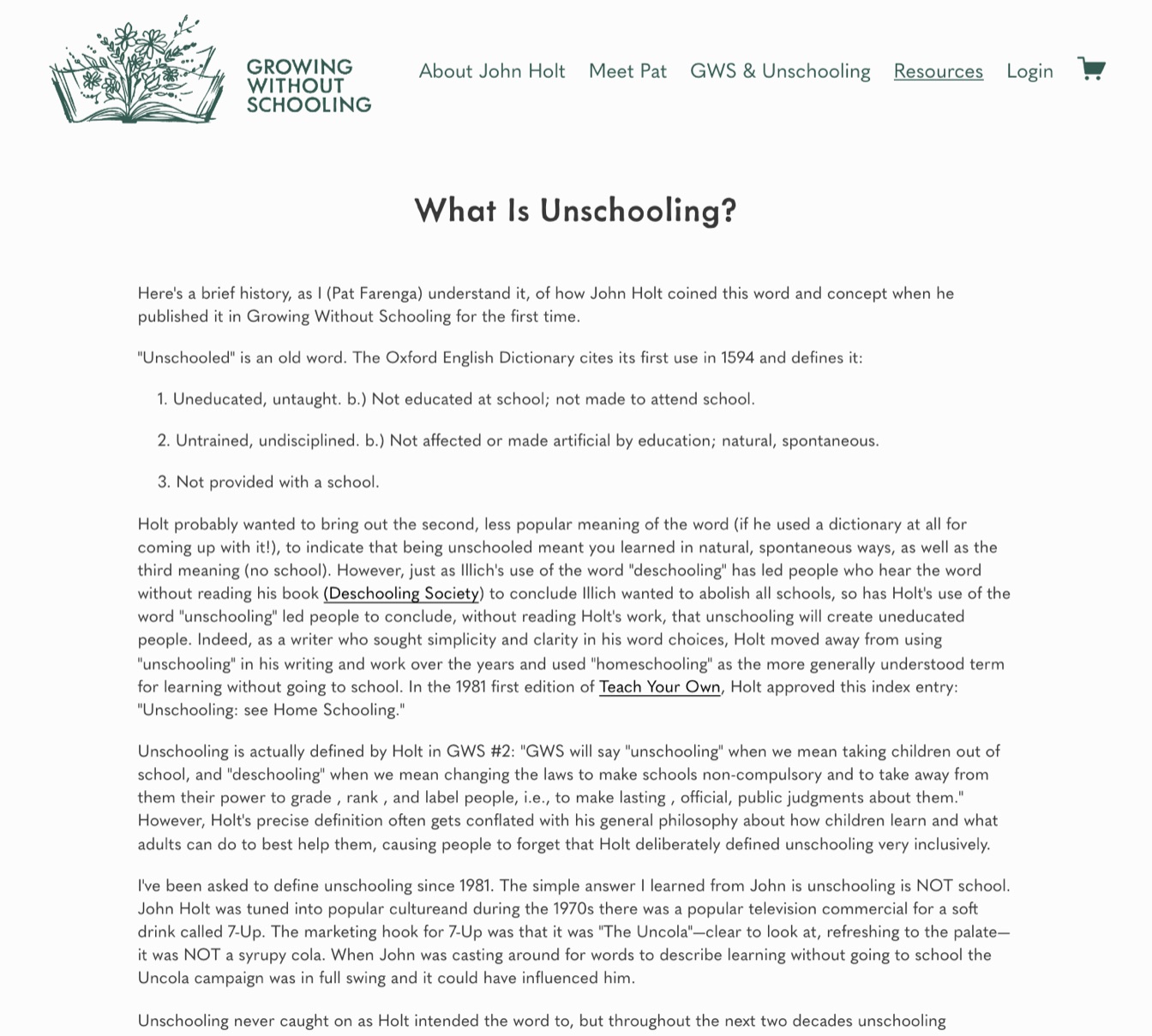
Unschooling is home education without a curriculum: the child does not go to school, and nobody at home sets lessons or tests unless the child asks for them. John Holt put the word into print in 1977, and Pat Farenga, who worked with him, thinks a 7-Up commercial may have helped. The soft drink was being sold as "The Uncola" at the time.
I build Understand, a tutor for adults, and I have no connection to anyone named below. I was not unschooled and I have unschooled nobody. This post rests on the papers and on the proponents' own pages, and I say where I read only an abstract. Whether to unschool a child is the parents' decision, and nothing here is advice on it.
Holt's word
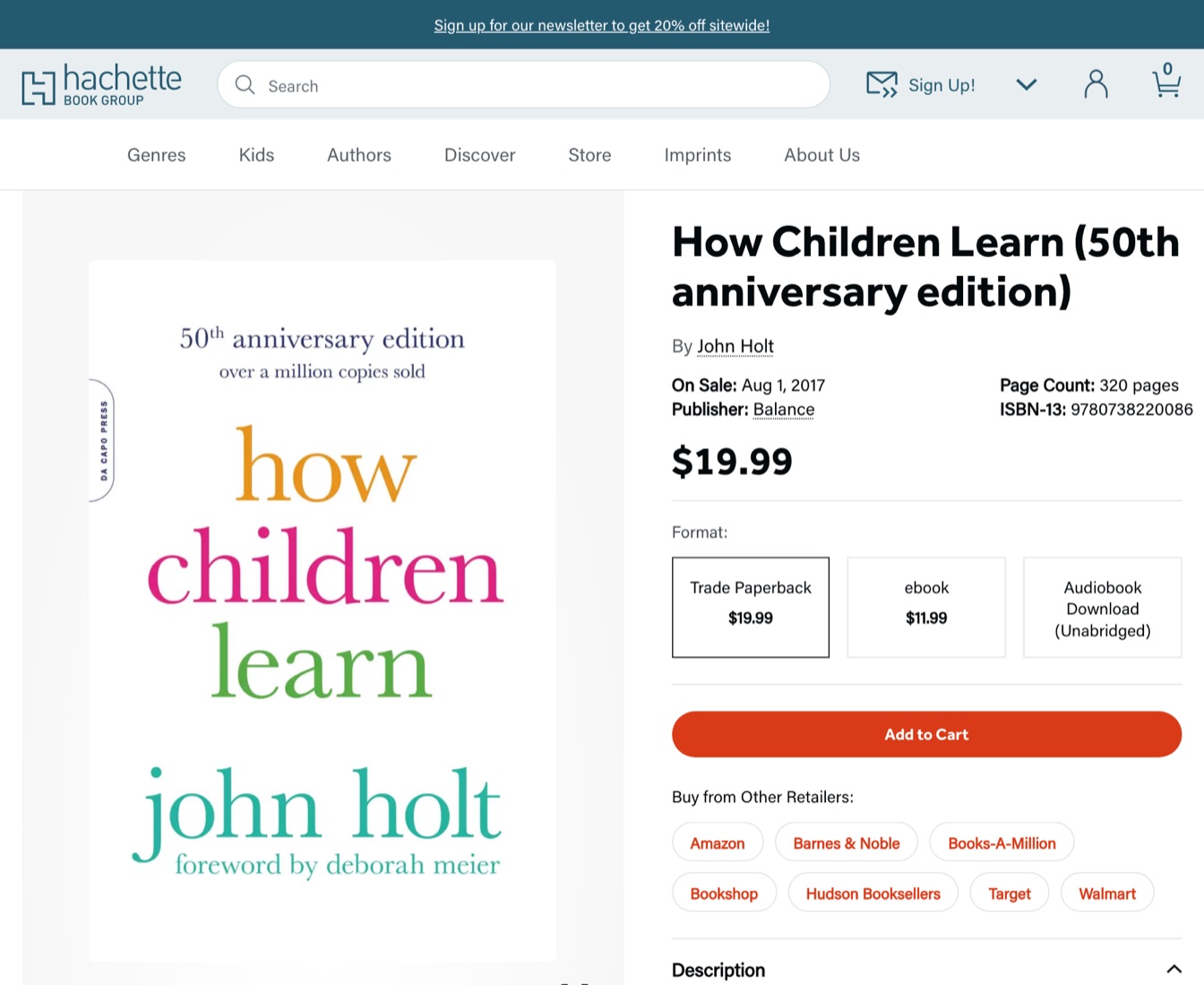
Holt was a schoolteacher whose books How Children Fail and How Children Learn made him known in the 1960s. His own summary of the second book, quoted on the Growing Without Schooling site, is that it "can be summed up in two words", and the words are "Trust Children". The publisher's page for the 50th anniversary edition quotes his claim that for small children "learning is as natural as breathing."
In 1977 he started a newsletter, Growing Without Schooling, which ran until 2001. Farenga's history of the word quotes the definition from the second issue: "GWS will say 'unschooling' when we mean taking children out of school". That is all it meant. It covered any family that had left, whatever they did at home.
Holt then stopped using it. The index of his 1981 book Teach Your Own has the entry "Unschooling: see Home Schooling." The narrower sense, homeschooling with no fixed curriculum, grew up after his death in 1985. Farenga's own definition is "allowing children as much freedom to learn in the world, as their parents can comfortably bear."
Peter Gray and Gina Riley, the researchers who have surveyed unschoolers most, describe the parents as busy. In their second report on grown unschoolers the parents answer questions and find materials, but "do not impose a curriculum".
Numbers and the law
The National Center for Education Statistics counts homeschoolers: 2.8% of American students aged 5 to 17 in 2019, about 1,457,000 children, up from 1.7% in 1999. Its 2022-23 survey put the figure at 3.4%, according to Pew's summary. In that survey half of homeschooling parents gave "a nontraditional approach" as one of their reasons.
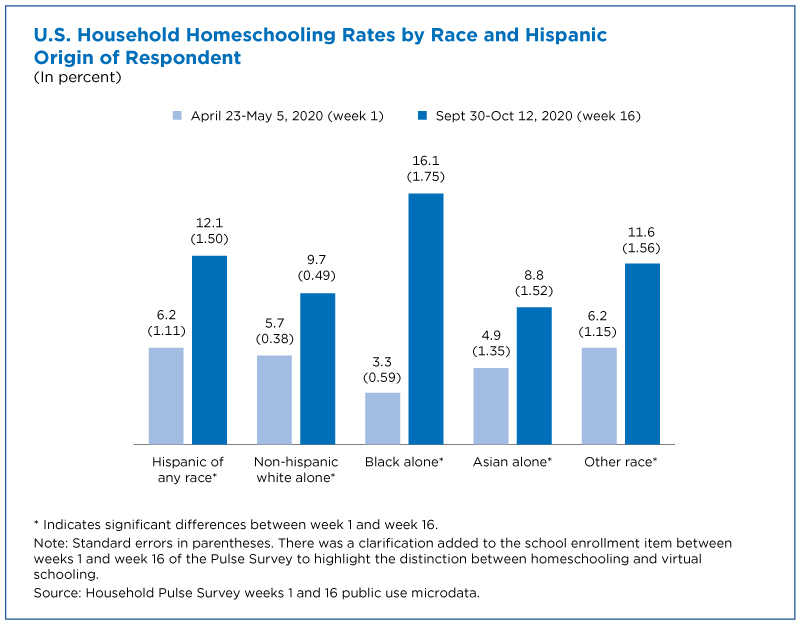
The Census Bureau's Household Pulse Survey asked a different question, of households, and found 5.4% homeschooling in spring 2020 and 11.1% that autumn. NCES warns that the two surveys cannot be compared directly.
Nobody counts unschoolers. Gray and Riley wrote in 2013 that their "best guess is that roughly 10% of homeschoolers" would call themselves unschoolers, and they based it on attendance at conventions and a conversation with Farenga.
The Census report says homeschooling "is a legal instructional option in all 50 states", and Gray and Riley note that for legal purposes unschooling is a kind of homeschooling. The requirements differ by state. The Home School Legal Defense Association sorts the states into four groups, from those that require no notice to those that ask for test scores or professional evaluations plus further conditions such as curriculum approval. A family that keeps no curriculum still has to meet whatever its state asks for, and the state's own education department is the place to check.
The studies
| Study | Who | Design | Finding | Main limit |
|---|---|---|---|---|
| Gray and Chanoff 1986 | 69 of the 82 people who left Sudbury Valley School, 1970 to 1981 | Questionnaire and interviews, no comparison group | Just over 50% had finished or were enrolled in a college degree | 83% had a college-educated parent; the authors disclose their involvement with the school |
| Martin-Chang, Gould and Meuse 2011 | 74 children aged 5 to 10 in Nova Scotia and New Brunswick: 37 in public school, 25 structured homeschoolers, 12 unstructured | Seven Woodcock-Johnson subtests, each homeschooled child matched to a schooled child | Structured homeschoolers scored above the schooled children; the 12 unstructured children scored below both on all seven tests | 12 children, recruited as volunteers; the comparison was exploratory |
| Gray and Riley 2013 | 232 unschooling families, 80% in the US; 95% of forms filled in by mothers | Open questions, recruited through Gray's Psychology Today blog and two other sites | 57% described better learning; the most common difficulty was other people's disapproval (43.5%) | Self-selected; parents' impressions; nothing measured |
| Gray and Riley 2015, in two reports | 75 adults unschooled for at least their last two high-school years; median age 24; 77% women | Questionnaire, recruited through the same blog | 83% had some higher education and 44% a bachelor's degree finished or under way; 11% reported a learning deficit | The authors expect volunteers to be "among the more successful or satisfied" |
| Green-Hennessy 2014 | Homeschooled and schooled 12-to-17-year-olds in a national health survey, 2002 to 2011 | Survey comparison with demographic controls | Homeschoolers with weaker religious ties were three times as likely to report being behind their grade level | Does not identify unschoolers; I read the abstract, which gives no sample size |
Gray and Chanoff's subject is a school. Sudbury Valley, in Framingham, Massachusetts, opened in 1968 and has no learning requirements. Its former students reported no trouble getting into college, and the authors raise the selection problem themselves: "only a self-selected few choose to enter."
Gray and Riley's two surveys are the largest of unschoolers. Among the 75 adults, 24 had never been to school or followed a curriculum, and that group was the most likely to have gone on to a bachelor's degree (58%). Most got in through community college courses. Asked whether they would unschool their own children, 67% said yes. The unhappy respondents numbered three, and all three described isolation and a mother in poor mental health.
The authors are open about what this proves. The first report says the study "shows what is possible for unschoolers, even if it can't address the question of what is most typical for all who try this practice." I read both reports from archived copies, since the journal's site has gone.
Martin-Chang's study is the only one here that tested children directly. The unstructured group trailed the structured homeschoolers by between 1.32 grade levels in calculation and 4.20 in word attack, a test of sounding out nonsense words. Against public school children the gaps were 0.64 to 1.67 grade levels and none survived the authors' correction for multiple tests. The children were 5 to 10, so the study cannot say whether the gap closes later. The paper also records why the group was so small. A mother told the researchers: "I think unschoolers by definition will be less inclined to want to participate in an education study."
Robert Kunzman and Milton Gaither reviewed the homeschooling literature in 2020 in the same journal as Gray and Riley's reports. Their verdict: "The research on unschooling is fraught. A good bit of it has been conducted by outspoken advocates, whose samples, drawn from networks of the like-minded, have tended to reflect well on the practice."
So the supportive evidence comes from volunteers recruited on a blog about the freedom to learn, and the unsupportive evidence comes from 12 children. I would not stake much on either.
A critic and a reply
The best-known recent criticism is of homeschooling as a whole. Elizabeth Bartholet of Harvard Law School published "Homeschooling: Parent Rights Absolutism vs. Child Rights to Education & Protection" in the Arizona Law Review (62 Ariz. L. Rev. 1, 2020). Harvard Magazine's account, by Erin O'Donnell, says she "recommends a presumptive ban on the practice", with parents carrying the burden of showing their case is justified. Her argument is about oversight: "there are very few requirements that parents do anything", and teachers are the largest group of people who report suspected abuse. She also says: "No doubt there are some parents who are motivated and capable of giving an education that's of a higher quality".
Kerry McDonald, who debated Bartholet at a Cato Institute event in June 2020, replied that child protective services already exist for abuse, that there is "no compelling evidence that homeschooling parents are more likely to abuse their children", and that routine home visits to families suspected of nothing are an intrusion.
Neither side's case depends on whether a family uses a curriculum.
Popper, Deutsch and Taking Children Seriously
Karl Popper wrote in his autobiography that he dreamt of founding a school "in which no unwanted answers to unasked questions would have to be listened to; in which one did not study for the sake of passing examinations." The passage is quoted on Taking Children Seriously, Sarah Fitz-Claridge's site, which also carries posts by the physicist David Deutsch. Fitz-Claridge writes that Popper's theory of knowledge is a critique of teacher-directed learning, "although it appears that Popper himself never made this connection." In that theory knowledge grows by conjecture and criticism, and a learner's conjecture is an attempt on a problem the learner has.
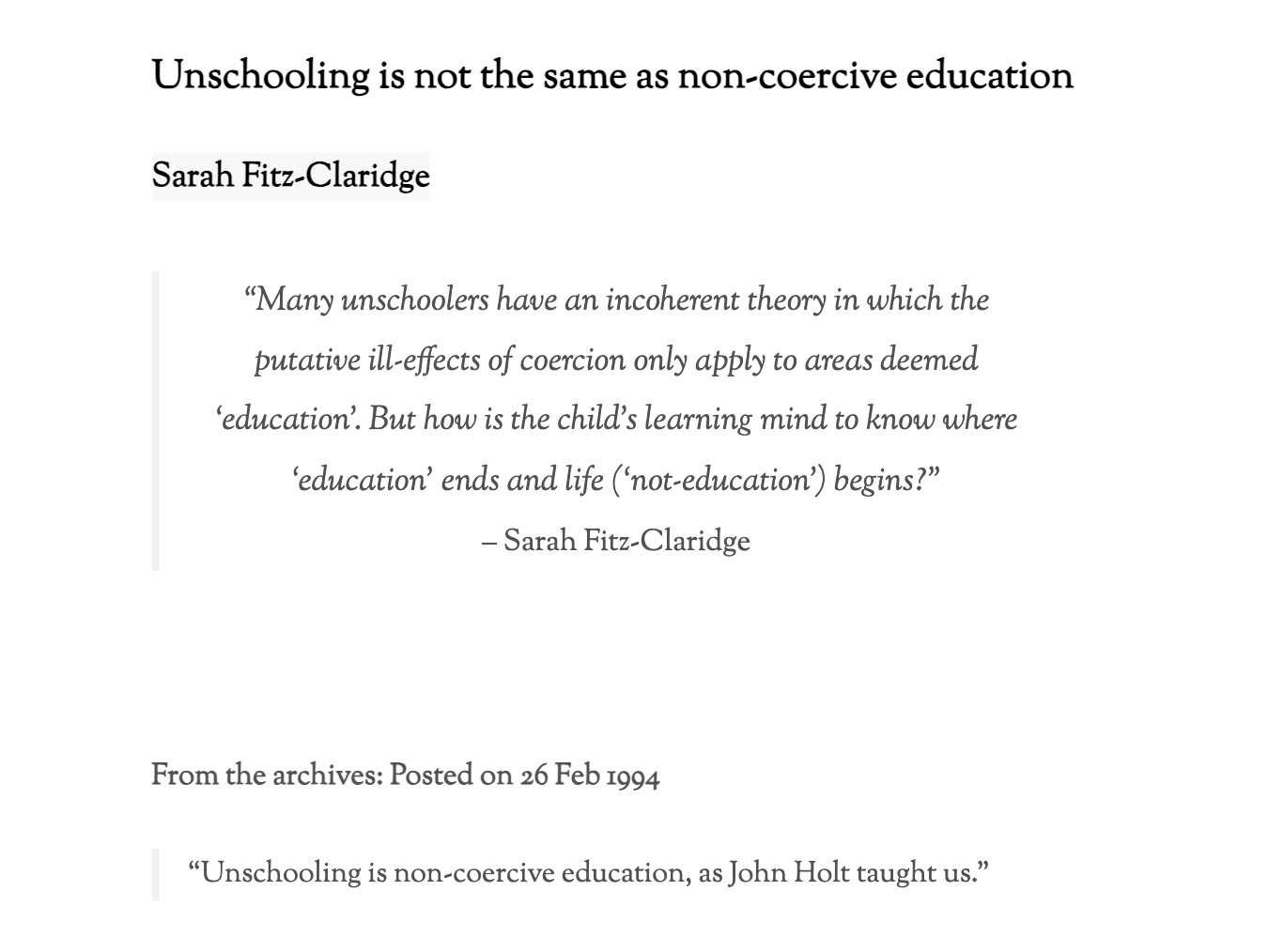
It would be easy to file this under unschooling. Fitz-Claridge objects. In a 1994 post she wrote that many unschoolers hold "an incoherent theory in which the putative ill-effects of coercion only apply to areas deemed 'education'", and that Holt "was not a great theoretician". The unschoolers' motto "Never offer, never refuse" she called "not interventionist enough". Her test is whether the child is put in conflict, and the amount of structure does not enter into it. A parent can bring home a textbook, and if the child "really loved it, that would be fine".
Deutsch's posts date from the 1990s. In 1998 he argued that the nearest thing to a non-coercive school is "the entire town (or city, or society, or internet) that the children have access to".
He would also reject my table. In a 1997 post he called almost all experiments in educational theory "irreparably flawed", and added that "people simply cite the ones that confirm their prior beliefs and ignore the rest." I think the second half is a fair description of how the 232 families and the 12 children get used.
The counter-case
Paul Kirschner, John Sweller and Richard Clark argued in 2006 that the evidence of half a century shows "minimally guided instruction is less effective and less efficient" than instruction with strong guidance. The reason they give is working memory: a novice searching for a solution has little capacity left to learn from the search. Their qualification matters as much: "The advantage of guidance begins to recede only when learners have sufficiently high prior knowledge".
That paper is about how a subject is taught once someone is learning it. It does not address who chose the subject. An unschooled teenager who asks for an algebra tutor is getting guided instruction, and Taking Children Seriously has a phrase for it, wanted teaching.
The harder problem is subjects that stack. Justin Skycak of Math Academy writes that math is a subject "where each advanced skill requires many simpler skills to be applied in complex ways", as I quoted in my Math Academy review. Curiosity about orbits does not supply fractions. Deutsch was asked in 2000 whether a 15-year-old who had done no academic math could become a scientist, and answered with a story about an imagined girl who starts community college in normal classes: "I am sure it can't be 'too late.'" Gray and Riley's respondents who took the community college route are the nearest thing to data for that, and they volunteered.
Adults are already unschooled
No adult has a curriculum or a test. Farenga's definition says as much: unschooling is "the way we learn before going to school and the way we learn when we leave school and enter the world of work."
Allen Tough measured this in the 1960s. The first chapter of The Adult's Learning Projects (1971) reports that the median adult undertook eight deliberate learning projects a year and that it was common to spend 700 hours on them. "About 70% of all learning projects are planned by the learner himself". I read that chapter only, and it summarises his studies without giving their samples.
So self-directed learning is the normal condition of adults, and the question is how well it goes.
Self-paced learning has a completion problem. Kulik's review of mastery learning found that "self-paced mastery programs often reduce the completion rates in college classes", and about 3% of people in MIT's and Harvard's open online courses finished one. I covered both in Alpha School for adults.
The studies I have read for earlier posts point to a short list for anyone wondering how to homeschool yourself:
- Start from a question you want answered. An adult who quit Math Academy blamed his own vague goal, and Popper's unasked questions are the same point from the other side.
- Take guidance where you are a novice. Kirschner's result applies to you as much as to a child, so hand the stacked skills to a course that orders them.
- Test yourself, since nobody else will. In Karpicke and Blunt's experiment students who closed the text and recalled it scored 67% a week later, against 45% for students who drew concept maps with it open. The details are in my post on audiobooks and reading.
- Put a stake on the dull parts and leave the parts you like unpaid. The trials are in Should you pay students to learn?
Understand
Understand is a voice tutor for adults that you can interrupt. It reads a text aloud word for word and stops when you ask a question. It asks you to explain an idea back, and it keeps a record of what you explained that you can read and correct. It starts from your question, which is the part of unschooling an adult can use.
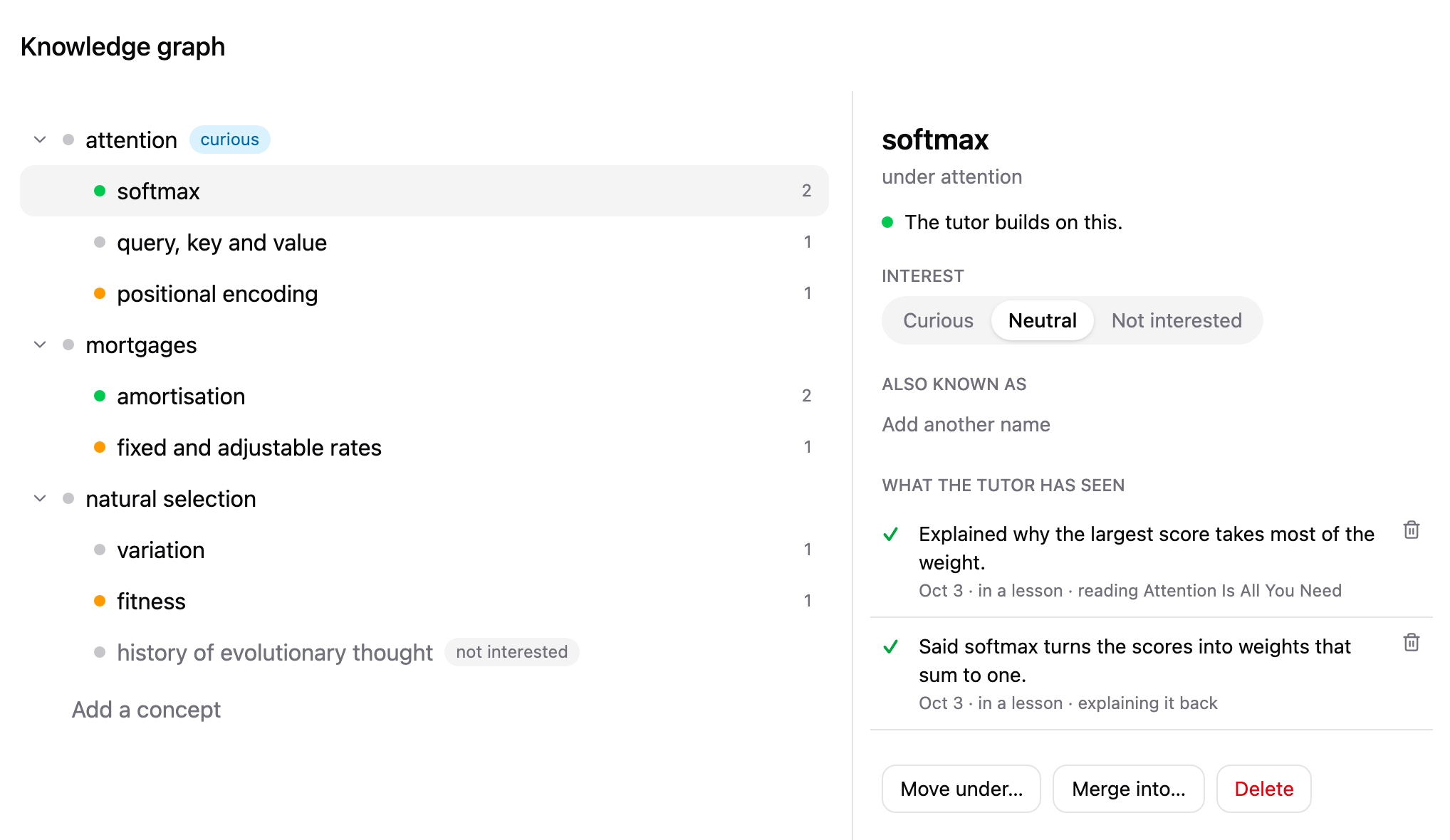
It supplies none of the structure the counter-case asks for. It has no courses, no problem sets and no spaced repetition, so for math you want Math Academy. There is no Android app, and no trial has evaluated it. It is for adults, and it is free for now.