What is a microschool? Prenda, KaiPod, Primer, costs and the evidence
A microschool is a school of about 20 children, usually of mixed ages, run by one or two adults in a house, a church or a rented shopfront. In law it is most often either a small private school or a learning centre for children registered as homeschoolers, and in most states the word has no legal meaning at all. Prenda, a network with over a thousand guides by its own count, lists the requirements for running one as "a safe and suitable location", "the internet" and "you".
I have visited none. This post rests on each organisation's own pages, state program pages, research reports and named reporters. I build Understand, a voice tutor for adults, and I have no connection to any school or network named here.
The meaning of microschool
The RAND Corporation's 2025 report defines microschools as "small, tuition-based schools (serving around 15 students)" built for a more personal and flexible experience than a conventional school. It estimates that between 1 million and 2 million students attend one full time.
The fullest description comes from the National Microschooling Center, a Las Vegas nonprofit run by Don Soifer that calls itself a "movement-builder". It is an advocacy organisation, and its numbers are what microschool leaders told it. Its 2026 sector analysis covers 1,000 microschools, surveyed or interviewed between October 2025 and January 2026. The sample is whoever answered.
- The median private microschool has 20 students. The median public or charter one has 30.
- 38% serve children whose families are registered as homeschoolers, 34% are private schools recognised by their state, and 26% say they are private schools "not officially sanctioned" by it.
- 67% are not accredited.
- 39% give a standardised test regularly, and 28% give letter grades.
- Half receive money from a state school choice program.
The Center's 2025 edition, on 800 microschools, found that 74% charge $10,000 a year or less and that the median cost of educating one child was $6,500. More than a quarter of founders took no regular salary.
The main networks
Prenda
Kelly Smith started Prenda in Arizona. By the company's own account, he opened the first Prenda microschool in his home in January 2018 with seven neighbourhood students.
The adult in a Prenda microschool is a guide, who needs no teaching credential. Prenda says about half of its guides are certified teachers anyway. Its FAQ is plain about the job: "Our learning experience does not depend on the guide to provide instruction as a teacher would in a classroom setting." The guide helps children set goals and watches their progress, the lessons come from Prenda's learning system, and Prenda's academic coaches back the guide up. Prenda recommends 7 to 10 children, kindergarten to eighth grade, for 16 to 20 hours a week.
Each guide is an independent business owner. Prenda pays for a background check on every adult at the location and says it "does not approve or certify microschool locations". Its FAQ puts responsibility for safety with the guide and the families.
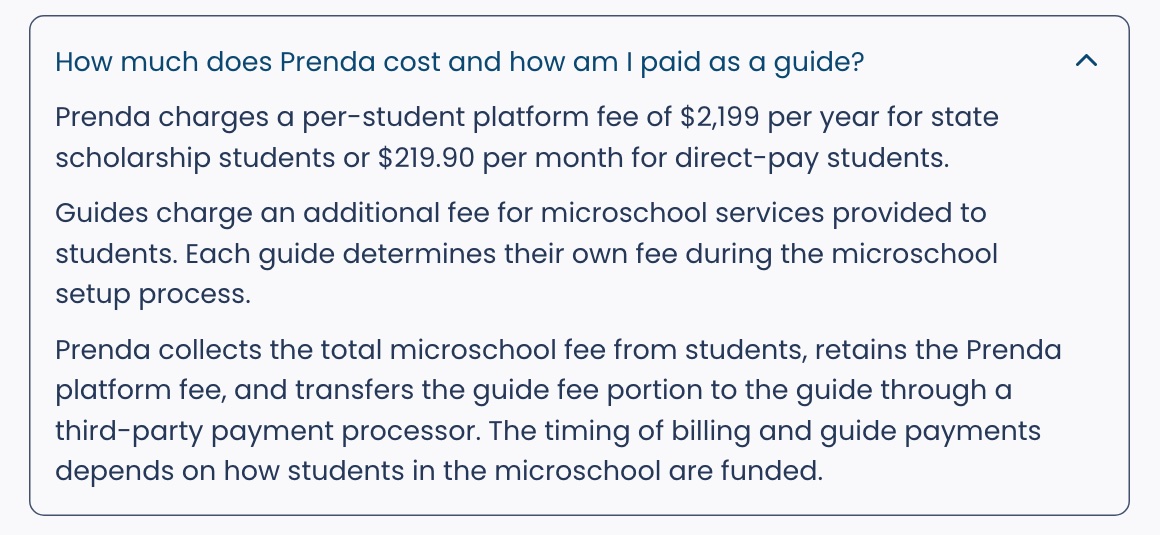
Prenda charges $2,199 per student per year, or $219.90 a month for families paying directly. The guide adds a fee, and Prenda says most guides charge about $4,000. The earnings calculator on its guide page opens at seven students and $28,000 a year. Where a state scholarship exists, Prenda says it is "typically enough" to leave families with little or nothing to pay.
Some of the money once came through a charter school. Rob O'Dell reported in The Arizona Republic on April 26, 2021 that the Arizona Attorney General's Office had opened an investigation into Prenda and its partner EdKey. Under their arrangement, EdKey enrolled students in its online charter school and collected state funding, Prenda's guides taught them, and the two companies split the money. The attorney general's office told the paper it could neither confirm nor deny an investigation, and Prenda declined to comment. Prenda later published its account: the office never contacted the company, and Prenda's outside lawyers reported that the allegations "were unfounded" and that any investigation "is now closed". I found no statement on the outcome from the attorney general's office itself.
KaiPod Learning
Amar Kumar, a former chief product officer of Pearson's online schooling division, founded KaiPod Learning. His company biography says he created it for families learning online or at home, as "a more social experience than online schools". Those were the pods. The site today is mostly a directory of microschools and a program for the people who start them.
That program is Catalyst. A founder spends 12 weeks building the plan with a cohort, then opens, then gets two years of support. It costs $149 a month, plus $30 per enrolled student once the school is open, with no revenue share. KaiPod gives no grants or loans and says founders should have $5,000 or more to start. Each school is independently owned. KaiPod says more than 500 founders have enrolled, in over 30 states.
KaiPod puts typical tuition at $8,000 to $15,000 a year. It also explains microschooling by vehicle: homeschooling is "driving a family car", a conventional school is "public transportation", and a microschool is "a private tour bus". I have nothing to add to the tour bus.
Primer
Ryan Delk is co-founder and chief executive of Primer, founded in 2019. Its first campus opened in Miami in 2023. Its schools page now describes ten locations in Florida, one in Scottsdale, Arizona, three in Alabama, and three in San Antonio from August 2026. Primer handles admissions and tuition itself, serves kindergarten to eighth grade, and calls its adults teachers.
Its tuition page lists what families pay after a state scholarship, by household income. In Florida and Arizona that runs from $0 below $50,000 of income to $6,752 above $150,000. In Texas a family earning $75,000 or less pays nothing, and others pay up to $10,710. The page does not give the tuition before scholarships.
Acton Academy and Alpha School
Acton Academy, opened in Austin in 2009, is the oldest of these: about 300 campuses, each locally owned. I compared it with Alpha in Acton Academy vs Alpha School.
Alpha School does not call itself a microschool, but the parts are the same: small groups, software for the academics, and adults called guides who, in its own words, "do not teach academics". It is the expensive end, at $10,000 to $75,000 a year. My Alpha School review covers its claims and the evidence for them.
| Network | Model | Grades | Where | Cost to a family | Paid by | Published evidence |
|---|---|---|---|---|---|---|
| Prenda | Independent guide, Prenda's software, 7 to 10 children | K-8 | Wherever a guide opens one | $2,199 a year plus the guide's fee, typically about $4,000 | State scholarship or direct pay | Testimonials. I found no outcome study |
| KaiPod Learning | Training and software for independent founders | Set by each school | Company says 30+ states | Set by each school. KaiPod says $8,000 to $15,000 is typical | Tuition, and ESAs where they exist | Company figures on founders. None on achievement |
| Primer | Company-run schools with teachers | K-8 | Florida, Arizona, Alabama, Texas | $0 to $6,752 after scholarships in Florida and Arizona, by income | State scholarships, then tuition | None on the pages I read |
| Acton Academy | Locally owned affiliates, learner-driven | Ages 4 to 18 | About 300 campuses, 30 countries | Set by each campus: $10,450 to $27,500 among those I checked | Tuition | A family satisfaction rating published by the network |
| Alpha School | Company-run campuses, software and guides | PK-12 across campuses | 47 campuses listed | $10,000 to $75,000 | Tuition. Eligible for Texas's program | Its own test-score multiples, disputed. No independent evaluation |
Education savings accounts
An education savings account is state money placed in an account that a parent controls and can spend on private tuition, tutoring, curriculum or therapies.
The most convenient tables are EdChoice's. EdChoice is an advocacy group whose stated mission is "to advance educational freedom and choice for all", so I use its counts and leave its adjectives. When I read it on October 4, 2026, it listed 21 ESA programs in 18 states, several of them limited to children with special needs. Its program pages were last updated in December 2025. EdChoice counts 19 states with some choice program open to every student, and five that pass its own test for "truly universal", a category it ticks off with green check marks.
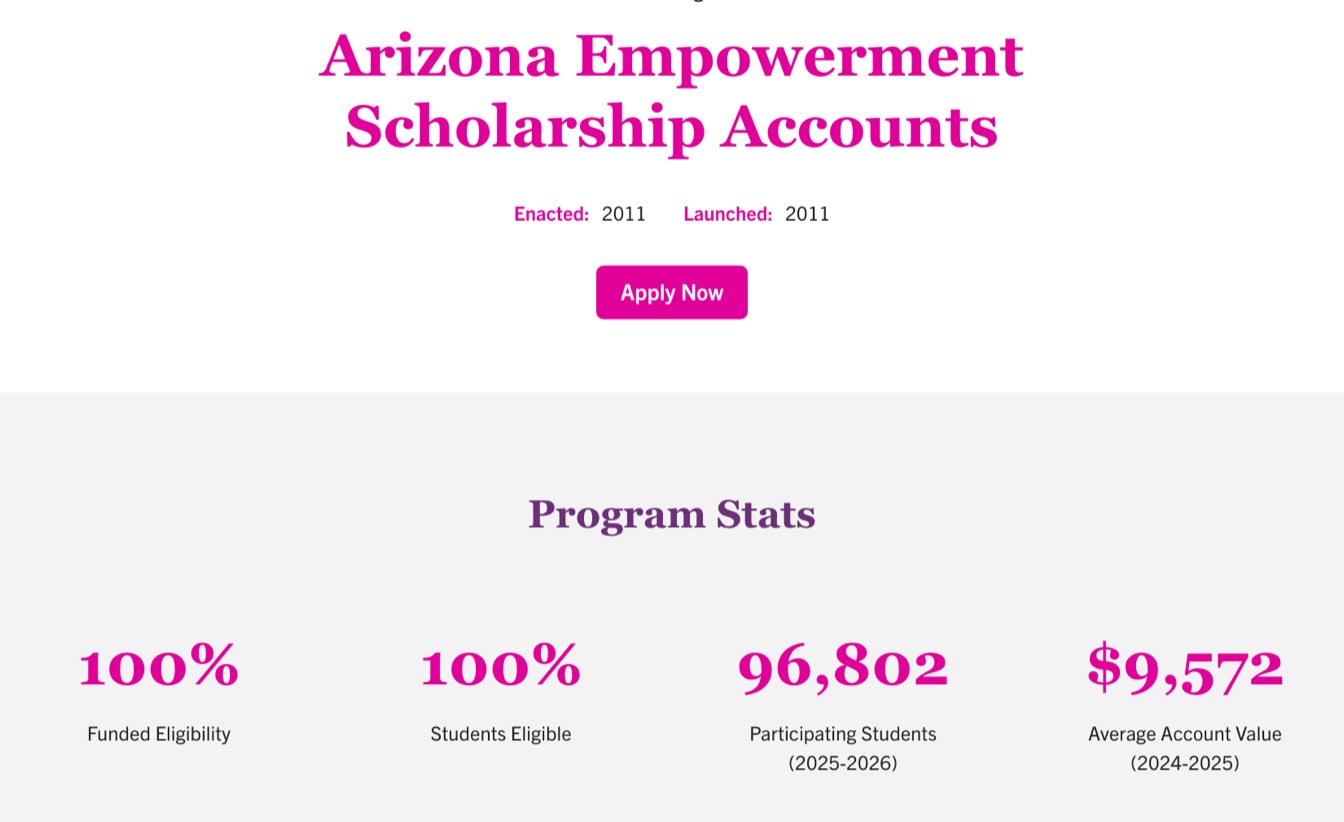
In Arizona every K-12 student is eligible. EdChoice reports 96,802 students there in 2025-26 and an average account of $9,572 the year before. In Florida any resident eligible for public school may apply, and EdChoice reports 280,611 students and an average of $8,000.
The Texas Education Freedom Accounts site says the legislature funded the program with $1 billion in 2025. For 2026-27 a child at a participating private school receives $10,474, a child with a disability up to $30,000, and a homeschooled child $2,000. The state received more than 274,000 applications and made over 100,000 awards, with priority by disability and income.
The gap between $10,474 and $2,000 is the part a Texas microschool should read twice. Lexi Churchill of ProPublica and The Texas Tribune reported on September 2, 2026 that the comptroller checked private schools for the following: operating in Texas, accreditation by an approved body, at least two years in operation, and annual standardised tests. Two thirds of the microschools in the Center's national survey are unaccredited. By those criteria their families would receive the homeschool amount. That inference is mine. The program's home page does not mention microschools.
Classification and regulation
A microschool has to fit its state's rules for private schools or its rules for homeschooling, unless it is a charter school. Only a few states, among them West Virginia, Georgia and Utah, define microschools or learning pods in statute, according to the Center.
The limits of the homeschool route vary by state. Todd Feathers reported in WIRED on June 4, 2026 that the New York State Education Department had declined to incorporate Alpha's Manhattan campus as a school, and that Alpha described the campus as "a homeschooling learning center, not a school". WIRED quotes the department's rule that homeschooling parents may arrange group instruction "for particular subjects but not for a majority of the home instruction program". Alpha told WIRED it complies with all applicable laws, and a new application was pending.
A parent can reasonably ask a microschool which category it operates under, and who has inspected the building.
The evidence on results
The RAND report, by Sarah Ohls, Lauren Covelli and Jonathan Schweig, was published on March 20, 2025 and paid for by the Walton Family Foundation. Its finding is that the effects of microschools on achievement "are yet to be rigorously evaluated", and that data on students' backgrounds and growth are "often unavailable, inconsistent, or unrepresentative". I read RAND's summary page, not the full report.
The Center on Reinventing Public Education publishes case studies, such as its January 2024 report on the Black Mothers Forum microschools in Phoenix. Its listed findings concern governance and funding, and I saw no achievement results in it.
The only test scores I found are in a September 2026 report by Daniel Hamlin of the University of Oklahoma, published by the National Microschooling Center, which also paid for the testing. Twenty-seven microschools gave the i-Ready test in fall and spring of 2025-26, to 423 students in reading and 405 in math. About 52% beat their expected growth in reading and 47% in math. Hamlin's own summary is that the students "largely perform no better or worse than expected". He also notes that the schools volunteered, that there was no comparison group, and that roughly 40% of the students had a disability or a chronic medical condition. The surveys in the same report are warmer: 97% of students said their teachers care about them. The Center deserves credit for publishing a flat result about its own movement.
The older evidence is about class size. In Tennessee's Project STAR, 11,600 children were randomly assigned from kindergarten to small classes of 13 to 17 or regular classes of 22 to 25. Alan Krueger's 1999 analysis found that scores rose by about four percentile points in the first year in a small class, and by about one more point for each year after, with larger effects for minority students and those on free lunch. I read the abstract and the working paper summary. The median private microschool, at 20 children, is larger than a STAR small class.
Nobody yet knows whether microschooling teaches more than the school down the road. Hamlin suggests the appeal may lie elsewhere, in places where children with significant needs "feel supported, engaged, and able to thrive".
Starting a microschool
People who ask how to start a microschool mostly need their own state's rules, and nothing here is legal advice. Which category your school falls under is a question for your state education agency and a lawyer.
- The National Microschooling Center publishes tools and training for founders. In its 2025 survey, 75% of people planning a microschool wanted help understanding the rules.
- KaiPod offers a free Microschool Basics course and the paid Catalyst program described above.
- Prenda's guide page is the route for someone who wants the curriculum, billing and training supplied.
The oldest idea in education
Primer's company page traces its model to the one-room schoolhouse, and KaiPod uses the same comparison. Both are claiming the oldest idea in education: a few learners and an adult who knows what each of them does and does not understand. I think the claim is fair. Bloom's 1984 tutoring experiments, which I covered in my history of intelligent tutoring systems, put one tutor with one student, or with two or three at once.
Karl Popper held that knowledge grows by conjecture and criticism. A learner makes a guess at how something works, and it gets better only when someone finds what is wrong with it. In a group of eight, an adult can hear each child's guess. In a room of 30, most guesses are never said aloud. That is my case for small schools, and size alone does not make it. Twenty children on laptops with one adult supervising are a small school in which nobody's guess gets heard.
An adult can take the same thing without a school. A study group of three people who explain the reading to each other does it. So does a tutor, for an hour a week, if the tutor makes you do the explaining.
Understand
Understand is for adults, so it is the wrong tool for anyone choosing a school for a child. It is a voice call with a tutor that you can interrupt. It reads a text aloud word for word and stops when you ask a question, asks you to explain an idea back, and keeps a record of what you explained that you can read and correct.
It is free for now. It has no courses, no problem sets, no spaced repetition and no Android app, and no trial has evaluated it. The microschools are one descriptive study ahead.