Synthesis Tutor review: the price, the SpaceX school and the DARPA study it cites
The study Synthesis cites as the basis of its math tutor for children tested 36 US Navy sailors on running and repairing computer networks. Synthesis Tutor itself is a math app for ages 5 to 11 that costs $29 a month or $119 a year for up to seven children, and I found no independent evaluation of it.
I have no child using it and I have not used it. I am about thirty years over the age limit. This review rests on Synthesis's own pages, the Navy study, the App Store listing, and people who wrote about it under a name or a handle. I build Understand, a voice tutor for adults, and have no connection to Synthesis.
Synthesis Tutor in brief
Synthesis Tutor "covers elementary math for ages 5-11". The company's about page lists the topics: counting, addition, subtraction, multiplication, division, fractions and algebraic thinking, which is the K-5 curriculum.
A lesson is a sequence of problems that the child solves by moving things on the screen. Synthesis calls these manipulatives. A voice guides each step, and for children under 7 "all text and answer choices will automatically be read aloud". The page says the system checks progress "with 'micro-assessments' present in every lesson", and a child moves on once they have shown they understood.
It runs on iPad, on Android tablets with a screen of at least 8 inches, and in a browser on a computer, Chromebooks included. The about page lists no phone app. Lessons are in English and Spanish.
Synthesis Tutor cost in October 2026
On October 4, 2026 the pricing section showed two plans, both "up to 7 kids": $29 a month, or $119 a year, which the page works out as $9.92 a month. Both start with a 7-day free trial. I loaded the page at desktop and at phone width and saw the same two cards.
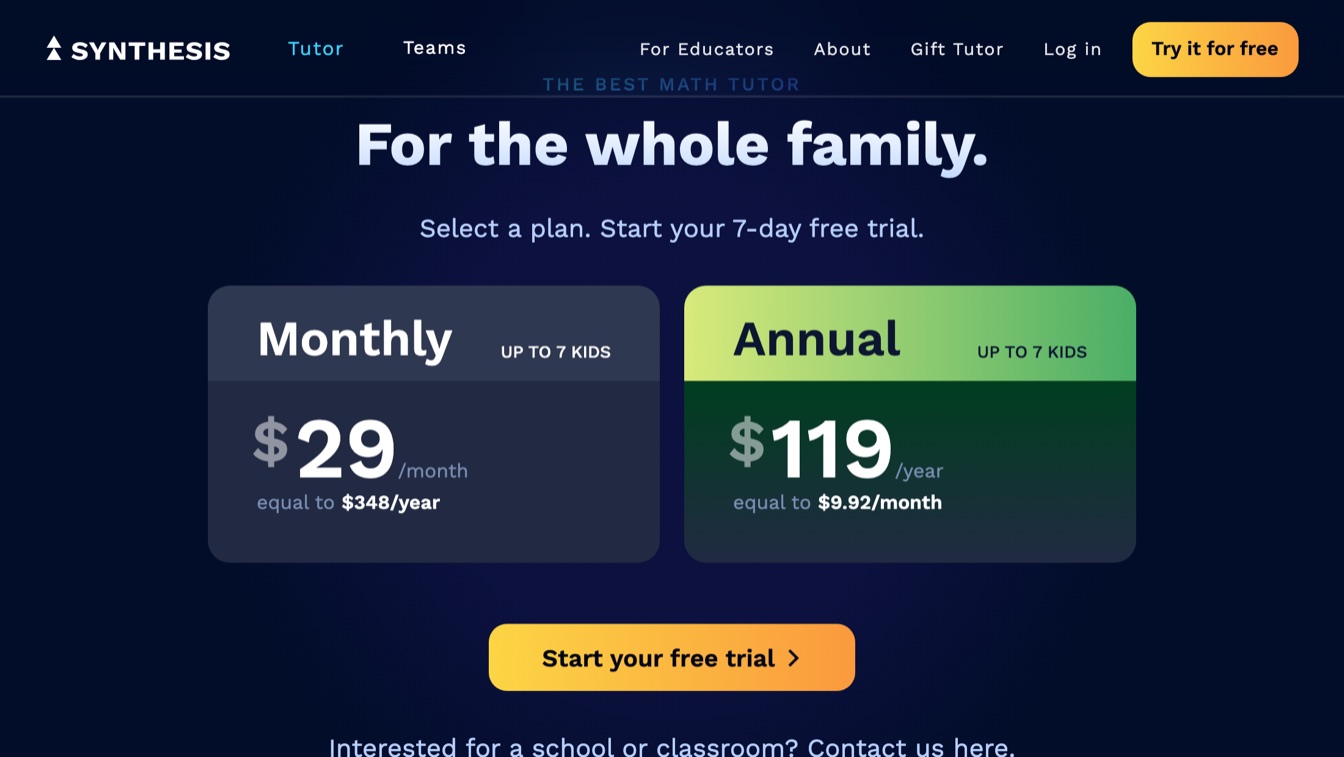
The page's source still carries older price blocks that a browser does not display. They include a one-child plan at $35 a month against $45, an annual plan at $300, a family plan at $70 a month, lifetime plans at $999 and $1,499, and a "HOLIDAY SALE" banner. Two days ago, for my comparison of AI tutors, I recorded $35 against a struck-through $45. A text reader or a search snippet may still hand you those numbers. The about page and the rendered pricing section agree on $29 and $119, so those are the ones I would expect at checkout. Confirm on the checkout screen before the trial ends.
At $119 a year the price is low for this category. Khanmigo costs $44 a year and Math Academy $588.
Synthesis also sells Teams, a live online program for ages 8 to 14: one 60-minute strategy game and one 45-minute discussion a week with a coach, for $95 a month. It is a separate product, and it is the one the company started with.
From Ad Astra to Synthesis School
The company's own account: "In 2014, Elon Musk asked educator Josh Dahn to start an experimental school with him on the SpaceX campus in Hawthorne, California." Synthesis "was the name of one of that school's classes, where kids tackled complex, open-ended challenges together". In 2020 Dahn and Chrisman Frank founded Synthesis School, Inc., which is now based in Scotts Valley, California.
The school was called Ad Astra. Peter Holley described it in the Washington Post on June 27, 2018: fewer than 50 students between 7 and 14, a curriculum that kept changing, and no formal grading. Dahn gave him an example of a lesson in which teams of children negotiated as the United States, China and North Korea. People searching for "Synthesis school" or "Ad Astra school" are mostly looking for that class, and its descendant is Teams. The math tutor arrived later. It was posted to Hacker News as a demo in June 2023, and the iPad app's App Store listing gives a release date of December 7, 2023.
On funding I could open only one primary source. Synthesis's page on Wefunder shows $2,986,282 raised from 1,113 investors. Its headline announces a round led by Replit's CEO, Amjad Masad, and still reads "a $XM financing round", with the X never filled in. Investor questions on the same page refer to a $12 million round. I could not open a news report of that round, so I leave the figure as theirs.
Scripted lessons, with AI at the edges
Synthesis sells this as an AI tutor and then describes something more careful. The FAQ says: "Synthesis Tutor leverages AI where appropriate while relying on our team of expert educators and neuroscientists to handle much of the pedagogy and interactive experiences." And: "we do not simply outsource your child's education teaching to an LLM."
When the demo reached Hacker News in 2023, brennancolberg, who called himself the core infrastructure engineer on the project, wrote: "No user ever sees live/unchecked LLM output". ClintFix, who also worked on it, answered a question about Khanmigo: "It has manipulatives/widgets that the tutor works with and responds to, rather than just a chat bot."
That is the main difference from a chatbot tutor. A general assistant, or Khanmigo, generates each reply, which lets a child ask anything and lets the model get arithmetic wrong. Synthesis writes the lessons in advance. A six-year-old gets fewer wrong statements and no way to ask about dinosaurs. For that age I think the trade is right.
The cost of a script showed in the same thread. jimmar tried the demo: "I entered incorrect values many times in the demo and it just proceeded with the pre-programmed lesson." light_hue_1, who has taught math, wrote that it "moves at a crawl". Those comments are about a demo more than three years old. I cannot tell you how much of that the current product has fixed.
Reports from parents and one student newsletter
The US App Store listing shows an average of 4.6 from 10,090 ratings. Many of the written reviews are by children, which I take as a point in the app's favour and will not quote.
Among the adults, mint9632, an educator, wrote on May 1, 2024 that the tutor "doesn't just reinforce what the kids have learned, it truly checks for and develops understanding".
The complaints repeat. VeggieSolo, February 2, 2026: "My kid is in 3rd grade and finished all content in less than a month, not even playing everyday." Nate45cring, July 12, 2025: "The lessons themselves seem pretty good, but it is extremely buggy". tmc08180 reported on October 20, 2025 that the tutor misheard a child's name at setup and kept mispronouncing it, with no setting to correct it. bartekr wrote on December 11, 2025 that an update "made it very hard to know what lessons are next".
The most informed outside account comes from Alpha School. Austin Scholar, a newsletter written by an Alpha student, listed Synthesis on August 10, 2025 as the app Alpha uses for math from kindergarten to third grade:
Synthesis a very engaging but niche app. It offers a limited curriculum and practice and is light on learning science. However, the Synthesis interactive learning widgets do a very good job at teaching math concepts in a compelling way.
The same entry says the AI tutor "garners mixed reviews, with advanced students feeling it slows them down". Alpha wraps the app in its own platform to keep students on task. I covered the rest of that stack in my Alpha School review.
I searched Common Sense Media for "synthesis tutor" and got five results, none of them this app. I found no review by a named journalist who tested it with children, and no study of its users by anyone outside the company.
The DARPA Digital Tutor study
Synthesis's post "Does the Synthesis Tutor get results?" opens: "Synthesis Tutor is built on research by DARPA". It says DARPA's "average student performed better than 99.99% of students who learned in a classroom" and "outperformed 99.9% of Navy technicians with an average of ten years of experience". It says Synthesis "partnered with the team that created the original DARPA program" and links the study.
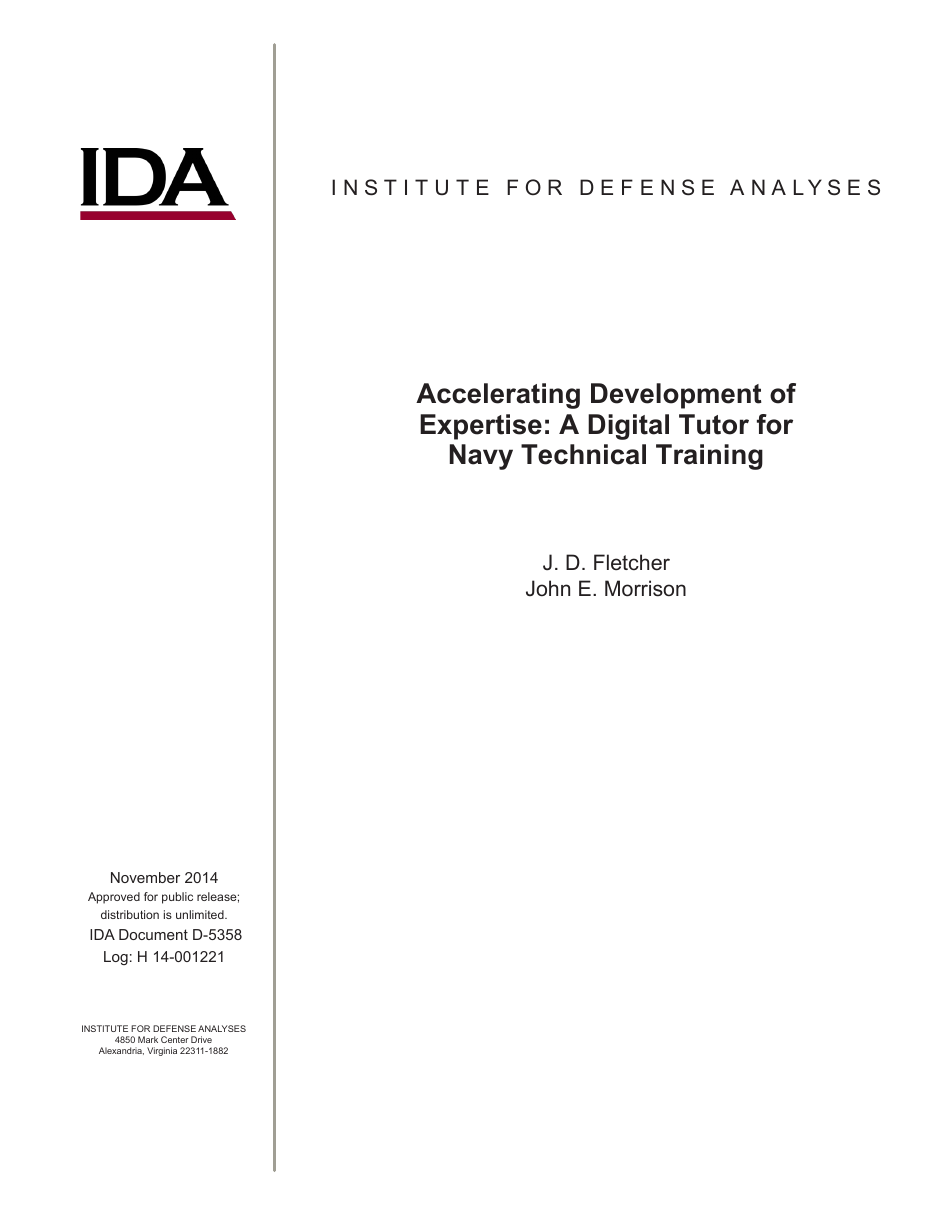
The study is J. D. Fletcher and John E. Morrison, "Accelerating Development of Expertise: A Digital Tutor for Navy Technical Training", Institute for Defense Analyses Document D-5358, November 2014, 75 pages. I read the executive summary and the sections on participants, comparison groups and human instructors in an archived copy, because the Defense Department's copy returned a maintenance page today.
The Digital Tutor taught information technology to newly recruited sailors. The capstone assessment compared 12 graduates of the 16-week tutor course, 12 graduates of a 35-week classroom course, and 12 senior Navy technicians with an average of 9.6 years in the Fleet. On a written knowledge test the tutor group beat the classroom group by 3.54 standard deviations and the technicians by 3.11. On troubleshooting, in teams of three, the gaps were 7.98 and 4.19. On a normal curve, 3.54 and 3.11 standard deviations are about the 99.98th and 99.9th percentiles, which is where Synthesis's two figures appear to come from.
Those are enormous effects. Kurt VanLehn's 2011 review, which I summarised in my history of intelligent tutoring systems, put human tutoring at 0.79 and step-based tutoring systems at 0.76.
The report states its own limits. Each group had 12 people. The tutor graduates were six drawn from each of two classes of 20, and the report does not say they were assigned at random. The classroom group was "the first 12 who had passed a certification exam" out of a class of 30. On the security exercise the tutor group did not beat either comparison group. The sailors used the tutor for 6 hours a day and then sat a 2-hour study hall led by a Navy instructor, and the authors write that the instructors "were essential in conducting the course".
Nothing in it concerns children or arithmetic. It studied adult Navy trainees on a full-time course in network administration. The report supports the claim that a carefully built tutor can train adult technicians fast. Whether the same design teaches fractions to a seven-year-old in twenty minutes on an iPad is a separate question, and Synthesis has published no data on it.
Synthesis Tutor compared with Khan Academy, IXL and Math Academy
Synthesis publishes its own comparison, with itself in the first row.
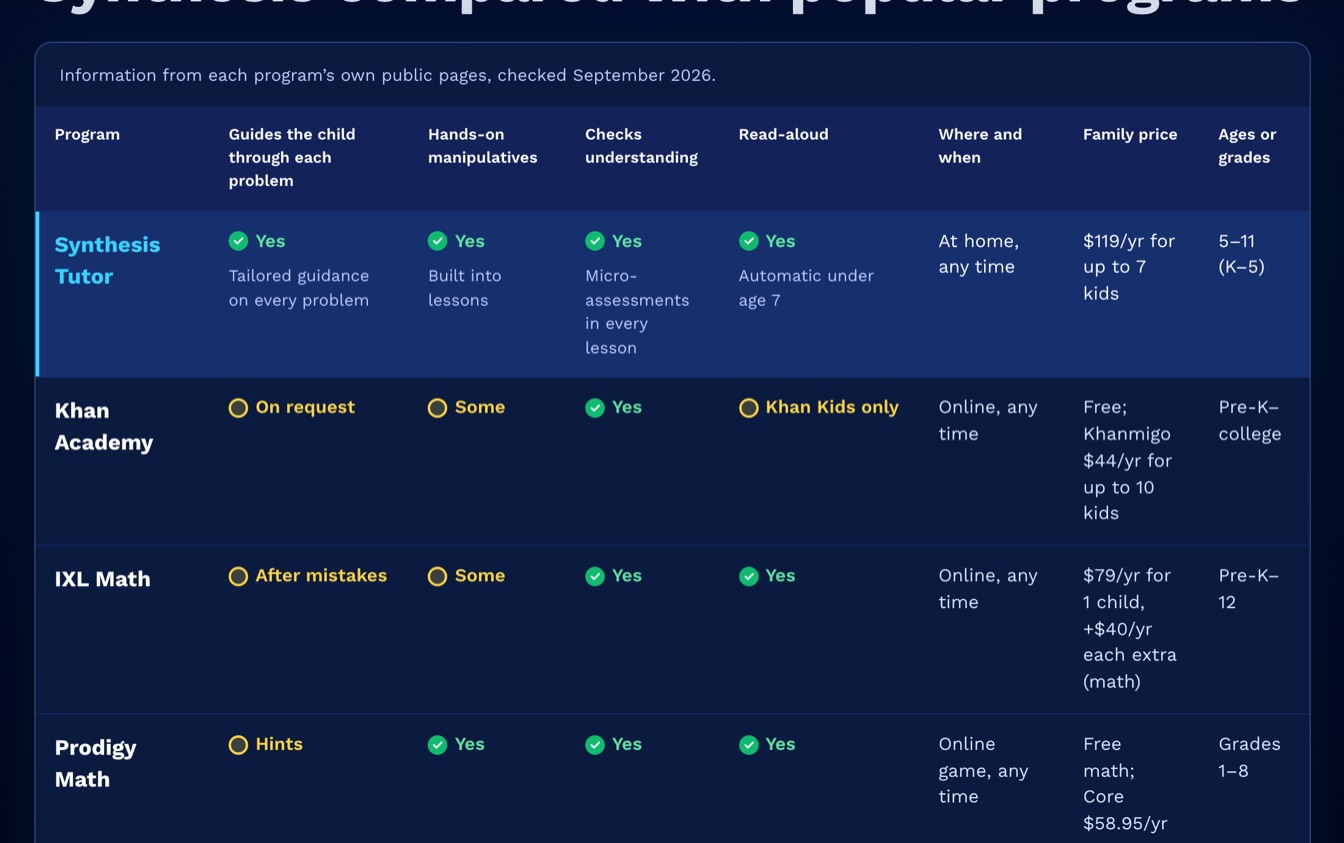
Mine uses each company's pages, read today or for an earlier post.
| Ages | Price | What the child does | Evidence | |
|---|---|---|---|---|
| Synthesis Tutor | 5 to 11 | $29 a month or $119 a year, up to 7 children | Scripted math lessons with on-screen manipulatives and a voice | None on children. The company cites a Navy study of adults |
| Khan Academy Kids | 2 to 8 | Free, no ads | Games, books and early math lessons | None that I have read |
| Khanmigo | School age, through a parent's account | $4 a month or $44 a year, up to 10 children | Chats with a tutor beside Khan Academy exercises | A randomized trial in 18 middle schools: about 0.06 to 0.08 standard deviations a year |
| IXL | Pre-K to 12 | Math from $9.95 a month | Practice questions by skill, with explanations | IXL's research page lists a randomized trial by Johns Hopkins researchers. I read IXL's summary only |
| Math Academy | Fourth-grade math to university | $49 a month | Worked examples, graded problems, scheduled reviews | Accounts from named adult users. My review cites no trial |
Khan Academy Kids is free and stops at 8. IXL is practice, and a child who does not yet understand a concept gets drilled on it. Math Academy starts at fourth-grade math, and Austin Scholar's list has Alpha using it from fourth grade on. Synthesis teaches the concept first, with pictures, to an age group that Math Academy does not serve.
No Synthesis for adults
If you landed here hoping for a grown-up version, there is none. The Tutor stops at fifth-grade math and Teams stops at 14. The FAQ mentions "older students who need additional support", by which I doubt it means me.
An adult who wants school math back should start with Math Academy's foundations courses, or Khan Academy for free. For other subjects I sorted the options in the best learning apps for adults.
Understand, for the parent
Understand is for adults, and it is the wrong choice for a child. It is a voice tutor you can interrupt. It reads an article or a PDF aloud word for word and stops when you ask a question. It asks you to explain an idea back, and keeps a record of what you explained that you can read and correct.
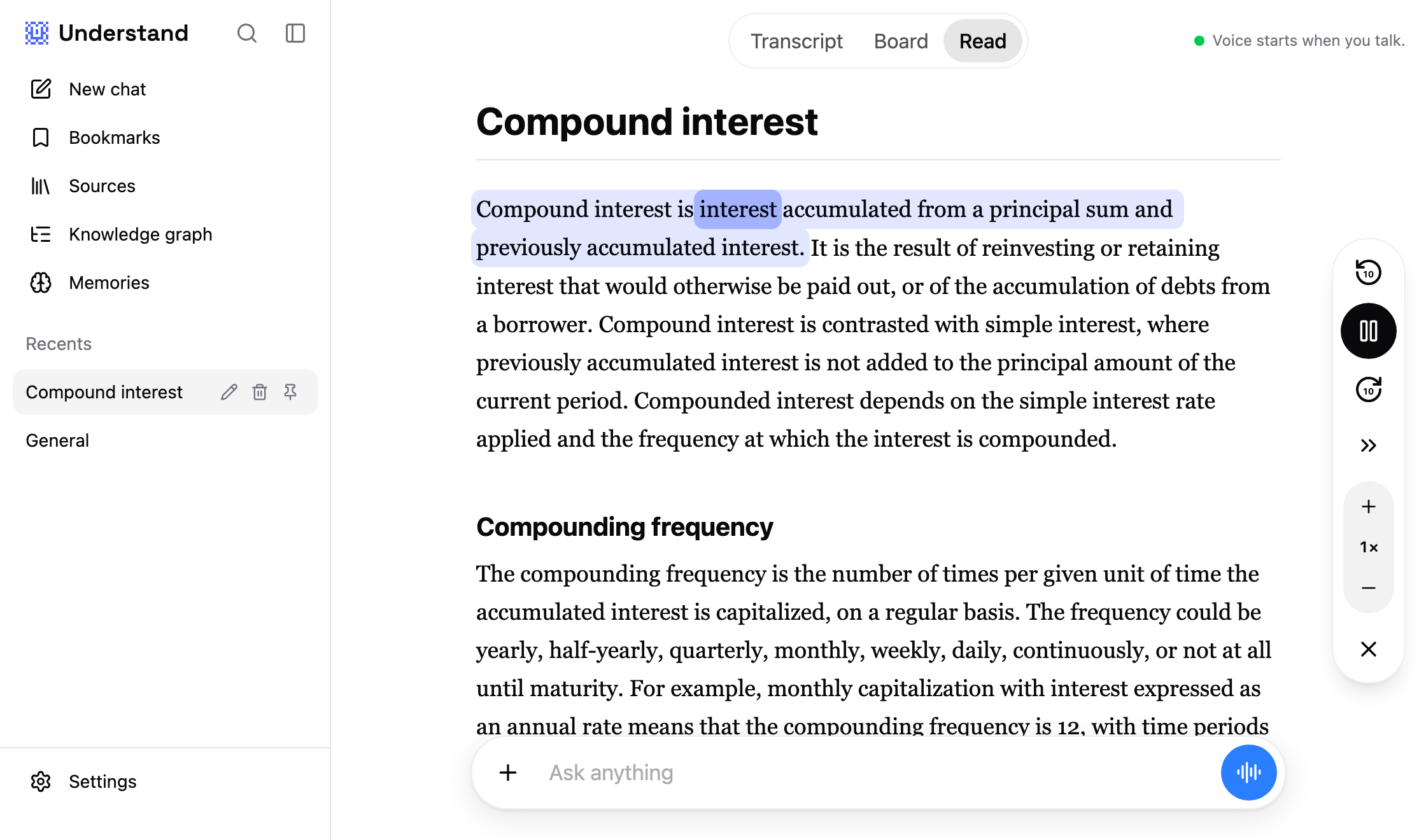
It has no courses, no problem sets, no spaced repetition and no Android app. No trial has evaluated it, which puts it level with Synthesis on evidence. It is free for now.
Choosing
For a child between 6 and 10 who dislikes math or has gaps, the 7-day trial costs nothing and will tell you more than this review. Sit nearby for the first sessions. If your child asks for it again on day three, $119 for a year and seven children is a fair price.
A quick child may finish the content within months, as VeggieSolo's did, and several reviewers met bugs. Pay for the year only after the trial, and judge it by what your child can do afterwards, since the Navy's result tells you nothing about that.