Educational podcasts for adults that teach a subject, and how to remember them
The educational podcasts for adults that teach the most are built around one subject and a host who knows it well: In Our Time and Revolutions for history, The Joy of Why for science, EconTalk for economics, Philosophy Bites for philosophy in under 20 minutes. Keeping what you hear is the harder part: in a 2025 trial, undergraduates got 55% of the questions right straight after a 30-minute podcast and 36% a month later.
I build Understand, a voice tutor for adults, and have no connection to any of the shows below. The numbers come from each show's own feed and website, read on 5 October 2026. I have not heard every episode of anything here. In Our Time alone has 1,110 episodes in its feed, which at its median length of 42 minutes is more than four months of 40-hour weeks.
The list
A show made the list if an episode leaves you knowing a subject better than before, if the host or guest knows that subject well, and if old episodes are still worth hearing. That ruled out news, chat shows and most of what is sold as self-improvement. The lists that rank for this search mix all three in, often next to the publisher's own podcast.
Each entry has one episode to start on that stands alone or begins a series, with its year and length.
| Show | Host | In feed since | Episodes in feed | Typical length | Transcripts |
|---|---|---|---|---|---|
| In Our Time | Misha Glenny | 1998 | 1,110 | 55 min | Not seen |
| Hardcore History | Dan Carlin | 2018 (older shows are paid) | 13 | 4 h 15 min | Not seen |
| The Rest Is History | Tom Holland, Dominic Sandbrook | 2020 | 729 | 75 min | Not seen |
| Revolutions | Mike Duncan | 2013 | 402 | 30 min | Not seen |
| The History of Rome | Mike Duncan | 2007 | 193 | 25 min | Not seen |
| The Joy of Why | Steven Strogatz, Janna Levin | 2022 | 76 | 45 min | Yes |
| Mindscape | Sean Carroll | 2018 | 447 | 80 min | Yes |
| Radiolab | Lulu Miller, Latif Nasser | 2006 | 673 | 45 min | Not seen |
| The Naked Scientists | Chris Smith and team | 2005 | 1,294 | 35 min | Articles instead |
| Planet Money | NPR | 2023 (feed is cut short) | 355 | 30 min | Yes |
| EconTalk | Russ Roberts | 2006 | 1,070 | 70 min | Yes |
| Conversations with Tyler | Tyler Cowen | 2015 | 303 | 55 min | Not seen |
| Philosophy Bites | David Edmonds, Nigel Warburton | 2007 | 411 | 20 min | Not seen |
| History of Philosophy without any gaps | Peter Adamson | 2010 | 511 | 20 min | Yes |
| Very Bad Wizards | Tamler Sommers, David Pizarro | 2012 | 356 | 70 min | Not seen |
| 99% Invisible | Roman Mars | 2010 | 831 | 40 min | Yes |
| You Are Not So Smart | David McRaney | 2012 | 346 | 65 min | Some |
| Acquired | Ben Gilbert, David Rosenthal | 2015 | 217 | 3 h 45 min | Yes |
| Dwarkesh Podcast | Dwarkesh Patel | 2020 | 142 | 1 h 40 min | Yes |
| Lex Fridman Podcast | Lex Fridman | 2018 | 503 | 3 h 50 min | Yes |
"Typical length" is the median of the last 30 episodes, rounded. "In feed since" is the oldest episode the public feed still carries. "Not seen" means I found no transcript on the pages I opened, which is weaker than saying there is none.
History
In Our Time
BBC Radio 4 puts a presenter and academic guests in a room for under an hour on one subject: the Bronze Age collapse, absolute zero, Plato's Republic. The feed goes back to 15 October 1998 and an episode called "War in the 20th Century". The BBC's page now says new episodes are "hosted by Misha Glenny", and Monday's archive picks are conversations "originally presented by Melvyn Bragg."
Start with "The Bronze Age Collapse" (2016, 47 minutes), which covers the destruction of several Mediterranean civilisations around 1200 BC.
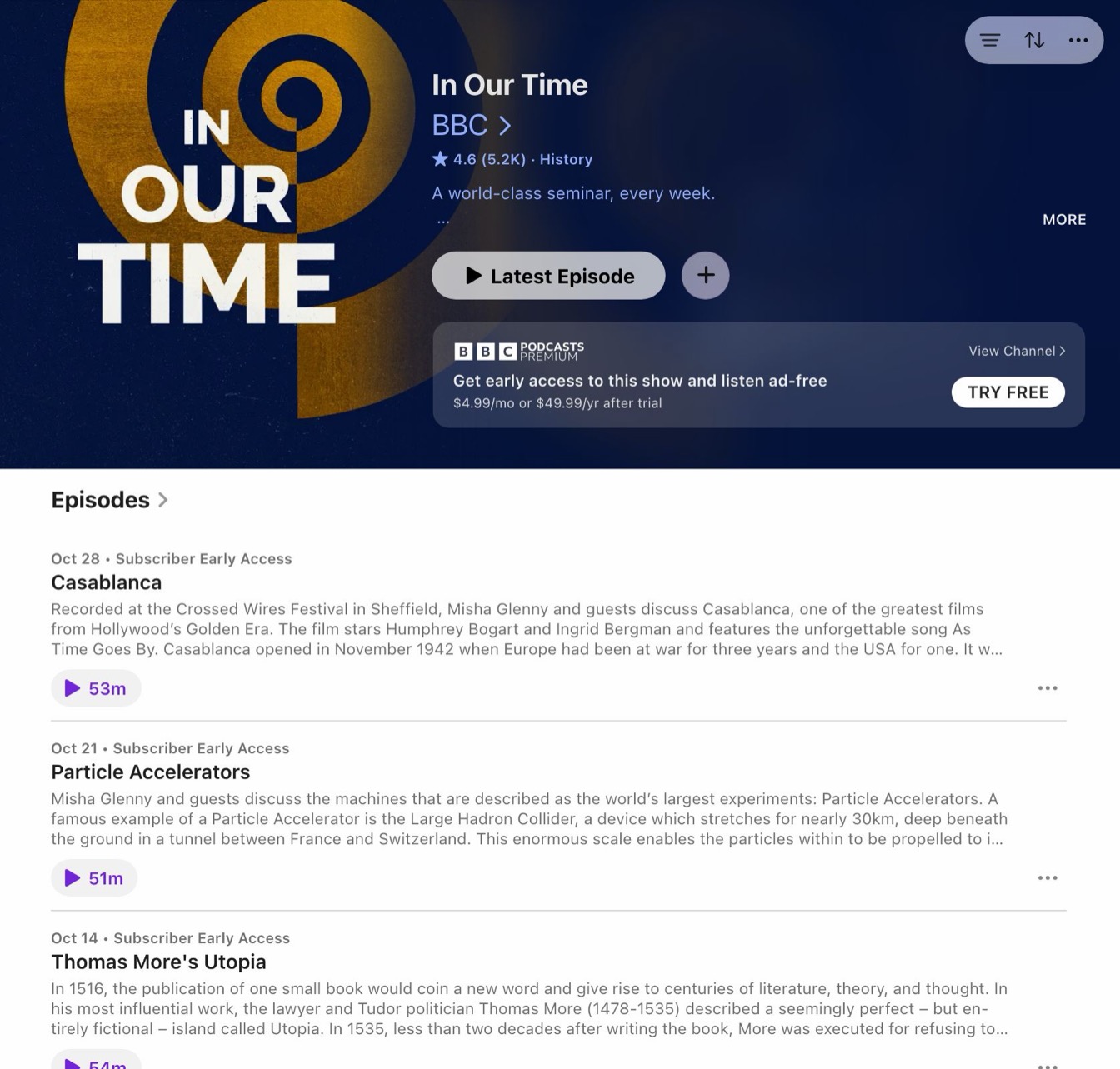
On 5 October, Apple's listing already showed episodes dated as late as 28 October, for BBC Podcasts Premium subscribers at $4.99 a month. The free feed gets them later.
Hardcore History
Dan Carlin's episodes are long and few. The free feed holds 13, from July 2018 to July 2026, and the longest runs six hours and 23 minutes. Everything before show 62 is sold on his site, at $2.99 a show or $99.99 for the catalogue.

Start with "Supernova in the East I" (2018, 4 hours 28 minutes), the first of six on the Asia-Pacific war of 1937 to 1945.
The Rest Is History
Tom Holland and Dominic Sandbrook have released two episodes a week lately, and tell big subjects over five or six parts. Start with "The Princes in the Tower Part 1" (2022, 49 minutes): a two-parter on a murder that has never been solved.
Revolutions and The History of Rome
Mike Duncan tells history in order, in short episodes, one revolution per season, beginning with Charles I's England. Start at "1.1- The Kingdoms of Charles Stuart" (2013, 24 minutes) and go forward.
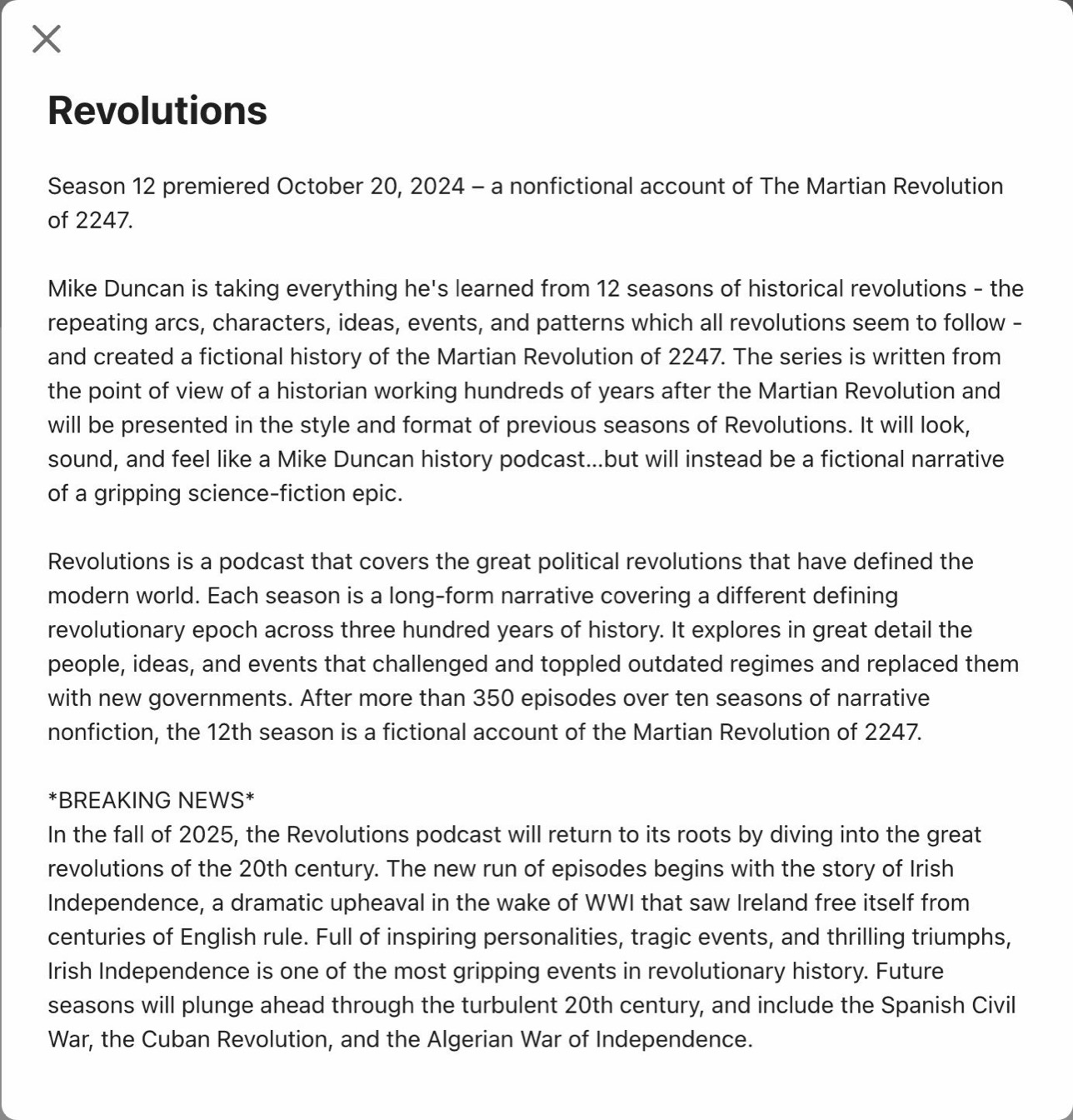
Season 12 was an invented "Martian Revolution of 2247", and the show's description still promises a return "in fall 2025" with Irish independence. In October 2026 the newest item in the feed was a notice for a live show. His older series, The History of Rome, ran from 2007 and starts with "001- In the Beginning", which is 12 minutes long.
Science
The Joy of Why
Quanta Magazine's podcast alternates between Steven Strogatz, a mathematician, and Janna Levin, a cosmologist, each interviewing a researcher about one question. Start with "What Does the Fourth Dimension Actually Look Like?" (2026, 53 minutes), with the mathematician Maggie Miller of the University of Texas.
Mindscape
Sean Carroll, a physicist, records 80-minute conversations with scientists and philosophers. Start with "Kate Jeffery on Entropy, Complexity, and Evolution" (2019, 73 minutes), on how a universe running down can still produce living things.
Radiolab
Radiolab teaches through stories and sound design more than explanation, and its feed goes back to "Where Am I?" in 2006. Start with "Colors" (2012, 66 minutes), in which, the description says, "Jad and Robert tear the rainbow to pieces." The current hosts are Lulu Miller and Latif Nasser.
The Naked Scientists
Chris Smith started The Naked Scientists in 2001, and it is now based at Cambridge University's Institute of Continuing Education. Each weekly episode covers several new findings with interviews, which makes it the closest thing here to science news. Start with the latest episode.
Economics
EconTalk
Russ Roberts has hosted a weekly hour-long interview since March 2006. His guests are economists and also doctors, psychologists, historians and philosophers. Start with "Michael Munger on Ticket Scalping and Opportunity Cost" (2006, 30 minutes), an early episode on what scalping shows about how people value things they got for free.
Planet Money
NPR's team answers one economic question per episode with reporting, in about half an hour. Its feed reaches back only to 2023. Start with any recent episode, such as "Where all those weird new drinks are coming from" (2026, 30 minutes).
Conversations with Tyler
Tyler Cowen, an economist at George Mason University, researches each guest's work and asks about it in detail. The Mercatus Center produces it. Start with "Patrick Collison has a Few Questions for Tyler (Live at Stripe)" (2017, 94 minutes), where the guest interviews the host.
Philosophy
Philosophy Bites
David Edmonds and Nigel Warburton interview one philosopher on one idea, in about 20 minutes. Start with the first, from June 2007: "Simon Blackburn on Plato's Cave" (14 minutes).
History of Philosophy without any gaps
Peter Adamson, a professor of philosophy at LMU Munich and King's College London, has been going through the history of philosophy in order since 2010, with series on philosophy in the Islamic world, Byzantium and Africana philosophy that survey courses skip. The newest episode, on 6 October, is numbered 500d. Start with "HoP 001 - Everything is Full of Gods - Thales" (2010, 22 minutes).
Very Bad Wizards
Tamler Sommers, a philosopher, and David Pizarro, a psychologist, argue about moral philosophy and moral psychology. Start with "Episode 6: Trolleys, Utilitarians, and Psychopaths (Part 1)" (2012, 62 minutes), whose description opens with Tamler unable to get "Call Me Maybe" out of his head. If you would rather have one person take philosophers one at a time, Stephen West's Philosophize This! does that in half-hour episodes.
Design and psychology
99% Invisible
Roman Mars makes episodes about design and the built world. The show's site says all past episodes "are evergreen", and the current series is "100 Objects". Start with "Kowloon Walled City" (2012, 15 minutes) or "Ten Thousand Years" (2014, 29 minutes), about how to warn people 10,000 years from now away from buried nuclear waste.
You Are Not So Smart
David McRaney interviews researchers about reasoning, biases, judgment and decision-making. The first episode, "001 - Attention" (2012, 40 minutes), is with Daniel Simons, co-author of The Invisible Gorilla.
Business, technology and long interviews
Acquired
Ben Gilbert and David Rosenthal tell the history of one company per episode. The recent ones run close to four hours. Start with "TSMC" (2021, 2 hours 21 minutes).
Dwarkesh Podcast
Dwarkesh Patel interviews one guest for about 100 minutes, often on AI. Start with a history episode instead, Sarah Paine's "Why Japan lost WWII" (2025, 2 hours 8 minutes), the second of three lectures with interviews by the Naval War College professor.
Lex Fridman Podcast
Lex Fridman's interviews are the longest here, one of them over ten hours. Use it for a guest you already care about, and the transcript to find the part you want.
Left off the list
Hidden Brain was on my first draft. Its recent titles include "How to Make a Difference", "How to Be A Better Partner" and "Making the Most of Your Mistakes". Those are advice episodes, and they are probably useful, but they belong on another list. Stuff You Should Know, Freakonomics Radio and TED Radio Hour are missing because I did not get to their feeds this week, which says more about my week than about them.
Keeping what you hear
Listening works about as well as reading
For fluent adults, comprehension from listening and from reading come out about the same. Rogowsky, Calhoun and Tallal (2016) gave 91 adults part of a nonfiction book as audio, as text, or both, and found no significant difference on a written test straight away or two weeks later. I read only the abstract. The longer case is in my post on whether audiobooks count as reading.
The cost of audio is attention. Varao Sousa, Carriere and Smilek (2013) asked students at Waterloo, at random moments, whether their minds had wandered: it happened most while listening and least while reading aloud, and listeners did worst on the memory test. Kopp and D'Mello (2015) found the same with Sherlock Holmes and Walden, though I saw only their abstract.
A month later
The 2025 trial in the first paragraph is by Jabbari and colleagues at McMaster. Nineteen medical residents and 22 undergraduates heard 30-minute medical education podcasts, some while driving a simulator through a city or the countryside and some sitting at a desk, in a randomized crossover. Driving made no significant difference to what they learned. On the immediate test, undergraduates scored 38% after city driving and 55% at a desk, though the paper reports only the gap between city and country driving as significant. A month later every condition had sunk to the same place, about 36%.
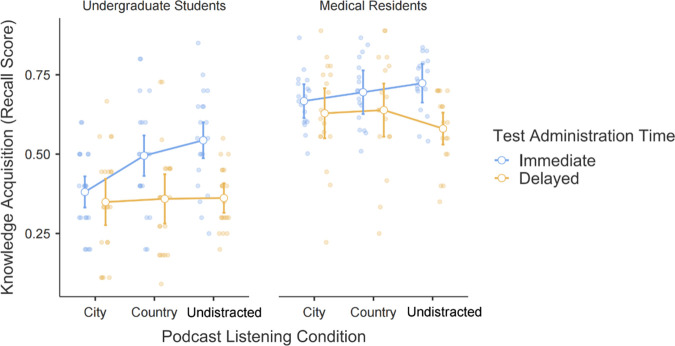
The residents scored around 60% a month later in every condition, presumably because they already knew the field and each fact had somewhere to go. The groups were not randomly assigned, so this is a comparison and not an experiment, but it fits a guess in my audiobooks post: audio works best on subjects you already know something about. If it holds, a first podcast on a new subject teaches less than it feels like, and the fifth one on the same subject teaches more.
Testing yourself beats hearing it again
The best-supported finding in learning research is that trying to recall something fixes it better than reviewing it. In Roediger and Karpicke (2006), students who restudied a passage did better five minutes later (81% against 75%), and students who had tested themselves did better a week later (56% against 42%). A 2013 review by Dunlosky and colleagues, Willingham among them, rated practice testing and spacing your study over time as the only two techniques of "high utility", and rereading as low. Hearing an episode a second time is the listening version of rereading.
Szpunar, Khan and Schacter (2013) tested this on a 21-minute statistics lecture split into four parts. One group answered a few questions after each part. Their minds wandered on 19% of the checks, against 39% and 41% for the groups that reviewed or did nothing, and on the last part they scored 86%, against 66% and 72%.
Karl Popper's account of knowledge gives the reason. He argued that knowledge grows by guessing and then criticising the guess, and listening supplies only the first half. Trying to say back what you heard is the quickest criticism there is, because the parts you misunderstood come out as sentences you cannot finish.
Pauses and teaching
Ruhl, Hughes and Schloss (1987) stopped university lectures three times for two minutes at natural breaks. The classes with pauses scored higher on free recall and on objective tests than the classes without. In Koh, Lee and Lim (2018), students who taught material without notes did as well a week later as students who simply practised recalling it, and better than students who taught from notes. Their reading is that teaching helps because it makes you recall. I read only the abstracts of both papers.
Speed
For lecture videos, Murphy and colleagues found "minimal costs" up to double speed and a decline beyond it. They also found that the time saved helps when you spend it on a second pass close to the test. The audiobook speed calculator works for podcasts too: a 75-minute episode at 1.5x is 50 minutes.
Habits I would keep
Stop at the end of each segment or chapter and say out loud what you just heard: the main claim and the reason for it. If you are driving, say it to the windscreen. If you can't do it, rewind; if you can, keep going. That is Ruhl's pause and Roediger's test in one move, and it costs two minutes.
Stay on one subject for a while. I would expect five episodes of Revolutions in a row to teach more than five episodes from five shows, because each gives the next something to attach to, as with the residents above.
Use the transcripts in the table for the parts you want to keep, but close them and recall the argument first, then check: reading a transcript back is still rereading.
Tell someone about it the next day, without notes, which is Koh's teaching condition; telling it over dinner counts. My post on remembering what you read has more on spacing these attempts over days.
Understand, and where it does not fit
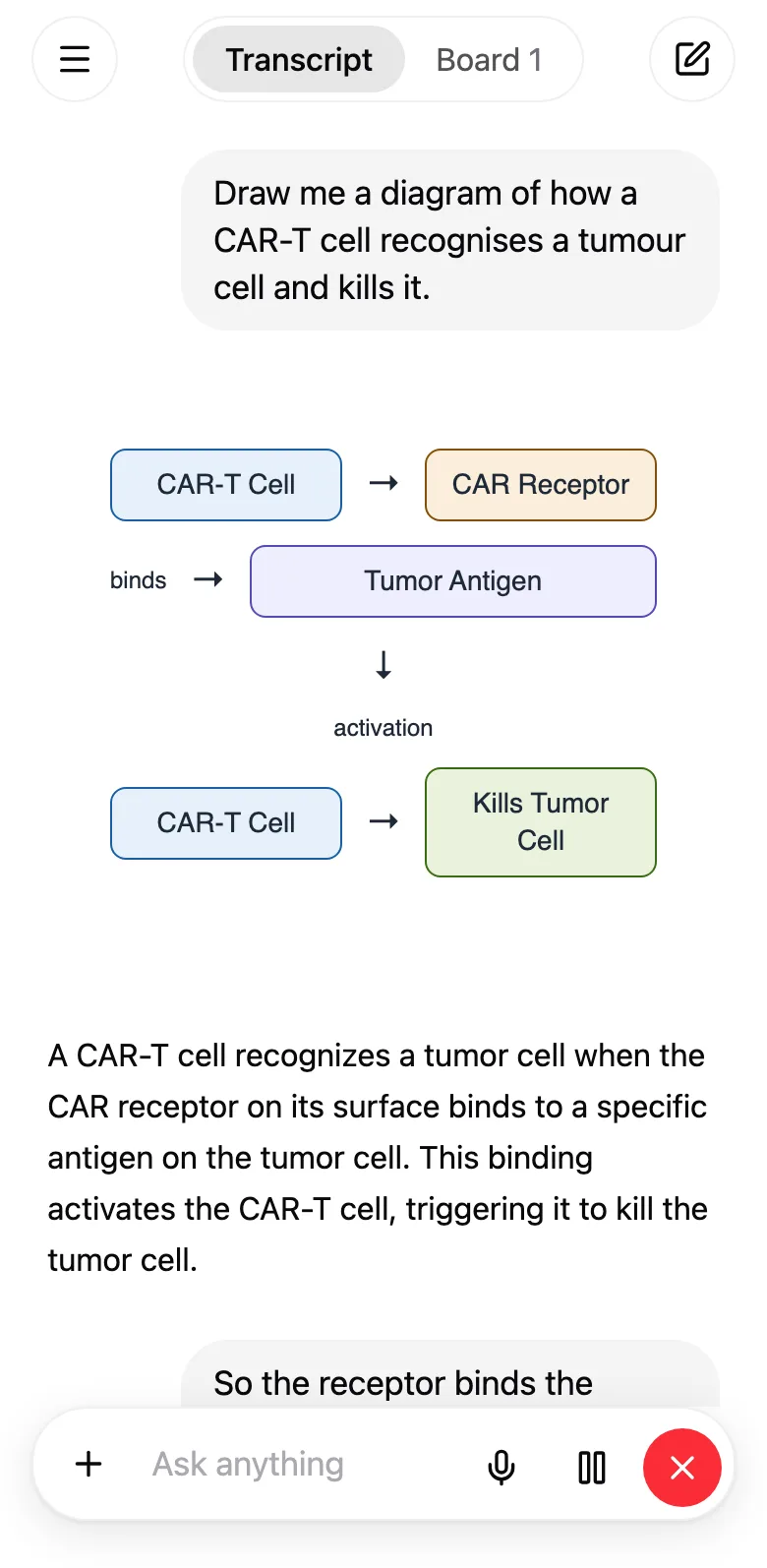
Understand is a voice tutor for adults: you talk with it, and you can interrupt it. Its manifesto calls it "an interactive alternative to audiobooks and podcasts". It answers your question directly, draws on a board while it talks, and when it has explained something new it ends on one question that takes the new idea to answer. It builds on what you say, going further if you got it and explaining a different way if you didn't. It keeps a record of the ideas you have shown you understand, which you can read and correct. It can also read an article or PDF aloud word for word and stop when you ask a question.
It does not play or import podcasts and does not hear audio. On an iPhone you can share an episode link to Understand from the Podcasts app, and it saves the page that link points to. From Apple's page that is only the episode description. If you save a show's own page with the transcript on it, such as an EconTalk or Mindscape episode, it reads that text and you can talk the conversation through: ask what Munger meant by opportunity cost, or have it question you on the argument before you move to the next episode.
It has no courses, no problem sets and no spaced repetition, and there is no Android app. No trial has evaluated it. Keep your podcast app for the podcasts; Understand is for the twenty minutes afterwards. It is free for now. The post on alternatives to audiobooks for learning compares it with other tools, and the one on learning apps for adults covers courses and practice.