Sal Khan's AI tutor prediction, checked against three years of evidence
In his 2011 TED talk, Sal Khan described the first review of his YouTube videos. It came from the cousins he had been tutoring remotely: "They told me that they preferred me on YouTube than in person."
Sal Khan is the founder and CEO of Khan Academy, a free library of school lessons, and the founder of Khan Lab School and Khan World School. In April 2023 he predicted that AI would give "every student on the planet" a personal tutor, and in April 2026 he told Chalkbeat that for a lot of students his own AI tutor "was a non-event".
I build Understand, a voice tutor for adults, and I have no connection to Khan or his organisations. I have not met him, visited either school, used Khanmigo or read Brave New Words. This profile rests on Khan Academy's and the schools' own pages, TED's transcripts, the publisher's page, named reviewers and a randomized trial.
From a cousin's homework to Khan Academy
Khan Academy's own history starts in August 2004. Khan, who grew up in New Orleans and has degrees from MIT and Harvard, was a hedge fund analyst in Boston. A cousin in New Orleans was stuck on unit conversion, and he tutored her after work over the phone and Yahoo Doodle. More relatives joined, scheduling became a problem, and in 2006 he began recording videos and posting them on YouTube.
The organisation was incorporated as a nonprofit in 2008. Khan left the hedge fund in the fall of 2009 and, by the same page's account, lived on savings for nine months until a first significant donation from Ann Doerr. Grants of $2 million from Google and $1.5 million from the Gates Foundation followed in September 2010.
Khan Academy's about page now claims 227 million registered users in more than 190 countries, and over 840 free courses for school and early college.
The 2011 talk
"Let's use video to reinvent education" was given at TED in March 2011. Khan Academy then had about 2,200 videos and a million students a month. Khan argued that lectures should be watched at home so that class time goes to problems, and that exercises should keep generating questions "until you get 10 in a row". Teachers who worked this way, he said, "have used technology to humanize the classroom".
The talk is more modest than its title. "We don't view this as a complete math education," he said of the software. And of his own first reaction to the videos: "It's good for motivated students."
Khan Lab School
Khan founded Khan Lab School in 2014, two years after his book The One World Schoolhouse, "to test and refine these ideas in an actual school setting", as his founder's letter puts it. The school's history says it began in his living room in Mountain View, California, with a PowerPoint presentation and a group of parents, and opened with 30 students in one mixed-age classroom.
It is now an independent school from transitional kindergarten to grade 12, with 315 students and 50 faculty. The lower school is in Palo Alto and the middle and upper school in Mountain View. The model is mastery-based and self-paced. The home page says roughly half of a student's time goes to discussion and applied work, and the other half to "fluency in essential skills and content".
Tuition for 2026-27 is $34,750 for grades TK to 5 and $38,850 for grades 6 to 12, with need-based financial assistance.
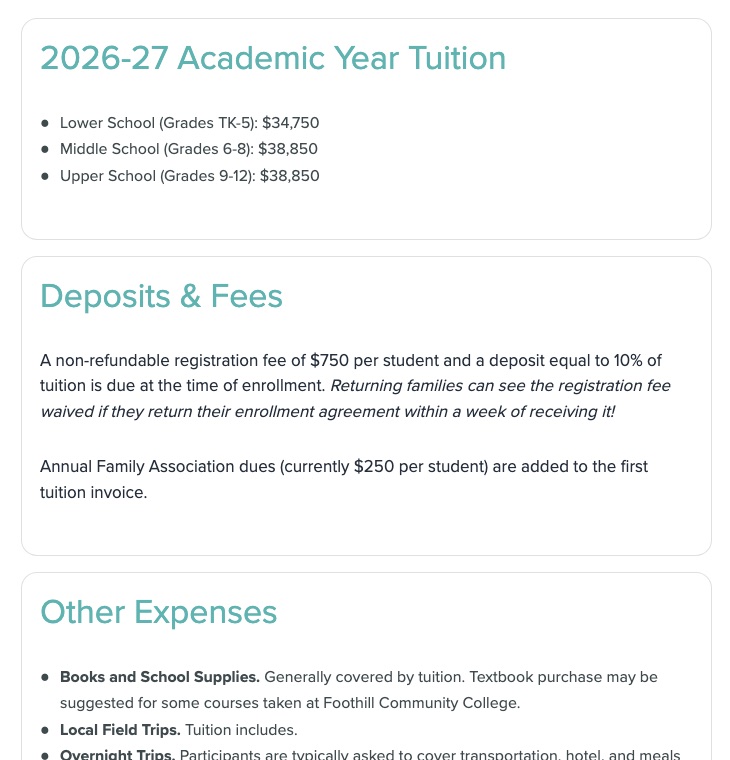
The school says its students often cover 1.5 to 2 grade levels a year and that its median student scores between the 95th and 99th percentiles on tests such as MAP and the SAT. Those are the school's numbers for families who chose it and can pay for it. I found no independent evaluation.
Khan World School
Khan World School is a full-time online school run with ASU Prep, which Arizona State University sponsors. ASU Prep announced it in April 2022, to open that August with ninth graders. It now takes grades 6 to 12.
Students work through self-paced courses and meet in seminars and in tutorials of four to eight students. Arizona residents attend free, because the state pays. Other US students pay $10,500 a year, and students abroad pay $13,700.
The school's page names its intended student: "Highly engaged + Self-driven + Curious". In the 2022 announcement Khan said the same: "These are highly engaged, enthusiastic, self-driven students".
The 2023 talk and a tutor for every student
Khan announced Khanmigo on March 14, 2023, as "a small AI pilot" built on GPT-4. The post is cautious: "AI makes mistakes. Even the newest generation of AI can still make errors in math."
A month later, at TED, he was less cautious. From the transcript of "How AI could save (not destroy) education":
"I think we're at the cusp of using AI for probably the biggest positive transformation that education has ever seen. And the way we're going to do that is by giving every student on the planet an artificially intelligent but amazing personal tutor."
He then showed a slide from Benjamin Bloom's 1984 paper on the 2 sigma problem. One-to-one tutoring, he said, "could take your average student and turn them into an exceptional student". He closed by saying "we together have a chance of addressing the 2 sigma problem and turning it into a 2 sigma opportunity". He said "a chance". He also called what he was showing "the first moves".
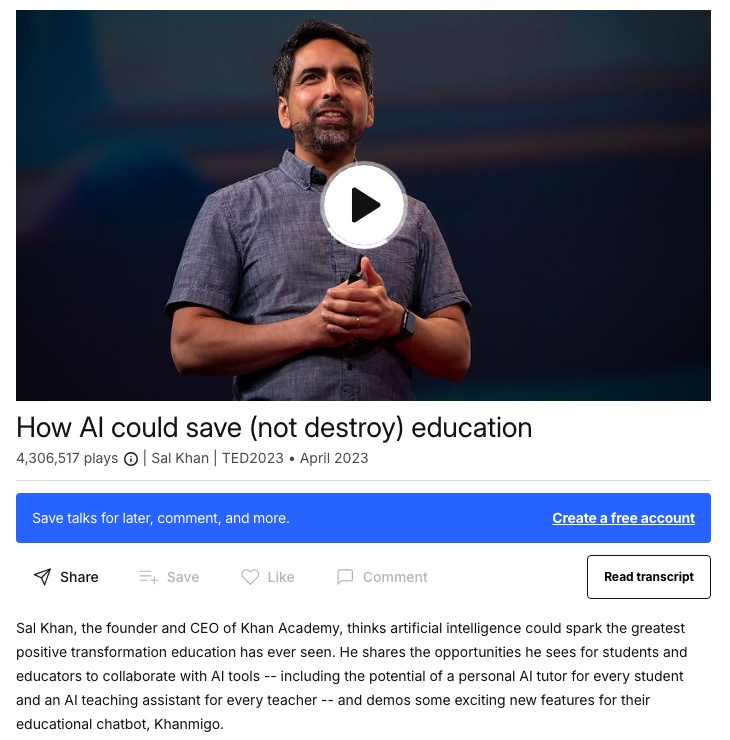
The demo itself made a design choice that lasted. Asked for the answer, Khanmigo replies, "I'm your tutor. What do you think is the next step for solving the problem?" Khan called its manner "more Socratic" than ChatGPT's.
The 2 sigma figure was already in doubt. As I describe in my history of intelligent tutoring systems, Bloom's number comes from two dissertations in which tutored students also had a stricter mastery threshold and more instruction. Later meta-analyses put the average effect of human tutoring at about a third of a standard deviation. One of them, from 2020, has Philip Oreopoulos as a co-author, and he returns below.
Dan Meyer, a former math teacher who works at Amplify, answered the talk in May 2023. He granted that the demos were "unlike anything I have ever seen from digital technology", and called them "extremely novel and extremely small". Khan had said a student could now ask a video as many questions as they could ever dream of. Meyer called that "a dream that I am wagering is not common among middle school students".
Brave New Words
Brave New Words: How AI Will Revolutionize Education (and Why That's a Good Thing) was published by Viking on May 14, 2024, at 272 pages. I have not read it, so what follows is what named readers wrote.
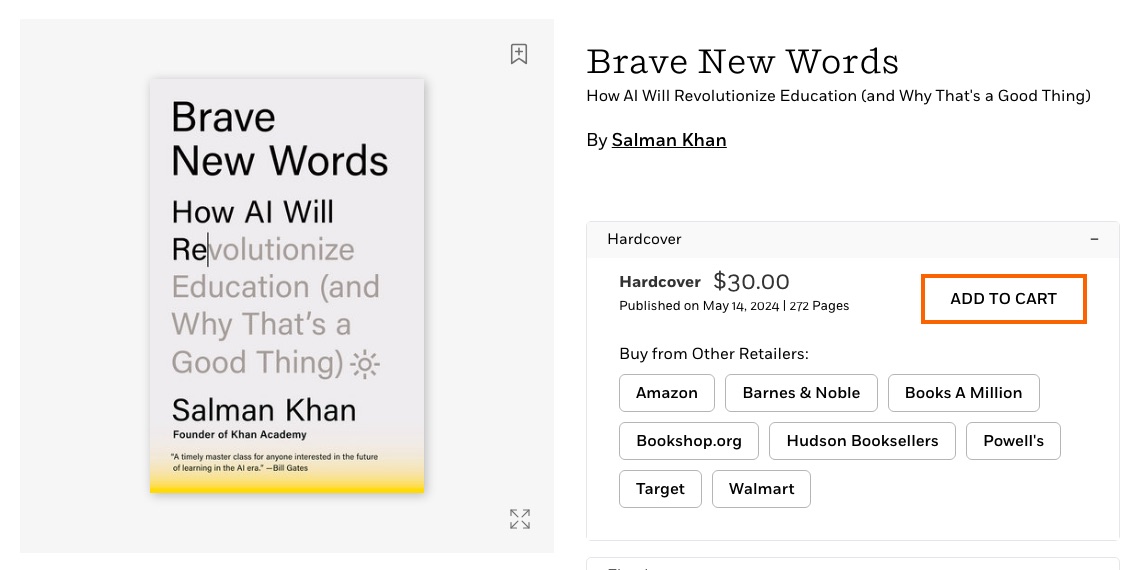
Kirkus wrote that Khan "writes with clarity, expertise, and optimism". Bill Gates, whose foundation gave Khan Academy one of its first large grants, called it "a masterclass" and quoted the book's premise: "Getting every student a dedicated on-call human tutor is cost prohibitive."
John Warner, a Chicago Tribune columnist who taught for more than twenty years, reviewed it in June 2024 as "a 270-page infomercial" for Khanmigo. He objected that "motivation, engagement, relationships have no salience to Khan's vision of teaching." In an Education Next forum that December, John Bailey of the American Enterprise Institute endorsed the book's vision. Warner, on the other side, cited Laurence Holt's estimate that about 5 percent of students use online math programs as recommended. He also quoted the head of IBM's abandoned Watson tutor: "At the heart of education, at the heart of any learning, is engagement."
I looked for reviews in the New York Times and the Wall Street Journal and could not find or open one.
Khanmigo after three years
The details are in my Khanmigo review, and I reopened the sources for this post.
Khan Academy announced a rebuilt product for school districts in October 2025. Google became a partner in January 2026, with Gemini models behind Khan Academy's Writing Coach.
In April 2026 Khan gave Matt Barnum of Chalkbeat an interview. "For a lot of students, it was a non-event," he said. "They just didn't use it much." He compared the chatbot to himself sitting at the back of a classroom, waiting for students to come and ask: "Some will; most won't."
In July he published a note objecting to how that was read: "Some people heard my recent comments about Khanmigo and interpreted them as 'AI tutoring failed.' That is not what I said, and it is not what I believe." The first version, he wrote, "did not change student learning as much as many of us hoped it would", and he drew a lesson from it: "The AI could not just sit next to the content. It had to be woven into it." The new version prompts students to explain how they got an answer.
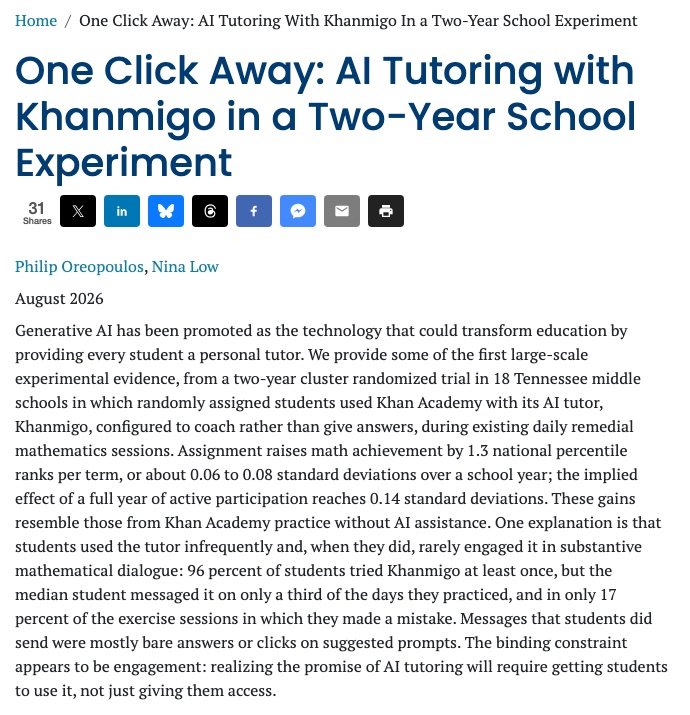
In August, Oreopoulos and Nina Low published a two-year randomized trial in 18 middle schools in Hamilton County, Tennessee. Students in remedial math sessions used Khan Academy with Khanmigo. Scores rose by 0.06 to 0.08 standard deviations over a school year, gains that "resemble those from Khan Academy practice without AI assistance". Of the students, 96 percent tried Khanmigo, and the median student messaged it on a third of the days they practiced. The trial tested the first design, in which the student had to open the chat.
Timeline
| Year | Event | Source |
|---|---|---|
| 2004 | Begins tutoring a cousin by phone | Khan Academy |
| 2006 | First videos on YouTube | Khan Academy |
| 2008 | Khan Academy incorporated as a nonprofit | Khan Academy |
| 2011 | TED talk on video and mastery | TED |
| 2014 | Founds Khan Lab School | Khan Lab School |
| 2022 | Khan World School announced in April; first access to GPT-4 in August | ASU Prep, TED transcript |
| 2023 | Khanmigo announced on March 14; TED talk in April | Khan Academy blog, TED |
| 2024 | Brave New Words published on May 14 | Penguin Random House |
| 2025 | Rebuilt Khan Academy for districts announced on October 8 | Khan Academy blog |
| 2026 | Google partnership in January; "non-event" interview in April; trial published in August | Google, Chalkbeat, EdWorkingPapers |
The parts he got right
Cost came true. The book's premise was that a human tutor for every student is unaffordable. Oreopoulos and Low put the Tennessee program at "roughly $15 per student per year". Khanmigo costs a family $4 a month.
Access mostly came true. Khan Academy's lessons are free in 190 countries. A learner can buy Khanmigo only in the United States, though, which falls short of "every student on the planet".
The Socratic default was right, and the industry followed it. OpenAI shipped a study mode for ChatGPT in 2025 that asks before it tells. A 2025 study by Bastani and colleagues found that high school students given plain GPT-4 during math practice scored 17 percent worse once it was taken away, and that a version restricted to hints largely avoided the harm. Khan's first demo had that restriction built in. I compare the current products in the best AI tutors in 2026.
He also published his own disappointing result and rebuilt the product around it. In Karl Popper's terms he made a claim that could fail a test, and when it failed he said so and revised the product.
The part the data contradicts
Khan predicted that every student would have a tutor and that the tutor would move the average student a long way. The first claim is engineering and it happened. The second depended on what middle schoolers would choose to do with a chat window, which nobody knew in 2023.
The measured gain in Tennessee is, by my arithmetic, about a thirtieth of two sigma, and the authors do not credit the tutor with it. They write: "Projections of what AI tutoring can achieve in schools should rest on how students actually use it rather than on what the technology can do in principle."
Bloom's tutored students did not open a chat window. A person sat down with them, and the session happened. Showing up was part of what the human tutor supplied, and Khanmigo's first version left that part to the student. Warner made the point in 2024. So did Khan, in 2011, when he thought his videos were good "for motivated students".
Predictions about education technology have a poor record, and mine is in it. In 2021 I wrote that general tutoring systems would arrive "in the coming decades". Khanmigo was announced fifteen months later.
My view, as someone building a voice tutor
Oreopoulos told Barnum in August: "If a keen, engaged student wants to use the technology as a good tutor, it's ready to go." Khan World School is built for that student and says so on its home page. The Tennessee trial tested the opposite case, students assigned to remedial sessions.
Adults who decide to learn something are closer to the keen student. Nobody assigns them, and they can leave. That is my reason for building for adults, and it is a conjecture. I know of no trial of an AI tutor on adults who chose it, and an adult can quit as easily as start.
The paper lists features it could not test and that might raise engagement: a tutor that is "more proactive, button driven, with voice, vision, or memory of the student". I am building two of those, so I would like the sentence to be true. Treat my optimism with the discount you would apply to anyone's forecast about their own product, Khan's 2023 talk included.
Understand
Understand is a voice tutor you can interrupt. It reads a text aloud word for word and stops when you ask a question. It asks you to explain an idea back, and it keeps a record of what you explained that you can read and correct.
It has no courses, no problem sets, no spaced repetition and no Android app. No trial has evaluated it, and Khanmigo has one. It is for adults, and it is free for now. A student in a US school should use Khan Academy.