Joe Liemandt, Trilogy and ESW Capital: the software fortune behind Alpha School and Timeback
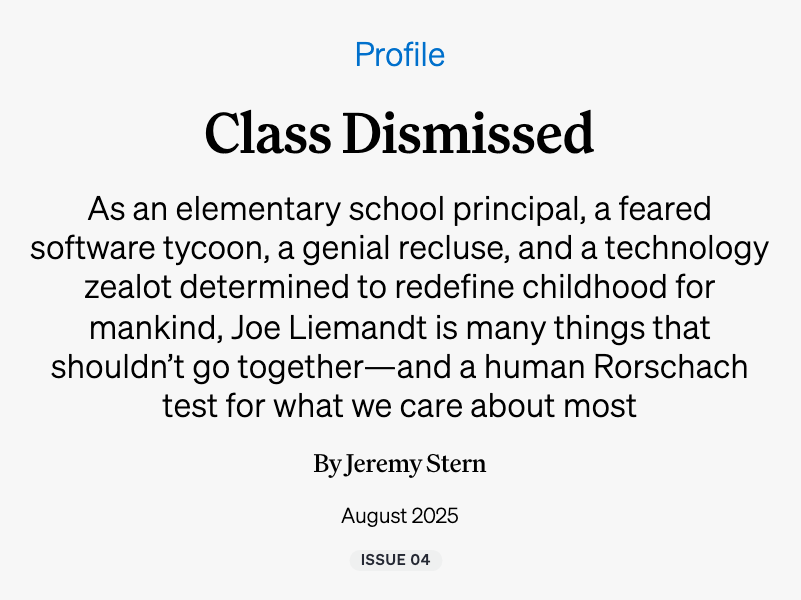
Joe Liemandt paid for his first company, Trilogy, with about 50 credit cards, and says he paid for his latest with $1 billion taken out of it. He is the founder of Trilogy and of ESW Capital, a private firm that buys ageing software companies and staffs them through its recruiting arm Crossover, and he is now the principal of Alpha School and, by his own account, the funder of its software, Timeback.
I have never met him or anyone who works for him. This profile rests on Jeremy Stern's profile for Colossus of August 2025, Nathan Vardi's 2018 reporting for Forbes, and the companies' own pages, which I read on October 4, 2026. I build Understand, a tutor for adults, and I have no connection to any of them.
The short answer
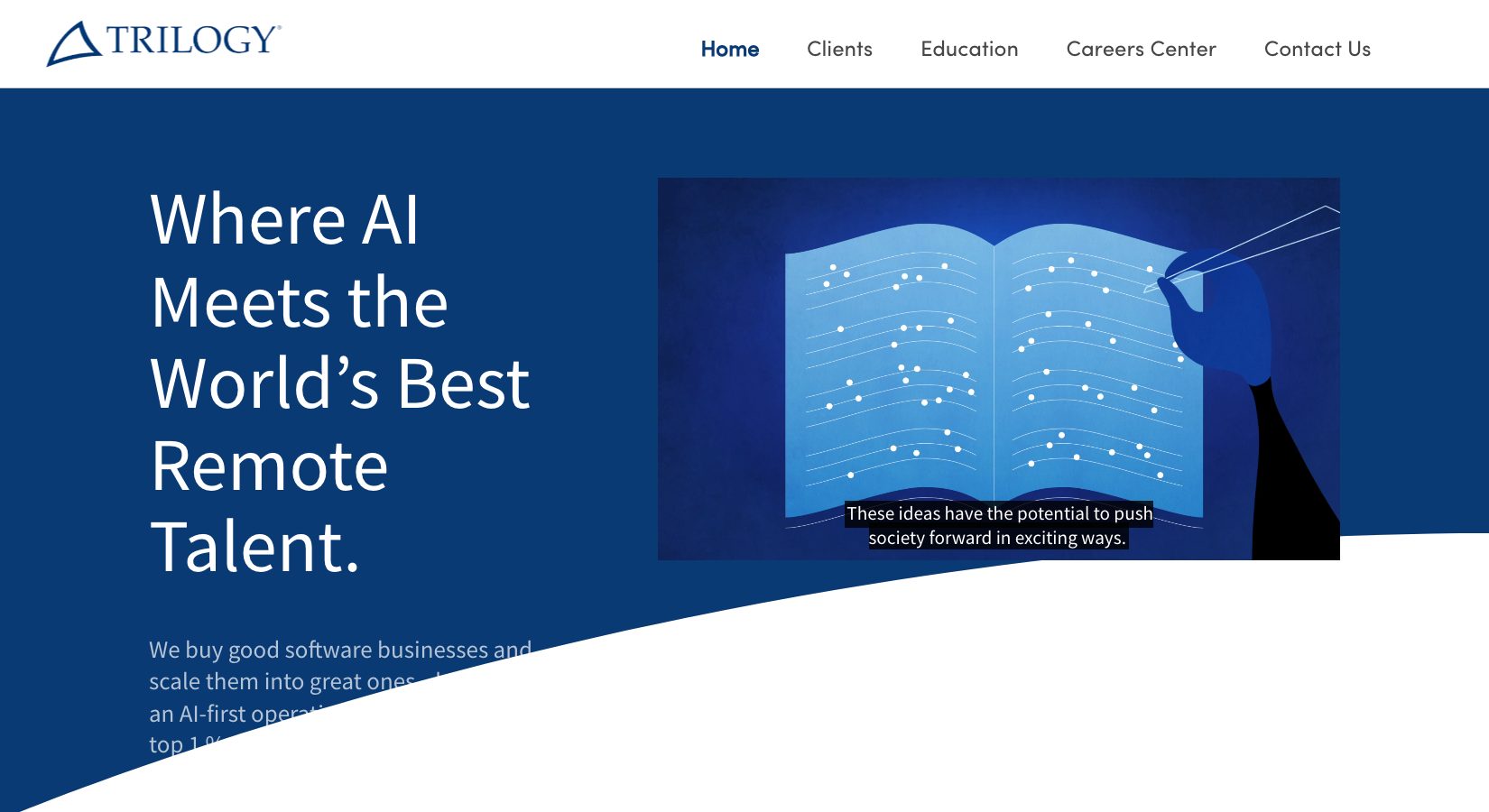
- Trilogy is the enterprise software company Liemandt started as a Stanford student in 1989. Its home page now reads: "We buy good software businesses and scale them into great ones".
- ESW Capital is his investment firm. Stern calls it a "separate legal entity from Trilogy but which in practice is one and the same". Forbes's profile of him says it "has purchased more than 100 small U.S. software companies with a strategy of moving their workforce to foreign freelance workers".
- Crossover is the recruiting company that finds those workers.
- MacKenzie Price co-founded Alpha School in 2014. She worked at Trilogy in the 1990s.
- Timeback is the software Alpha's students use for two hours a day, and the product he wants to sell to everyone else.
Forbes put his net worth at $7.6 billion on October 4, 2026 and ranks him 224th on the 2026 Forbes 400. Stern calls him a "decabillionaire". Forbes's number is the one with a method behind it.
Trilogy and the 1990s
Trilogy's site dates the company to 1989 and says it was "Founded by Stanford drop-outs in Silicon Valley". Vardi has Liemandt leaving Stanford in 1990, at 21. He and Stern agree on the product: a configurator, software that stops a sales rep from selling a combination of parts that cannot be built.
No venture firm would fund it, by Stern's account, so the founders applied for pre-approved credit cards. Each application had a box for the number of cards the applicant already held, with room for a single digit. Liemandt had about 50. The debt was approaching half a million dollars when the team moved from Palo Alto to Austin.
The first customer, in Liemandt's telling to Stern, was Silicon Graphics. He quoted $100,000 at the demo and was turned down for being five people in a garage. When Silicon Graphics called back a few weeks later, he said the price had tripled, and they paid $300,000. Hewlett-Packard then paid $3.5 million and IBM $25 million.
In 1996 he was on the cover of Forbes twice. Vardi writes that at 27 he was "the youngest self-made member of The Forbes 400, with a $500 million net worth". Jack Welch, his late father's old boss at General Electric, was less impressed. Stern reports Welch's advice over lunch that year: "You could be doing 10 times more, Joe," and "Don't be such a wuss."
The company became known for how it hired. Stern says Trilogy spent $10,000 a head recruiting about 300 graduates in 1998 and put them through Trilogy University, a 100-day programme in which every new hire's work was "continuously monitored, measured, assessed, ranked". Fast Company's 1998 feature on the place is titled "Insanity Inc." Vardi and Stern both cite the 2018 book Brotopia, which has a chapter called "How Trilogy Wrote The Bro Code". Vardi calls Liemandt's formula misogynistic. Stern notes that the book "does not allege any wrongdoing, misconduct, or unethical behavior". I have not read the book.
Trilogy never went public. After the crash of 2000 Liemandt bought out the other shareholders, dropped off the Forbes 400 in 2001, and stopped giving interviews.
ESW Capital and the software roll-up
Stern dates ESW Capital to 2001 and says the name stands for enterprise software. Vardi dates the buying to 2006, when Trilogy acquired a company called Versata for $3.3 million.
The model is to buy mature business software with paying customers, stop spending on growth, and collect the maintenance revenue at lower cost. Liemandt's version, to Stern: "There's a cycle in a company where it's built to last, and there's a cycle in a company where it's built to die." Vardi describes the offers as quick cash for founders, with no earn-outs and closing "within 45 days". He counted about 75 acquisitions by 2018. Stern and Trilogy's own site both now say hundreds.
Vardi's example is Jive Software of Portland, Oregon, which ESW agreed to buy for $462 million in 2017. He reports that by the autumn of 2018 the Portland office was closed and nearly all of its 250 employees were gone.
Liemandt declined to speak to Vardi. Forbes did get one sentence from him in 2017, which it printed: "I am very private; I am an introvert." ESW Capital's own website returned "Error establishing a database connection" when I visited, so everything here about its holdings is as others reported it.
Crossover and WorkSmart
In 2018 Vardi found Crossover with "5,000 workers in 131 countries", hired as contractors at $15, $30 or $50 an hour depending on seniority, with no paid vacation or benefits.
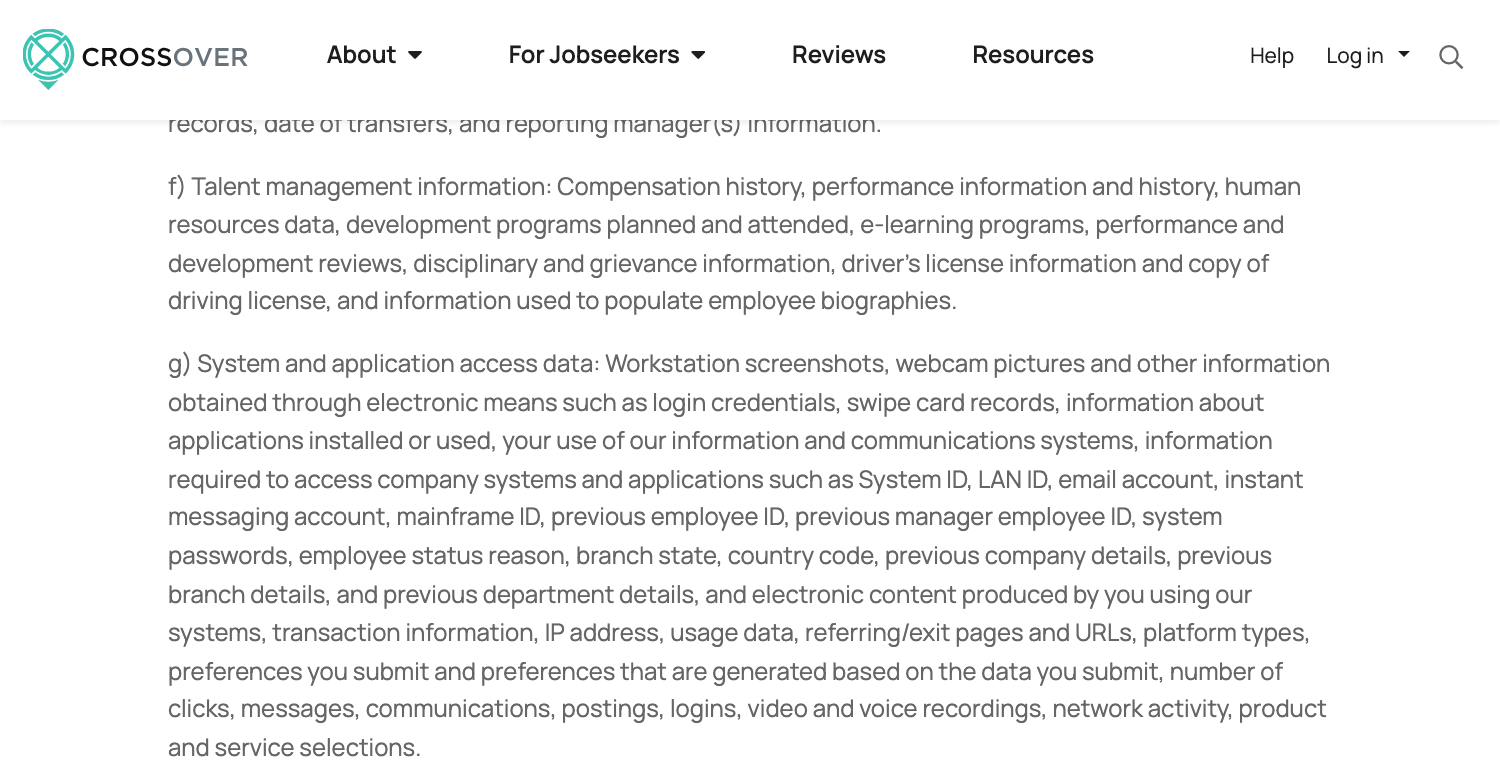
The contractors run a program called WorkSmart. Vardi: "The tracking software takes screenshots every ten minutes and, in some cases, snaps photos from PC webcams." Olivia Solon had reported the same in The Guardian on November 6, 2017. Two former Crossover workers quoted by name in Forbes objected to the tracking, and one said his productivity targets could not be met in 40 hours. Forbes's headline called the operation "a global software sweatshop".
The company's replies are on the record. A spokesperson told Forbes that all contractors authorise the tracking. Andy Tryba, Crossover's chief executive at the time, called WorkSmart "a Fitbit for how you work" and said it gives "actionable coaching". Crossover's Sanjeev Patni told The Guardian that workers come to think: "if the company is paying for my time how does it matter if it's recording what I'm doing? It's only for my betterment". Stern's defence is the pay, which he says Crossover now sets in tiers from $60,000 to $400,000 a year, and which for a contractor in Venezuela he thinks makes the tracking "more or less beside the point".
Crossover's privacy policy, last updated on September 8, 2026, still lists "Workstation screenshots, webcam pictures" among the data it collects from contractors.
The oddest page in this story is Crossover's home page. The company Forbes covered in 2018 as a recruiter of overseas programmers now says: "We recruit AI-driven educators for US school networks." One heading reads "School sucks. So we're fixing it." 2 Hour Learning is listed first among the schools hiring, and the remote software jobs are a single link further down.
MacKenzie Price and the school before him
Price's own biography describes "A Stanford graduate in Psychology" who started the school after her daughters told her school was boring. She hosts the Future of Education podcast, which had reached episode 360 of its second season when I looked.
Stern supplies the Trilogy connection. Price was hired at a Trilogy recruiting event at Stanford in 1998 and later married the company's chief financial officer, with Liemandt as best man. She and Brian Holtz started the school in Holtz's house in 2014 with 16 children. Stern's verdict is that Liemandt is the "product guy" and the school's ideas are hers.
His own account of coming to Alpha
This is Liemandt's story as he told it to Stern.
He and Price had earlier paid for a trial by the economist Roland Fryer, who offered fifth-graders in Houston money for homework and grades. Price's lesson from it: "It's hard to incentivize outcomes, but you can incentivize the work itself."
For two years he refused to enrol his daughters. "I was like, MacKenzie, I'm not sending my kids to your weird, janky school," he told Stern. "It was in a dude's garage." He says he gave in after the girls spent a week there and asked to stay.
He then spent years as a parent who thought the school could not grow: "It's not scalable. You can't scale this to the world." Generative AI changed his mind in 2022. He says he told his Trilogy managers: "For 25 years you guys have been telling me you could run this place better than me. Let's see. Good luck. I'm out. I'm going to go be a school principal."
The reported $1 billion
Stern writes that since 2022 Liemandt "has taken $1 billion out of Trilogy/ESW in order to fund and incubate proprietary AI software products at Alpha School". Liemandt's own words in the same article: "I took a billion dollars out of my software company."
Every later mention I found traces to this interview. ProPublica's Lexi Churchill links to Colossus for it. Trilogy and ESW are private and publish no accounts, and I found no filing that shows the transfer or how much has been spent. Alpha's blog describes Timeback as "a $100 million project".
So the number is a claim by the man who would know, made to one journalist. I would write "reported".
Timeback and the case against chatbots
As Stern saw it demonstrated, Timeback sits on top of a lesson generator called Incept, which wraps commercial language models. Timeback's "primary tool is the vision model that monitors and records a student's 'anti-patterns'", such as rushing or socialising, and it feeds a "waste meter" on the student's screen. Crossover's contractors would recognise the design. Stern makes the connection himself, summing up the worldview behind Trilogy, ESW and Crossover as "record, capture, and minutely measure all the data possible". WIRED's reporting on how some families experienced that monitoring, and Alpha's denial, are in my Alpha School review.
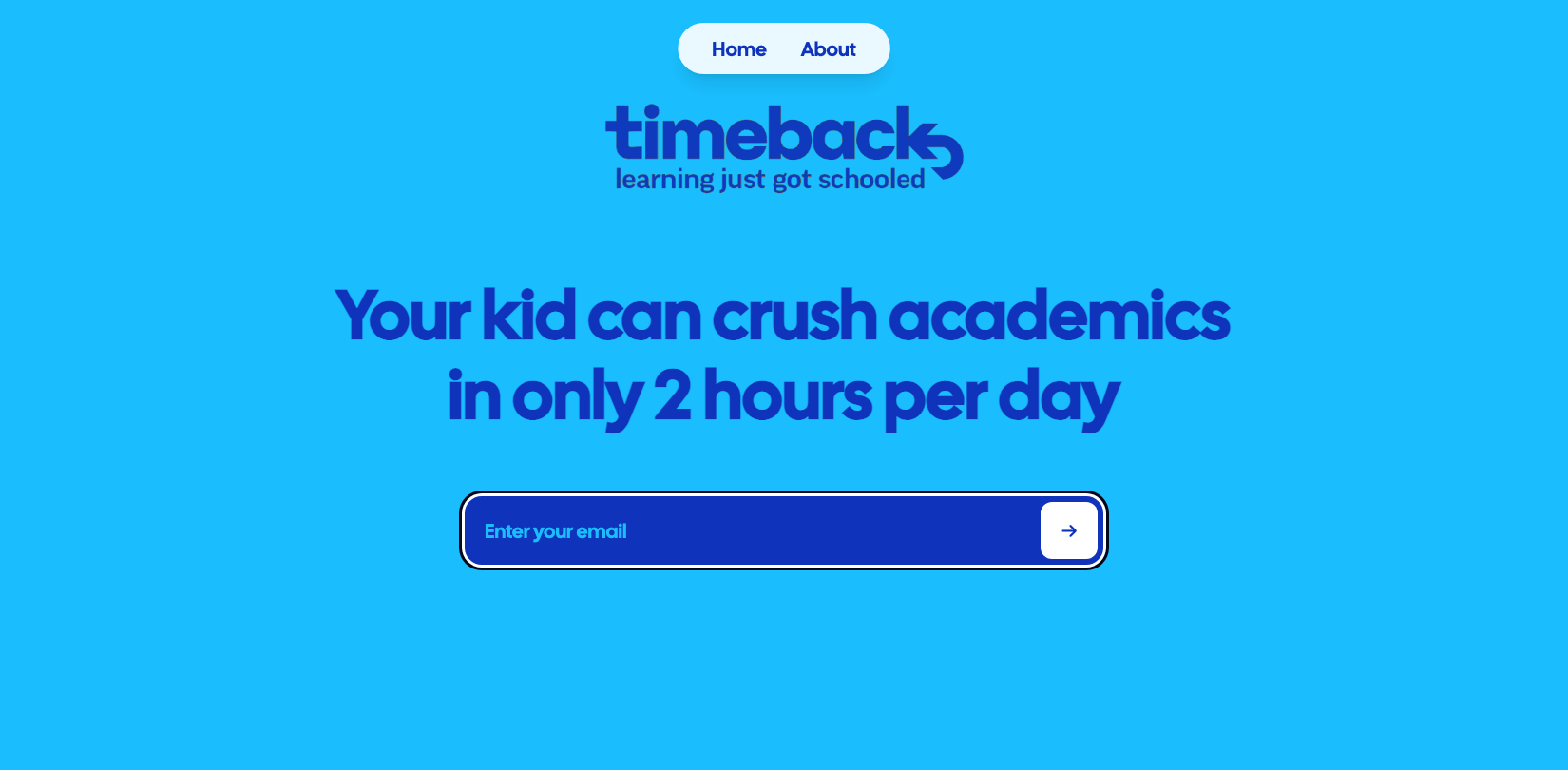
Stern wrote that it would be free once released. On October 4, 2026 timeback.com was a waitlist promising notice "when we launch in 2026".
He does not want a chatbot in it:
"Not chatbots. If you deploy ChatGPT to every student in America, we will become the dumbest country on the planet."
Alpha's summary of a podcast interview he gave to Mike Maples Jr. has the heading 'Chatbots are "Cheatbots"' and says the platform "has no chat functionality enabled", because, in its paraphrase of him, 90% of children given a chatbot use it to cheat. I found no source for the 90%.
The critics and the evidence
The case for Timeback is Alpha's test scores, and Alpha's page quotes Liemandt telling parents: "Don't trust what we tell you... trust the third party test." The critics I cited in the review did.
Kelsey Piper showed in The Argument that Alpha's growth multiple divides by expected gains that are close to zero for older, high-scoring students. Peter Naimoli, an Alpha parent, called the 2.6x figure "an erroneously computed and meaningless number". Andrew McEachin of ETS told Scientific American that the scores may reflect "who's attending the school, not the experience of the kid attending". Dylan Kane compared the multiples before and after Timeback replaced the older apps, found them about the same, and concluded: "Motivation is doing most of the work." Dan Meyer found that Unbound Academy, a tuition-free charter using the model, reported 10% of students proficient in math on preliminary state tests, against a projected 60%.
Scientific American wrote in August 2026 that Alpha "has not released the underlying data behind its claims". In February 2026 Liemandt gave the mid-year test data to Gemini and Claude and published their assessments. Piper's own guess is that the gains are real for children the school suits, and smaller than 2x. The links are in the review.
Timeline
| Year | Event | Source |
|---|---|---|
| 1989 | Trilogy founded by Stanford students | Trilogy's site; Stern. Vardi dates Liemandt's leaving Stanford to 1990 |
| 1996 | Two Forbes covers; youngest self-made member of the Forbes 400 at $500 million | Vardi, Forbes |
| 2001 | Drops off the Forbes 400; ESW Capital started | Vardi; Stern |
| 2006 | Trilogy buys Versata for $3.3 million | Vardi |
| 2014 | Price and Brian Holtz open the school that becomes Alpha | Stern |
| 2017 | ESW agrees to buy Jive Software for $462 million; The Guardian reports on WorkSmart | Vardi; Solon |
| 2018 | Forbes puts his net worth at $3 billion | Vardi |
| 2022 | Begins moving a reported $1 billion into Alpha's software | Stern |
| 2025 | First interview in about 25 years; Alpha renames its model Timeback in November | Stern; Alpha's blog |
| 2026 | Forbes estimate of $7.6 billion; Timeback still a waitlist | Forbes; timeback.com |
One idea I agree with and one I doubt
I agree with him about who should build this. He told Stern: "Education is a multitrillion dollar industry with no good products that you can't donate or tax your way out of." A school that has to persuade a parent to pay, and a child to prefer it to a holiday, hears about its failures faster than one that answers to a grant committee. Liemandt wants other people to build for-profit schools on Timeback, and I hope some of them compete with him on evidence.
I doubt "not chatbots". Bastani's experiment, which I covered in my history of intelligent tutoring systems, found that students given plain GPT-4 for practice scored 17% worse once it was taken away. The same study found the harm largely gone when the model gave hints instead of answers. A machine that hands over answers did the damage, and the version that gave hints was also a chatbot.
His alternative also worries me. "It's putting a mind virus into a kid's head, which is what education is," he said of Incept. Karl Popper called that picture the bucket theory of the mind, and David Deutsch follows him in holding that knowledge grows by conjecture and criticism. Timeback, as Stern describes it, checks answers and watches for wasted time. Nothing in his description asks the student what she thinks and then argues with it. Conversation is the one format that can do that, which is why I build a conversational tutor. I build it for adults, who chose to be there and have nobody to cheat. For a ten-year-old with two hours of lessons to clear, he may be right.
Understand
Understand is a voice tutor for adults that you can interrupt: it reads a text aloud word for word and stops when you ask a question, asks you to explain an idea back, and keeps a record of what you explained that you can read and correct. It has no courses, no problem sets, no spaced repetition and no Android app, and no trial has evaluated it, so my evidence is thinner than his. It is free for now, and an adult who wants Alpha's method instead can assemble most of it from the tools in Alpha School for adults.