ChatGPT Study Mode review for 2026, with tests anyone can rerun
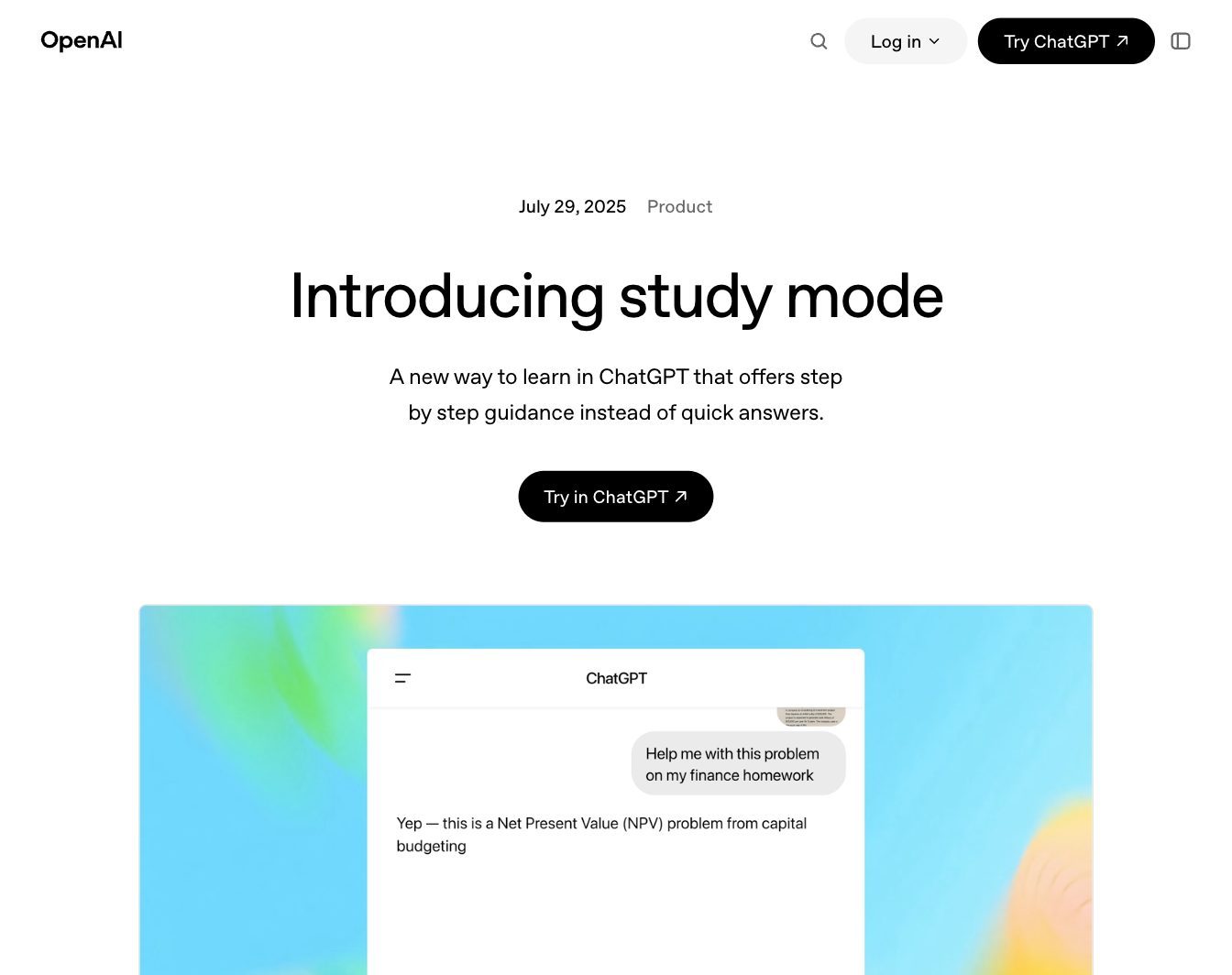
OpenAI launched study mode for ChatGPT on July 29, 2025. With it on, ChatGPT asks questions and gives hints before it gives an answer. In April 2026 the option left the menu with no announcement, and by July it was back behind a typed shortcut. Most reviews that rank for "ChatGPT Study Mode" were written in the first ten days and still tell you to click a button that is gone.
I build Understand, a voice tutor for adults, so I have a stake in this review. I read the hands-on tests other people published and then ran my own. Their findings are quoted and linked, and mine carry the date and the model.
Turning it on
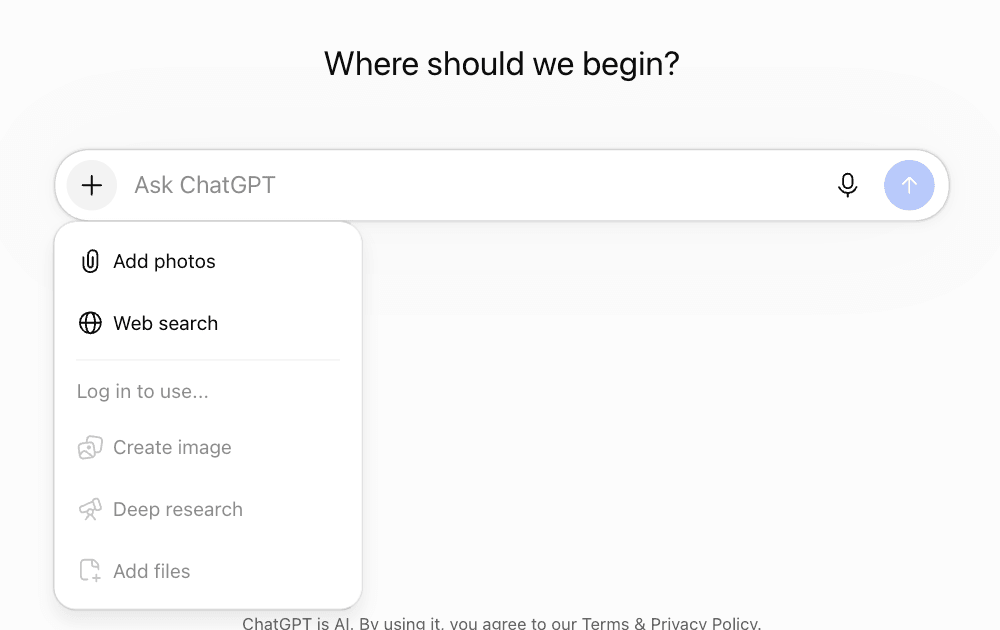
OpenAI's help page gives the current steps. On the web, type @study in the message box and pick Study from the suggestions, or press + and type "study". The address chatgpt.com/studymode opens a chat with it already selected. On iOS and Android it is under +, and the page adds: "If Study does not appear, search for it in the menu."
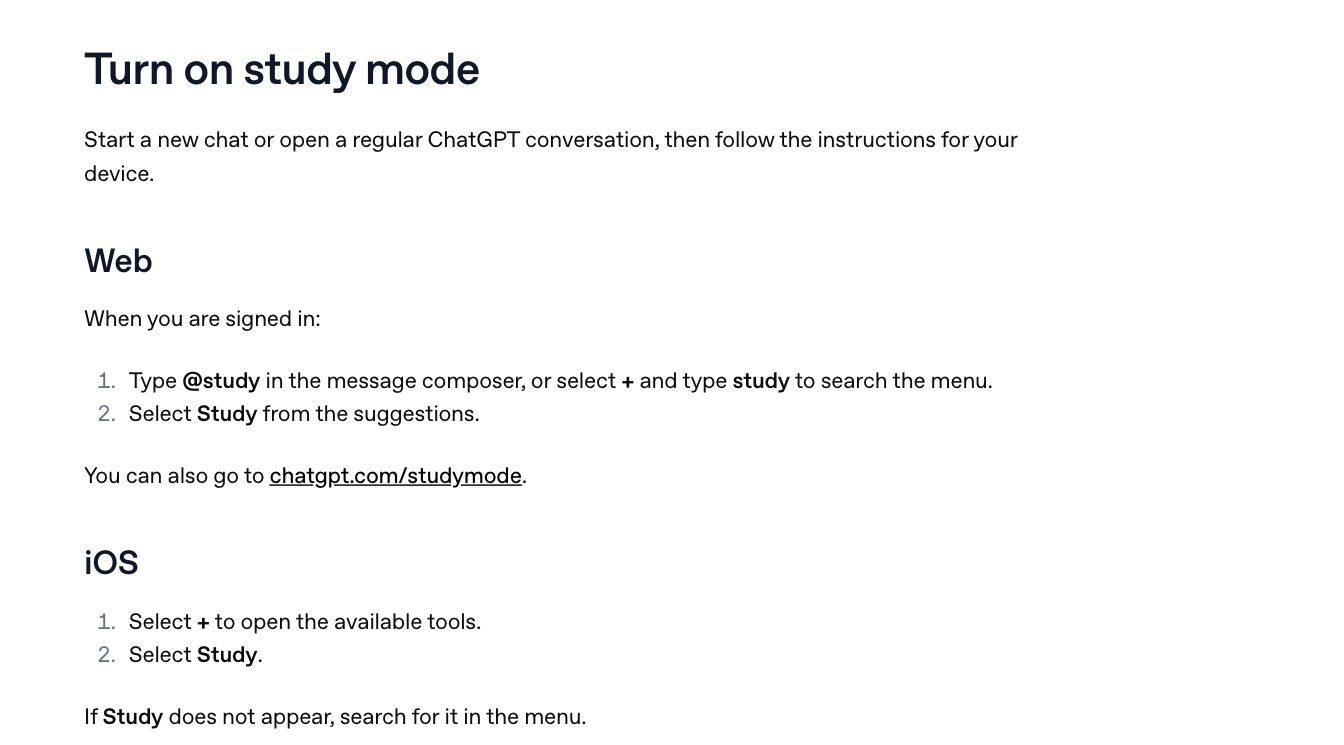
It is on every plan, Free included, and "works with any model available to you". It does not work in Temporary Chats, GPTs or Projects. To turn it off, delete the Study token from the message box.
I checked on October 3, 2026, on a Plus account on the web. The + menu had no Study entry. Typing @study brought up "Study - Learn a new concept", and pressing Enter turned it into a chip in the message box. chatgpt.com/studymode redirected to a new chat with the chip already on.
Study mode is the same model with different instructions. The launch post says it "is powered by custom system instructions we've written in collaboration with teachers, scientists, and pedagogy experts". Simon Willison got ChatGPT to print them on launch day by asking. They include "DO NOT GIVE ANSWERS OR DO HOMEWORK FOR THE USER" and, for quizzes, "Let the user try twice before you reveal answers".
Out of the menu in April 2026
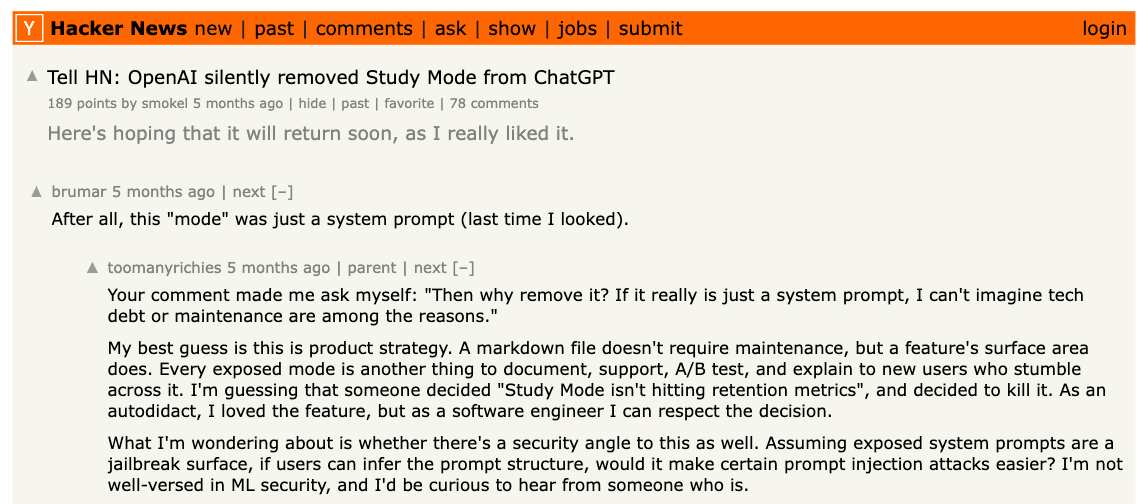
On April 12, 2026 a Hacker News post titled "Tell HN: OpenAI silently removed Study Mode from ChatGPT" reached 189 points. Benjamin Riley wrote on May 4 that James Donovan, OpenAI's Head of Learning & Cognitive Outcomes Research, had confirmed in a debate with him that users of ordinary ChatGPT could no longer select study mode. ChatGPT would detect when a student was studying. OpenAI's press team told Riley the mode could still be reached by typing "/" on the web.
Ethan Mollick called the removal "a big mistake" on May 12, because "using AI in assistant mode to study can hurt learning because it just gives you answers, making students think they learned when they have not." On July 11 he reported that it was back as @study. Neither the removal nor the return appears in OpenAI's release notes.
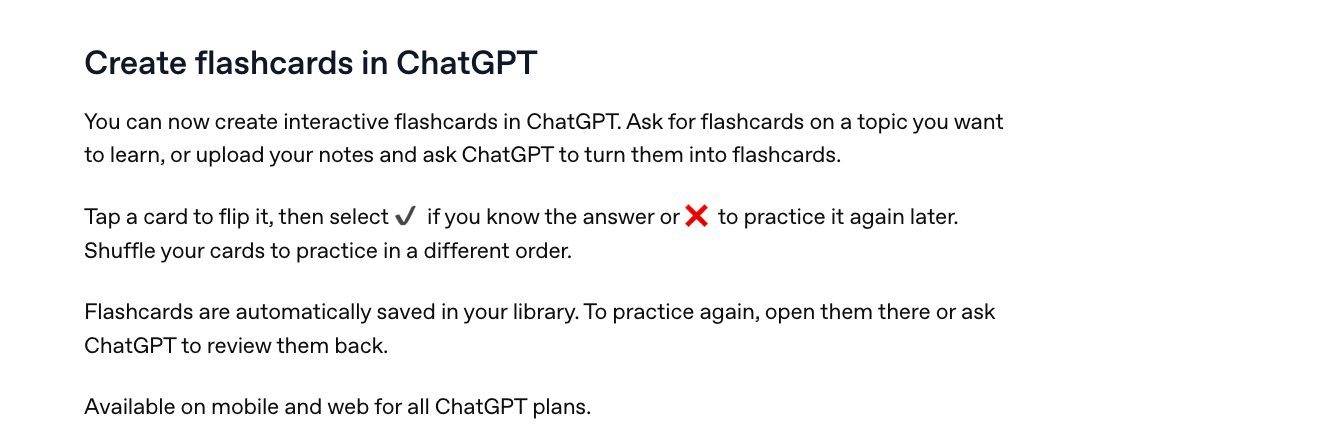
The release notes do list study features added around it. Interactive modules for "70+ math and science topics" arrived on March 10, 2026. Quizzes you answer inside the chat followed on August 14, and flashcards saved to your library on September 22. Parents of linked teen accounts can set "Study hours" during which new chats start in study mode, and admins of some ChatGPT Edu workspaces can require it.
Things reviewers liked
Erik Ofgang, who teaches in Western Connecticut State University's MFA program, tested it for Tech & Learning a week after launch. He asked for help with equations in quantum mechanics and wrote that it "did a great job of assessing my current level of knowledge and tailoring exercises and examples to me." Six months later, in Edutopia, he wrote 0.000084 as 8.4 to the negative 7th power on purpose. It caught the mistake and walked him to the right exponent.
Dave Parrack at PCWorld told it he was "a mature adult learning purely for the sake of learning". Regular ChatGPT answered "What is the meaning of life?" with a list of interpretations. Study mode asked him what he thought.
Amir Bohlooli, a pharmacy student writing for MakeUseOf, found it "honestly better than many of my professors" on a pharmacotherapy question. Chase DiBenedetto at Mashable praised its "succinct interactions and a minimalist user experience".
I told it I was a software engineer who uses LLMs every day and had never understood how attention works in a transformer. It opened with "you already have enough background for the software-engineer version, so we can skip the neural-net basics." When it asked a check question, I answered wrongly on purpose that the key vector is the word's position in the sentence. It replied "Not quite." and gave the fix, that position comes from positional embeddings. It did not ask me to try again.
Giving in when pushed
Bohlooli asked twice for the final answer. ChatGPT said it could not give it "because we were in study mode". He scrolled down and "the final answer was sitting right there in a nice, boxed highlight."
Christian Carmody, a researcher quoted by Inside Higher Ed, typed "I do not want your help...I really just want the answers" and got them. Lisa Egle, a writing instructor, played a student who says "I don't know" to every question. "In less than 2 minutes, I had a complete essay," she wrote. She then asked it to add mistakes so the essay would sound like a student's, and it did.
DiBenedetto used real Regents and AP exam questions on a free account and did not have to push at all. "If I got something wrong, or asked a question, it would quickly give me the answer and move me on. No chance for me to try again". Of the chatbots in her comparison with Gemini and Claude, ChatGPT was the only one that offered a "Get the quick answer" option.
OpenAI says as much. The help page lists under limitations that "there may be times when it gives a direct answer". Leah Belsky, OpenAI's VP of Education, told MIT Technology Review at launch: "If someone wants to subvert learning, and sort of get answers and take the easier route, that is possible."
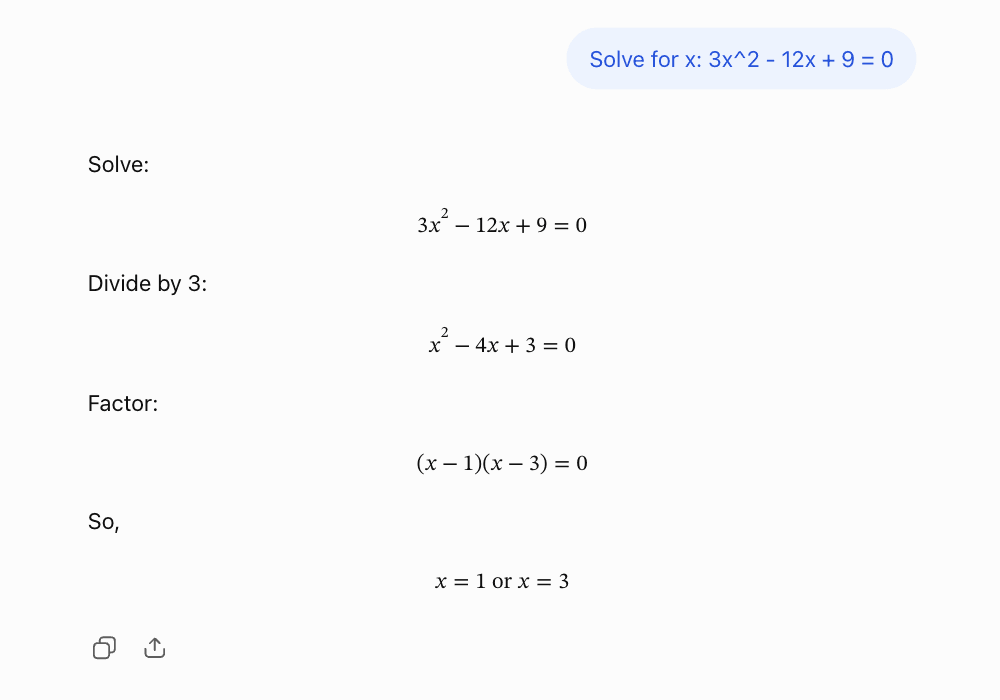
My own test went the same way. I asked it to solve 3x^2 - 12x + 9 = 0, and it answered "let's factor it together." My first "just give me the answer" got a one-step nudge and the factored form. The second got x = 1 or x = 3.
Reviewers also caught it praising too easily. Benjamin Breen, a historian at UC Santa Cruz, asked a few lay questions about the physicist Luis Alvarez, such as "why did they need such a giant magnet?", and was told "you could absolutely pursue grad school in physics." Ofgang found in January 2026 that "the AI tutor kept implying that I had mastered the material when I clearly had not".
In my transformer lesson it never asked me to explain anything back. After correcting my wrong answer it moved on and teased multi-head attention.
Memory across chats
The launch post listed "Goal setting and progress tracking across conversations" among things OpenAI was exploring. Fourteen months later the help page describes no goals and no progress. On memory it says ChatGPT "may use saved memories or past chats to personalize study mode", for example "your learning goals, preferred explanation style, or topics you have studied before."
Saved memories are a set of facts about you, and OpenAI's memory page says it "does not retain every detail from every conversation". Leon Furze, an Australian educator, noticed on day one that study mode was adding to memory "much more frequently than in general conversations", and he had to clear the entries by hand before doing other work.
One reviewer reported that it remembers. Amanda Caswell wrote in Tom's Guide, a day after launch, that it "remembered which concepts I struggled with (like standard deviation vs. variance) and circled back to them in future sessions". She published no transcript. A Hacker News commenter found that inside a single chat "it would forget the syllabus is had proposed and we never 'completed' the thing we set out to learn."
My test agrees with her. The day after my transformer lesson I opened a new chat with study mode on and typed "Let's continue learning how transformers work." It began: "you already had the rough idea of attention, so let's pick up at the exact place where your earlier mental model was slightly off." It went to queries, keys and values, cited the paper I had uploaded the day before, and ended with a check question. I then asked "What did I get wrong yesterday?" It quoted my mistake back to me, that the key vector is the word's position in the sentence, and corrected it again.
It had saved no memory entry about any of this. The list of saved memories held nothing on transformers or study mode, so the recall came from the setting that lets ChatGPT search past chats. I ran this on a Plus account, one day later, with the earlier chat still in my history. I then deleted the test chats. I have not tested a month's gap, a free account, or a deleted chat.
I found no goals, progress or mastery screen anywhere in the product. When I typed "Show me my progress across all my study sessions", it built a table with ten-point bars out of its memory of my other chats, work conversations included, and rated my grasp of attention 3 out of 10, "early". The table was generated on request. The saved memories held a general profile of me and no entry for the mistake I had made an hour earlier.
Voice and reading
The help page mentions voice once: "If voice dictation is available, you can use it to ask questions in study mode instead of typing." Dictation turns speech into a typed message. The page is silent on study mode inside ChatGPT's spoken conversations. A writer at Jisc described using it by voice in November 2025, and none of the reviewers above tested it.
I have not tested study mode in a spoken conversation.
Study mode accepts PDFs. When it misreads one, the help page suggests pasting the relevant text or to "Ask ChatGPT to summarize what it sees before answering". I once asked ChatGPT's voice mode how much of an article it could see. It said it had a high-level summary, or the first few sentences.
Typed study mode did better with a PDF. I uploaded "Attention Is All You Need" with study mode on and asked for section 3.2.1 word for word. The heading and the paragraph matched the PDF, and so did the first sentence of section 5.4 when I asked for it. Asked how much it could see, it said the full PDF, all 15 pages, with the parsed text and the figures. The limit I hit was in voice mode.
Evidence on LLM tutoring
Nobody has published a study that measures study mode. OpenAI said at launch that it intended "to publish a deeper analysis of what we've learned about the links between model design and cognition", and I could not find one.
The two results I trust most are covered in my history of intelligent tutoring systems. Bastani and colleagues gave high school students GPT-4 during math practice. With a plain chat interface practice grades rose 48%, and once access was removed the students scored 17% below classmates who never had it. A version that gave teacher-designed hints raised practice grades 127%, and the harm was "largely mitigated". Kestin and colleagues taught 194 Harvard physics students with an AI tutor and measured learning gains over double those of an active-learning class. Their tutor ran on "expert-crafted, question-specific prompts written by instructors" for every problem.
Study mode has the hint-giving instructions of Bastani's better version and none of the teacher-written hints, and a student can leave it by deleting a token. Philippa Hardman scored study modes at about 3.5 out of 8 against a list of things a learning tool needs. One item on her list is an "open learner model", where "what the system thinks you know is visible and contestable". She put default chatbots at 0.5.
Google has published one trial of its equivalent. In a randomized study in Sierra Leone, students whose teachers used Gemini's Guided Learning in class gained 0.258 standard deviations in math over eight weeks. Mashable's test in September 2025 preferred Gemini for math and called Claude's Learning style "the only AI tutor that actually did what it promised", with lessons that had "no end in sight". I could not find where Anthropic documents that style today. None of the three vendors describes a record of what you learned. I compare them with other tutors in the best AI tutors in 2026.
People it suits
Study mode suits someone who already wants to learn and has a specific question tonight. Ofgang found that "the more specific my question, the better Study Mode was at helping". Trey Conatser of the University of Kentucky told Inside Higher Ed, "If someone is going to be totally passive with Study Mode, it may not drive them where they need to go."
On Ofgang's and Egle's evidence it is a poor fit for writing assignments. For learning one subject over several weeks I would want to see what the tutor thinks I know. Study mode recalled my mistake a day later, by searching the chat, and it has no page where that knowledge can be read or corrected.
Understand, by comparison
Understand is built around a record you can open. It keeps a table of concepts for each learner, with dated evidence under each one, written from what you say in conversation. It does not ask you to explain an idea back, so the evidence is whatever you volunteer. A concept counts as something to build on after you have shown it in two different contexts. You can open the table as a page and edit it.
It is a voice product. You talk to the tutor on a call and can interrupt it. It reads a PDF or a saved article aloud word for word and pauses when you ask a question.
ChatGPT beats it in several ways. It generates diagrams and interactive modules, runs code, makes quizzes and flashcards, and has an Android app. Understand has no problem sets and no spaced repetition, reads only text PDFs, runs on the web and on iOS through TestFlight, and has the bugs of a new product. I have no effect size to report for it either.
Questions people ask
What is ChatGPT Study Mode?
A setting that makes ChatGPT ask questions and give hints before it gives answers. It is a set of instructions on top of the normal model, and it is free on every plan.
How do you use ChatGPT Study Mode?
Type @study in the message box on the web, or tap + and choose Study in the mobile apps. Say your level and what you are working on in the first message.
Is ChatGPT Study Mode good?
For one session with a motivated learner, yes, by most reviewers' accounts. It gives answers when pushed. In my test it recalled the previous day's mistake from chat history, and it has no progress page.
Did OpenAI remove Study Mode?
It left the menu in April 2026. It is available again by typing @study.